



Description
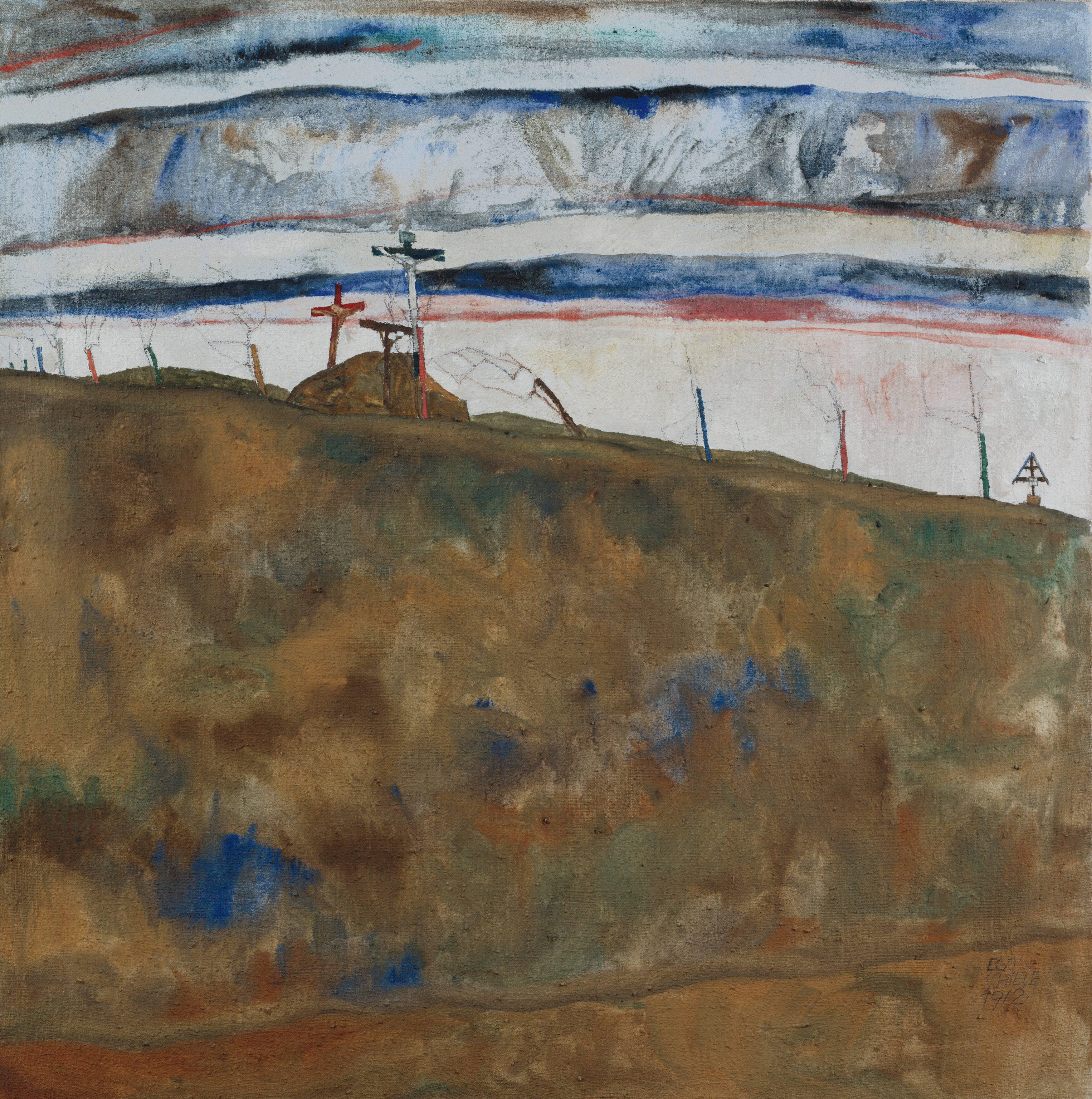
Calvary is a work of 1912 by Egon Schiele: a bare hill under a sky laid in bands of colour, with three crosses on its ridge among bare trees and thin posts. The original is in the Leopold Museum in Vienna under inventory number 480; it measures 81.7 x 80 cm — 80 cm wide and 81.7 cm tall, so very nearly square. We make it as a hand-painted oil painting on canvas, in fifteen sizes or to your own measurement, and we send you a photograph of the finished work for approval before it ships.
| Title: | Calvary |
| Other titles: | Kalvarienberg · Kalvarija |
| Painter: | Egon Schiele (1890–1918) |
| Year: | 1912; signed and dated lower right in pencil “EGON SCHIELE 1912” |
| Original size (width × height): | 81.7 cm x 80 cm |
| Original technique: | Oil, gouache and pencil on canvas |
| Style: | Expressionism |
| Location: | Leopold Museum, Vienna (inv. 480) |
| Our reproduction: | hand-painted oil on canvas, 15 sizes from 50 x 50 cm to 200 x 200 cm, or a made-to-measure size |
Calvary – Egon Schiele
What does the work show?
A hill, and above it the sky. Most of the canvas is open ground in brown, ochre and olive, put down thinly, with patches of blue and traces of green. The ridge runs high at the left and falls gently to the right. Left of centre lies a brown mound, and on and beside it stand three crosses: a red one, a tall thin one in grey and white, and a low dark one. Along the ridge thin posts stand at intervals, red, blue and green, with bare, spindly trees beside them; at the far right edge there is a small shrine with a pointed roof. The sky is laid in horizontal bands of white, grey, blue and near-black, crossed by thin red lines, and above the horizon at the right it turns pink and red.
Why is a Calvary painted as a landscape?
The museum record answers with Schiele’s own move. In August 1911 he left Český Krumlov (Krumau) for Neulengbach, and per the museum the move shows in the emancipation of a motif that had until then played only a supporting part in his work: the landscape. The record quotes his letter to the painter Anton Peschka (1885–1940), later his brother-in-law: from the Buchberg near Neulengbach one overlooks the finest farmland he knew. In Calvary, the museum writes, the reduction of the figurative in favour of the atmospheric and spiritual qualities of nature reaches an early high point. That is the reading of the house that holds the work, and we give it as theirs.
What is happening on the horizon?
Per the museum description, the three crosses are written into a procession of bare, wind-bent trees and posts that leads to a Station of the Cross at the right-hand edge — the small shrine with the pointed roof. Above the horizon stretch dark bands of cloud that light up in the last glow of the sunset and, in the museum’s words, dramatise the calvary and with it nature as a place of religious devotion. The posts and saplings are not decoration: they are the procession.
How was the original painted?
Per the record, with oil, gouache and pencil on canvas; the signature lower right is also in pencil. The museum names one consequence of the method: the paint is applied in glazes, which takes all bodily weight from the meadow and sends the eye up to the horizon. Our reproduction is painted in oils alone, on canvas. We do not present those as the same thing: we paint the thin, glazed effect in oils rather than claim to repeat the original’s materials.
Is the format square?
Almost, but not quite. In size it is close to Self-Seers II of the year before, 80.5 x 80 cm and in the same collection. For this work every one of our steps is a square format, from 50 x 50 cm to 200 x 200 cm; because the horizon lies high, the ground carries most of the weight.
Can I have it at the size of the original?
In size, very nearly; in exact proportion, no, and we would rather say so. The original is 80 cm wide and 81.7 cm tall. Our 80 x 80 cm step matches its width exactly and is 1.7 cm lower. Because all our steps for this work are square and the original is not, the difference grows with the size: at 200 x 200 cm the original’s proportion would call for a height of about 204 cm. Only a made-to-measure size can match that proportion exactly.
Where does the work come from and where is it now?
This page carried no provenance note before — for this work there was none, which we say openly rather than quietly supplying a substitute. What follows is the chain as the museum publishes it: Heinrich Benesch, Vienna, until 1947; Otto Benesch, Vienna, 1947–1964; Eva Benesch, Vienna, 1964–1983; Jenö Eisenberger, Vienna, 1983; Rudolf Leopold, Vienna, 1983–1994; and from 1994 the Leopold Museum Private Foundation. Three things in it are worth attention, and the reading is ours. First, after 1947 the dates join without a gap, but the chain has no beginning: the first owner is given only “until 1947”. Second, for at least thirty-six years the work stayed with three owners of one surname; the record does not say whether or how they were related, and neither do we. Third, 1983 brought two changes of hands in one year; the museum’s sources include a receipt of 30 September 1983, a confirmation from the art dealers Giese & Schweiger of 19 February 2002 and a dossier by Sonja Niederacher of 30 April 2011. The work is today in the Leopold Museum under inventory number 480; the museum’s whole Schiele holding is on the Leopold Museum’s Egon Schiele page.
Where does this work sit among Schiele’s works?
Among the landscapes that followed his move to Neulengbach. From the year before are Self-Seers II, a square self-portrait, and Small Tree in Late Autumn, a small landscape on a wooden panel; the town itself gives its name to The Artist’s Room in Neulengbach. The full selection is in the Egon Schiele gallery, with more on his life in our article about Egon Schiele. Schiele was a younger contemporary of Gustav Klimt and the Vienna Secession was the milieu he came out of; Viennese Expressionism is the movement he helped define, and Austrian art of the period is still read through those two names. As an expressionist painting Calvary applies that movement to a landscape rather than to a face. Self-Seers II is oil on canvas alone; here gouache and pencil join the oil.
How is our hand-painted version made?
Every canvas is painted by an artist in oils, stroke by stroke — not a machine impression but a hand-painted copy made for your order. Two places are the hardest here. The first is the hill: its colour has to stay thin, with the blue and green patches showing through the brown; build it up into a solid, even surface and the ground acquires exactly the bodily weight the museum says the glazes take away. The second is the horizon: the crosses, the coloured posts, the saplings and the little shrine are all small and drawn with a few thin strokes, and they must stay thin and uneven; thicken them and the procession turns into a fence. When the work is finished we photograph it and send you the photograph for approval, and only then does it ship. For this family we hold no studio photographs — it has not been photographed in our workshop yet, and nothing has been removed; when it is next painted it will be photographed and the images added here. As a canvas reproduction it arrives stretched on a wooden bar, ready to hang.
Which size suits which wall?
Short answer: a square does not follow the furniture but asks for the middle of a wall and some emptiness around it. Above a sofa 100 x 100 cm and 110 x 110 cm work; for a smaller wall 60 x 60 cm or 65 x 65 cm; for a large room 170 x 170 cm and 200 x 200 cm. Our smallest size is 50 x 50 cm. A canvas painting of this subject gains from size: the crosses and posts are small, and from 100 x 100 cm upwards the procession reads from across the room.
How do I order a made-to-measure size, stretcher bar and frame?
If none of the fifteen sizes suits your wall, we paint the work to your own measurement. The canvas comes stretched on a wooden bar; our 3D application is for choosing a frame only, not for showing the work on your wall. The frame is chosen separately and need not be part of the order.
How is it delivered and what do we guarantee?
We paint to order and deliver to sixteen countries in the European Union, among them Germany, France, Italy, the Netherlands and Poland; the United Kingdom and Ireland are not currently among them. Before dispatch we send you a photograph of the finished work for approval, and if you are not satisfied we correct the work or paint it again. Production time varies with the size and the studio’s workload.
Frequently asked questions
What does Schiele’s Calvary show?
A bare hill under a banded evening sky, with three crosses on its ridge: a red one, a tall thin one in grey and white, and a low dark one. Per the Leopold Museum, the crosses join a procession of bare, wind-bent trees and posts that leads to a Station of the Cross at the right edge, the small shrine with the pointed roof. There are no people in it at all.
When did Schiele paint Calvary?
In 1912: the canvas is signed and dated lower right in pencil “EGON SCHIELE 1912”. It belongs to the landscapes that followed his move from Český Krumlov to Neulengbach, near Vienna, in August 1911.
Where is Calvary today?
In the Leopold Museum in Vienna, under inventory number 480. It measures 81.7 x 80 cm, so it is very nearly square: 80 cm wide and 1.7 cm taller than that.
Why did Schiele paint a Calvary as a landscape?
Per the Leopold Museum, after the move to Neulengbach the landscape grew from a supporting motif into a subject of its own in his work. In Calvary the museum sees the reduction of the figurative in favour of the atmospheric and spiritual qualities of nature reach an early high point. The dark bands of cloud, lit by the last glow of sunset, dramatise the calvary and with it nature as a place of religious devotion.
How did Schiele paint Calvary?
In oil, gouache and pencil on canvas, and the signature too is in pencil. According to the museum the paint is applied in thin glazes, which takes all bodily weight from the meadow and sends the eye up to the horizon.
Does it work as a gift?
It does; if you are unsure which size to choose there is a gift voucher.
- Subject: a bare hill with three crosses on the ridge, a procession of trees and posts, and a small shrine at the right edge.
- Original: 1912, oil, gouache and pencil on canvas, 81.7 x 80 cm, signed lower right, Leopold Museum, Vienna, inv. 480.
- Ours: hand-painted in oils on canvas, 15 sizes or a made-to-measure size.
- Worth knowing: this page carried no provenance note for this work; the chain is given as the museum publishes it.