




Description
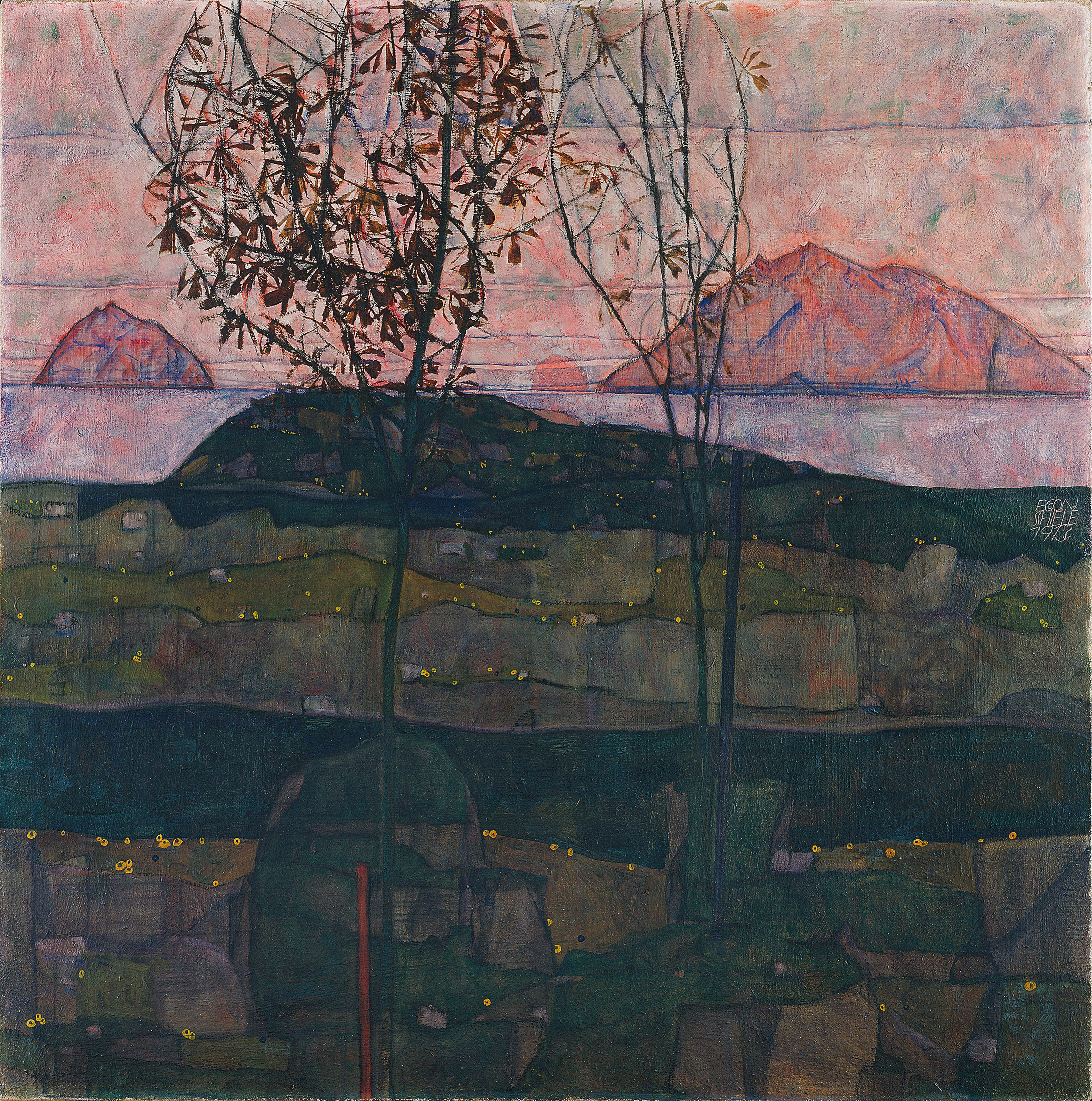
Setting Sun is a work of 1913 by Egon Schiele: two thin young trees in front of a landscape of dark fields, with two pink mountains under a pink sky. The original is in the Leopold Museum in Vienna under inventory number 625; it measures 90 x 90.5 cm — 90.5 cm wide and 90 cm tall, so all but square. We make it as a hand-painted oil painting on canvas, in fifteen sizes or to your own measurement, and we send you a photograph of the finished work for approval before it ships.
| Title: | Setting Sun |
| Other titles: | Versinkende Sonne · Zahajajoče sonce |
| Painter: | Egon Schiele (1890–1918) |
| Year: | 1913; signed and dated upper centre right “EGON SCHIELE 1913” |
| Original size (width × height): | 90 cm x 90.5 cm |
| Original technique: | Oil on canvas |
| Style: | Expressionism |
| Location: | Leopold Museum, Vienna (inv. 625) |
| Our reproduction: | hand-painted oil on canvas, 15 sizes from 50 x 50 cm to 200 x 200 cm, or a made-to-measure size |
Setting Sun – Egon Schiele
What does the work show?
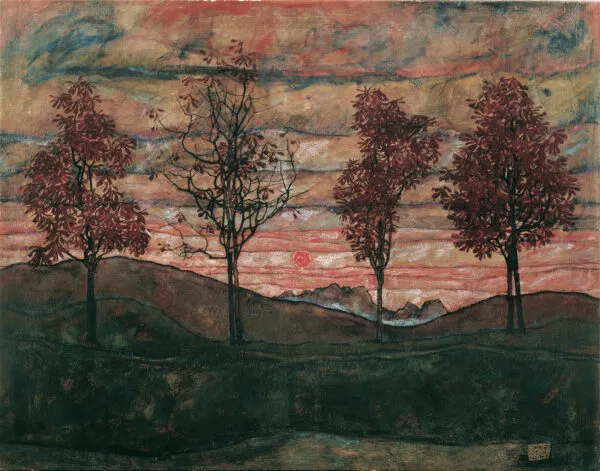
A landscape seen through two young trees. The left tree still carries a crown of rust-brown and dark red leaves; the right one is almost bare, a few thin branches with a handful of leaves, and beside it stands a straight dark post. Behind them the upper third is a pale pink sky drawn with fine horizontal lines, with two pink mountains on the horizon — a small one at the left, a larger one at the right — above a pale band. Below that lies a dark hill, and the lower half is a patchwork of fields in dark green, olive, grey and brown, laid in horizontal strips and scattered with tiny yellow dots. At the lower left of centre a thin red stake stands upright in the dark ground. Upper right, in three short lines, is the signature.
What is the painting about?
Per the museum record, about the moment of the day when we must mourn the setting sun: it still gives warmth in the distance, while in the shadows the contours are already dissolving. The record says that the artist focused not on the beauty of nature but on its embeddedness in a continuous coming and going, and that this melancholy atmosphere is typical of Schiele’s landscapes — to which he gave titles such as Bare Trees or Sunless Landscape. That is the reading of the museum that holds the work, and we give it as theirs.
Why does Schiele keep painting the sun?
Because, per the museum, the sun is a recurring motif in his work and a cipher for the cyclical: a constant that keeps leaving and keeps coming back, and so a symbol of the cycle of life and of the connectedness of all living things. The record ties it to one of his central themes, coming into being and passing away, and quotes how Schiele once put it with regard to his own body: “Mein Wesen, mein – Verwesen” — my being, my decay.
Where exactly is the signature?
Upper centre right, per the record: “EGON SCHIELE 1913”, in three short lines near the right edge, level with the top of the fields, where it is easy to overlook against the dark ground.
What is the original painted with?
Per the record, in oils on canvas. Ours is painted in oils on canvas as well: the medium and the support are the same as the original.
Is the format square?
As good as. For this work every one of our steps is a square format, from 50 x 50 cm to 200 x 200 cm.
Can I have it at the size of the original?
Yes, within half a centimetre. Our 90 x 90 cm step matches the original’s height exactly and is five millimetres narrower. Because every step is square and the original is not quite, that small difference grows with the size, but slowly: at 200 x 200 cm the original’s proportion would call for about 201 cm of width. For all practical purposes every step keeps the proportion; for the exact 90 x 90.5 cm, a made-to-measure size will do it.
Where does the work come from and where is it now?
This page carried no provenance note before — for this work there was none, which we say openly rather than quietly supplying a substitute. What follows is the chain as the museum publishes it, and it is short: Arthur Roessler, Vienna, from 1913 to 1957; Rudolf Leopold, Vienna, from 1957 to 1994; and from 1994 the Leopold Museum Private Foundation. The reading of it is ours. The first owner held the work from the year it was painted; the museum’s sources for him include Tobias Natter’s book on collectors and patrons of 2003 and the catalogue of the memorial exhibition the Neue Galerie held in 1948 for the thirtieth anniversary of Schiele’s death, where it was number 37. One detail does not add up: the chain dates Leopold’s ownership from 1957, but the purchase contract it cites for him is dated 7 January 1953. The record does not reconcile the two, and we give both. A dossier by Sonja Niederacher of 30 April 2011 is also listed. The work is today in the Leopold Museum under inventory number 625; the museum’s whole Schiele holding is on the Leopold Museum’s Egon Schiele page.
Where does this work sit among Schiele’s works?
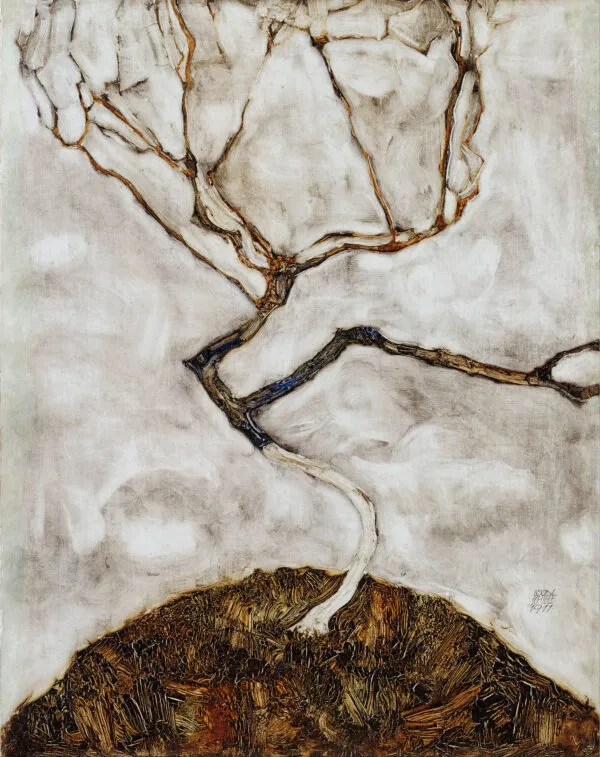
Among his landscapes of the years 1911 to 1914. Two years earlier came the small panel Small Tree in Late Autumn, a year earlier Calvary, and a year later Houses by the Sea. The full selection is in the Egon Schiele gallery, with more on his life in our article about Egon Schiele. Schiele was a younger contemporary of Gustav Klimt and the Vienna Secession was the milieu he came out of; Viennese Expressionism is the movement he helped define, and Austrian art of the period is still read through those two names. As an expressionist painting it turns a sunset into a meditation on passing. Like Houses by the Sea, it is oil on canvas; Calvary adds gouache and pencil.
How is our hand-painted version made?
Every canvas is painted by an artist in oils, stroke by stroke — not a machine impression but a hand-painted copy made for your order. Two places are the hardest here. The first is the crown of the left tree: hundreds of small rust-red leaves over a pink sky, each laid on separately; fill them in as a mass and the tree loses the light that comes through it. The second is the pink of the sky and the mountains, which must stay pale and cool rather than sweet — lift it towards candy-pink and the mourning the museum speaks of turns into a postcard. When the work is finished we photograph it and send you the photograph for approval, and only then does it ship. For this family we hold no studio photographs — it has not been photographed in our workshop yet, and nothing has been removed; when it is next painted it will be photographed and the images added here. As a canvas reproduction it arrives stretched on a wooden bar, ready to hang.
Which size suits which wall?
Short answer: a square asks for the middle of a wall and some emptiness around it. For a smaller wall 60 x 60 cm or 70 x 70 cm; above a sofa 90 x 90 cm, the original’s own size, or 100 x 100 cm; for a large room 150 x 150 cm and up to 200 x 200 cm. Our smallest size is 50 x 50 cm. A canvas painting with so many small leaves and yellow dots gains from size: from 90 x 90 cm upwards they read as the original’s detail rather than as texture.
How do I order a made-to-measure size, stretcher bar and frame?
If none of the fifteen sizes suits your wall, we paint the work to your own measurement. The canvas comes stretched on a wooden bar; our 3D application is for choosing a frame only, not for showing the work on your wall. The frame is chosen separately and need not be part of the order.
How is it delivered and what do we guarantee?
We paint to order and deliver to sixteen countries in the European Union, among them Germany, France, Italy, the Netherlands and Poland; the United Kingdom and Ireland are not currently among them. Before dispatch we send you a photograph of the finished work for approval, and if you are not satisfied we correct the work or paint it again. Production time varies with the size and the studio’s workload.
Frequently asked questions
What place does Setting Sun show?
Neither the title nor the museum record names a place. The Leopold Museum’s own text on Google Arts & Culture says Schiele’s inspiration most likely came from the coast near Trieste and the two barren, red-rocked islands off that coast. Read that way, the two pink forms on the horizon are those islands.
Where is the sun in Setting Sun?
Barely there: according to the Leopold Museum, the sinking sun is only partially visible, and the forms on the horizon appear backlit in a cold carmine. What the eye sees is its afterglow, a pale pink sky above dark fields. The museum reads the scene as a farewell to light, warmth and life.
What does Setting Sun mean?
Per the museum record, it shows the moment of the day when we must mourn the setting sun: it still gives warmth in the distance while the contours in the shadows dissolve. Schiele focused not on the beauty of nature but on its place in a continuous coming and going. The museum calls the sun a cipher for the cyclical in his work, a symbol of the cycle of life.
What does “Mein Wesen, mein – Verwesen” mean?
“My being, my decay”: a line Schiele wrote about his own body, which the museum quotes in its text on this work. It ties the painting to one of his central themes, coming into being and passing away.
Who owned Setting Sun first?
Arthur Roessler, the Viennese critic who was Schiele’s long-time patron, from 1913, the year it was painted, until 1957. According to the Leopold Museum, it hung above his desk. It then passed to Rudolf Leopold, and in 1994 to the Leopold Museum Private Foundation.
Where is Setting Sun today?
In the Leopold Museum in Vienna, under inventory number 625. In German it is titled Versinkende Sonne.
Does it work as a gift?
It does; if you are unsure which size to choose there is a gift voucher.
- Subject: two young trees before dark fields, pink mountains and a pink evening sky.
- Original: 1913, oil paint on canvas, 90 x 90.5 cm, signed upper centre right, Leopold Museum, Vienna, inv. 625.
- Ours: hand-painted in oils on canvas, 15 sizes or a made-to-measure size.
- Worth knowing: this page carried no provenance note for this work; the chain is given as the museum publishes it.