




Description
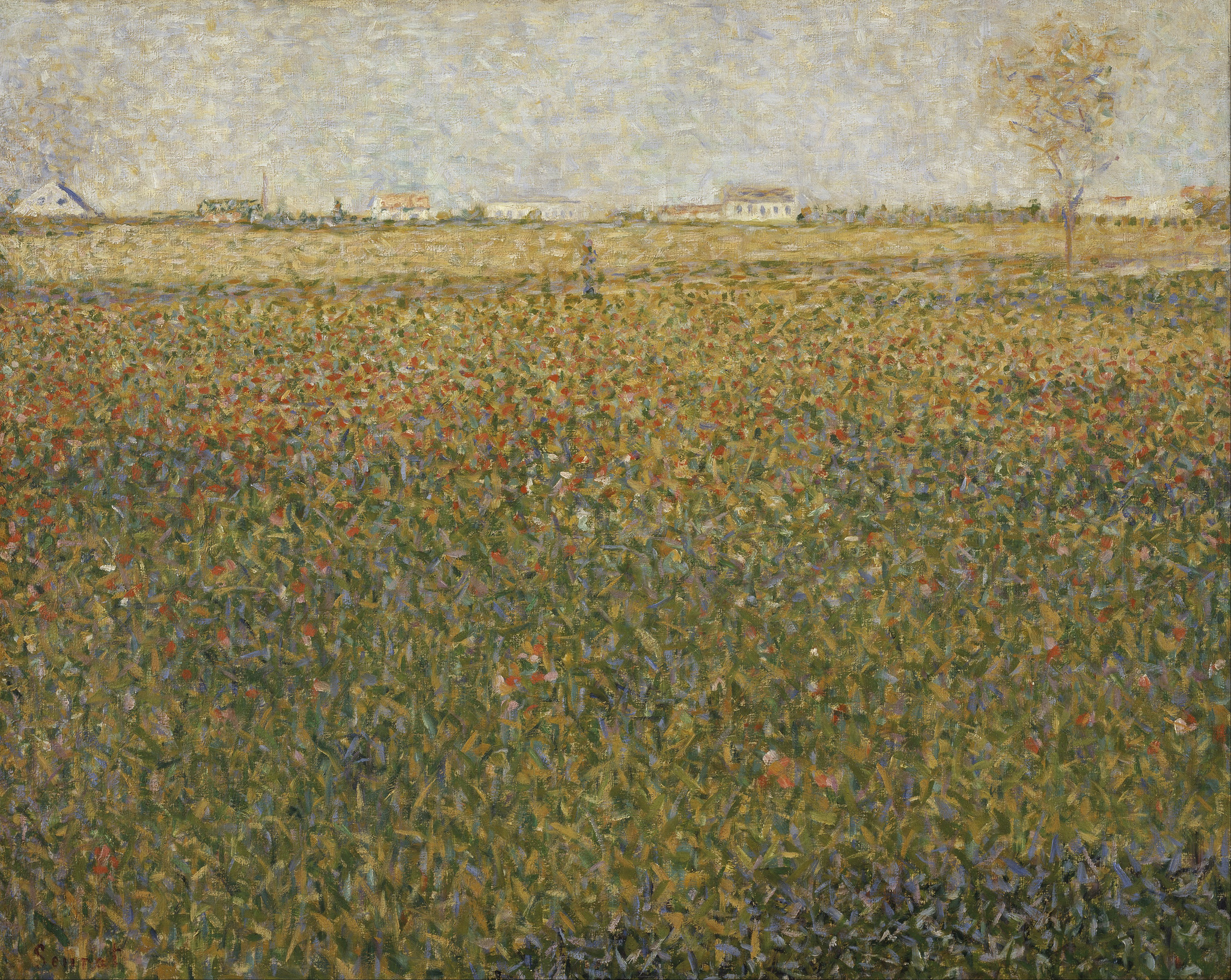
A Field of Alfalfa, Saint-Denis is a painting by Georges Seurat from 1884–1885: a wide field scattered with tiny red flecks stretches to a distant horizon lined with white houses, while a single slender tree rises above it on the right. The original, in oil paint on canvas, measures 81.3 x 65.3 cm and is held by the National Galleries of Scotland in Edinburgh under number NG 2324. We make it as a canvas painting, hand-painted in oils, in eight sizes or to your own measurements, and before dispatch you receive a photograph of the finished work to approve.
| Title: | A Field of Alfalfa, Saint-Denis |
| Other titles: | A Field of Alfalfa, Saint-Denis (»La Luzerne, Saint-Denis«) – the title the museum itself uses |
| Painter: | Georges Seurat (1859–1891) |
| Year painted: | 1884–1885 |
| Original size: | 81.3 cm x 65.3 cm |
| Original technique: | Oil on canvas |
| Painting style: | Short, criss-crossing strokes of pure colour |
| Located at: | National Galleries of Scotland, Edinburgh (inv. no. NG 2324) |
| Our reproduction: | hand-painted in oils on canvas, 8 sizes from 46 x 38 cm to 150 x 120 cm, custom sizes on request |
A Field of Alfalfa, Saint-Denis – Georges Seurat
What does the painting show?
A field, and very little else. Most of the canvas is taken up by a crop of alfalfa, as the title calls it, densely woven from green, yellowish and violet strokes. Tiny red flecks are scattered across the whole surface, thickening towards the middle, where they read like poppies among the green. Beyond the alfalfa runs a narrower band of lighter, yellowish ochre field. On the horizon stands a low row of buildings: on the left a white house with a steep roof, in the middle and on the right long white buildings with reddish roofs, and between them a thin upright pole or chimney. On the right rises a single young tree with sparse leaves. In the middle of the yellow band there is a barely visible small upright shape, perhaps a person; if so, it is so small that the eye only finds it on a second look. The sky is pale, a greyish white, and occupies only the top of the painting.
What is on the canvas?
A horizontal canvas covered with thousands of short strokes crossing in every direction. None of them is long; together they form a dense fabric of colour in which green, ochre, violet, blue and red are not mixed on the palette but lie side by side. Cooler, blue-violet tones dominate the lower right, warmer yellow-greens the middle and upper part. Even the sky is not a flat area: it is built from small light strokes with delicate hints of pink and yellow. Anyone who expects Seurat’s pointillism of even, round dots will find something different here: the strokes are elongated, vary in size and point in different directions, which makes the surface look lively and restless. The museum describes the dimensions of the original as irregular.
Why does this painting matter?
Because almost its whole subject is colour itself. There is no story on the canvas, no people in the foreground and no architecture to catch the eye; what remains is a field that the painter builds stroke by stroke. A painting like this shows how the French painter Georges Seurat assembled even a plain field entirely from small strokes of pure colour. The museum record adds another layer: the painting was owned by the English artist and influential critic Roger Fry (1866–1934). In 1973 the National Galleries of Scotland bought it with the help of the Art Fund, government support and Roger Fry’s family. For a buyer this is a quiet, meditative Seurat, right for someone who would rather look at colour than at a scene.
What does the painting mean?
The calm of open country. The horizon is distant and level, the houses are small and far off, the tree stands alone, and the field spreads almost to the edge of the painting. With no accent in the foreground, the eye travels slowly across the surface, discovering the red flecks, the band of yellow field and the white walls in the distance. The painting does not tell a story; it invites you to look. At home it feels calm and bright, and its greens and violets go well with wood, linen, white walls and plants.
What place does this painting have among Seurat’s works?
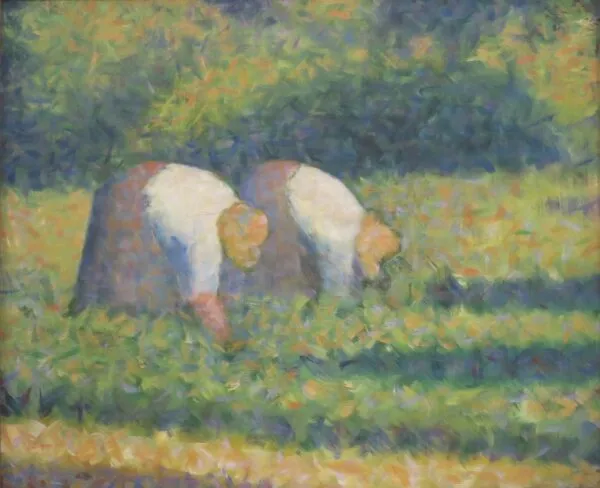
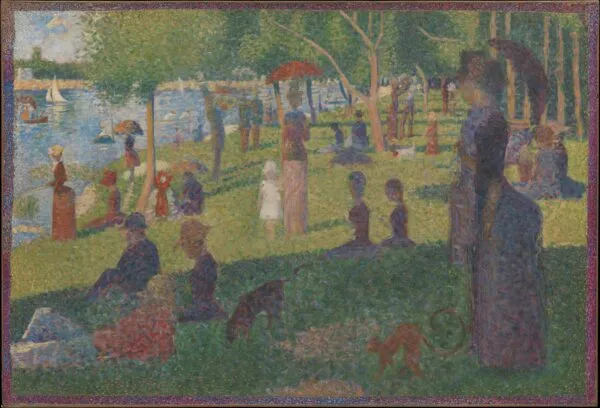
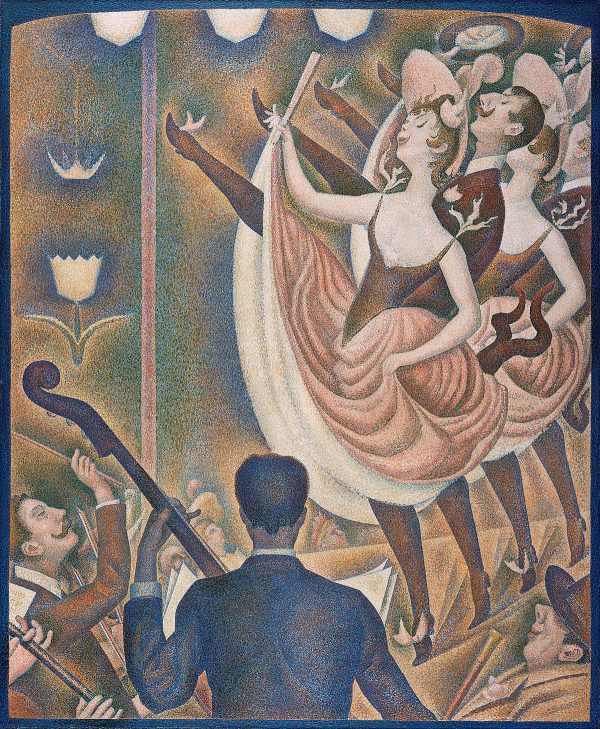
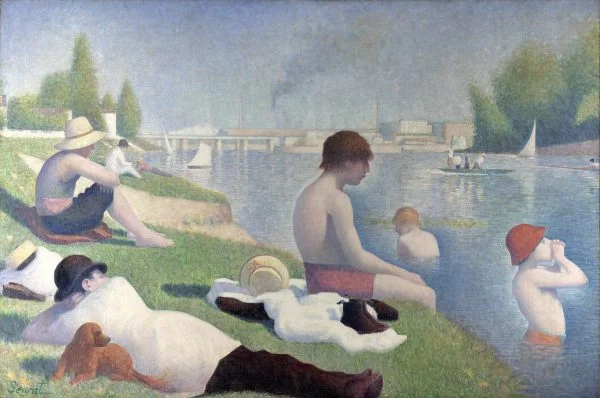
The museum record dates it to 1884–1885, the years in which Seurat’s largest and best-known canvas was also taking shape: Sunday Afternoon on the Island of La Grande Jatte (1884–1886), held by the Art Institute of Chicago. That canvas is full of people; here the field is almost empty. Earlier still are two country subjects that we also offer: Farm Women at Work from 1882–1883 and Peasant Woman Seated in the Grass (Paysanne assise dans l’herbe) from 1883. Beside them, A Field of Alfalfa, Saint-Denis shows the countryside with no person in the leading role, only earth, plants and light.
How is our hand-painted version made?
With a brush and oil paint, never with a printer. Our painter works from a reference image of the original and builds the dense fabric of colour stroke by stroke: green, ochre, violet and blue strokes cross one another, while the red flecks stay clean and separate. A pointillist technique of even, round dots would be the wrong choice here, because the original has no such dots; we keep the short strokes running in different directions, just as you see them in the painting. We pay particular attention to the balance between the cool lower part and the warm band of field below the horizon, and to the pale sky, which must stay light without looking empty. Because everything is done by hand, no two canvases are ever quite alike, and every hand-painted copy remains unique. We do not yet have our own photographs of a finished canvas of this subject; when we paint it for the first time, we will photograph it and show the photos here.
Which size suits which wall?
If you are not sure which to choose, take 80 x 65 cm. It is the size closest to the original: the original measures 81.3 x 65.3 cm, and ours is 1.3 cm narrower and 0.3 cm shorter. The format is horizontal, so it fits above a sofa, a chest of drawers or a bed. 46 x 38 and 50 x 40 cm suit smaller walls, hallways and work corners; 60 x 50 and 70 x 60 cm fill a bedroom or dining-room wall on their own; 80 x 65 and 90 x 75 cm give the painting a size at which the strokes can be seen properly; 120 x 100 and 150 x 120 cm are for large living rooms, where the field becomes almost a window onto the landscape. Every oil painting reproduction of this subject is made to order.
Custom size, stretcher bar and frame
If none of the eight sizes suits your wall, we paint to your measurements and keep the proportions of the original, so the horizon and the tree stay where they belong; that is our custom size painting service. You can order the painting in three forms: as a rolled canvas without a stretcher, stretched on a wooden stretcher bar and ready to hang, or framed; you choose the form when you order. You choose the frame in our 3D app, which shows gold, silver, black, white and wooden profiles on this subject; the app is for choosing the frame only. For a view of the painting on your own wall, there is our separate room-visualisation service.
Delivery and guarantee
We paint every canvas to order in our studio in Slovenia, so allow 15 to 45 days, depending on size. We ship it in the form you chose when ordering — rolled, stretched or framed — protected for transport, within Slovenia and across the EU without customs duty. Before dispatch you receive a photograph of the finished work to approve, and every order is covered by our returns policy. You will find all of Seurat’s subjects in the Georges Seurat gallery, and our article about Georges Seurat explains when a reproduction of a famous painting is genuinely good.
Frequently asked questions
Where is the original?
At the National Galleries of Scotland in Edinburgh, under number NG 2324. According to the museum record it was owned by Roger Fry; in 1973 it was bought with the help of the Art Fund, government support and Roger Fry’s family. The record does not say when Fry acquired it.
Are there people in the painting?
Perhaps one: in the middle of the yellow band below the horizon is a small upright shape that could be a person. Otherwise the canvas holds only the field, the houses and the tree.
Is »La Luzerne, Saint-Denis« the same work?
Yes. That is the French title, which the museum gives in brackets next to the English one; A Field of Alfalfa, Saint-Denis is the museum’s English title for the same canvas.
Is this a print?
No. The work is a hand-painted oil on canvas; you can see and feel the brushstrokes.
Which size should I choose?
80 x 65 cm, the size closest to the original. The detailed guide is above.
Can I have a size that is not on the list?
Yes, we paint to measure and keep the side ratio of the original.
Is it neo-impressionism?
The museum record does not assign the painting to any movement, so neither do we. What you can see is a surface of short strokes of pure colour laid side by side.
What do the red flecks mean?
The museum record does not explain them. In the painting they look like flowers scattered across the green field, most densely in the middle of the canvas.
Is the original for sale?
No. The canvas is in a museum collection and is not for sale, but you can have it at home as one of our hand-painted versions.
How high should I hang it?
With its centre at eye level, about 145–150 cm from the floor; hang smaller sizes lower, closer to where you sit.
Is it suitable as a gift?
Yes, especially for someone who loves nature and peaceful landscapes. If you would rather leave the choice to the person receiving it, there is our gift voucher.
- Subject: a field of alfalfa with red flecks, a distant horizon with white houses and a solitary tree – 1884–1885
- Original: 81.3 x 65.3 cm, oil paint on canvas, National Galleries of Scotland, Edinburgh (inv. no. NG 2324)
- Ours: a fine art reproduction painted by hand, eight sizes from 46 x 38 to 150 x 120 cm, as a rolled canvas, stretched on a stretcher bar or framed — your choice
- Worth knowing: the painting was owned by the English critic Roger Fry, and in 1973 his family helped the museum buy it