



Description
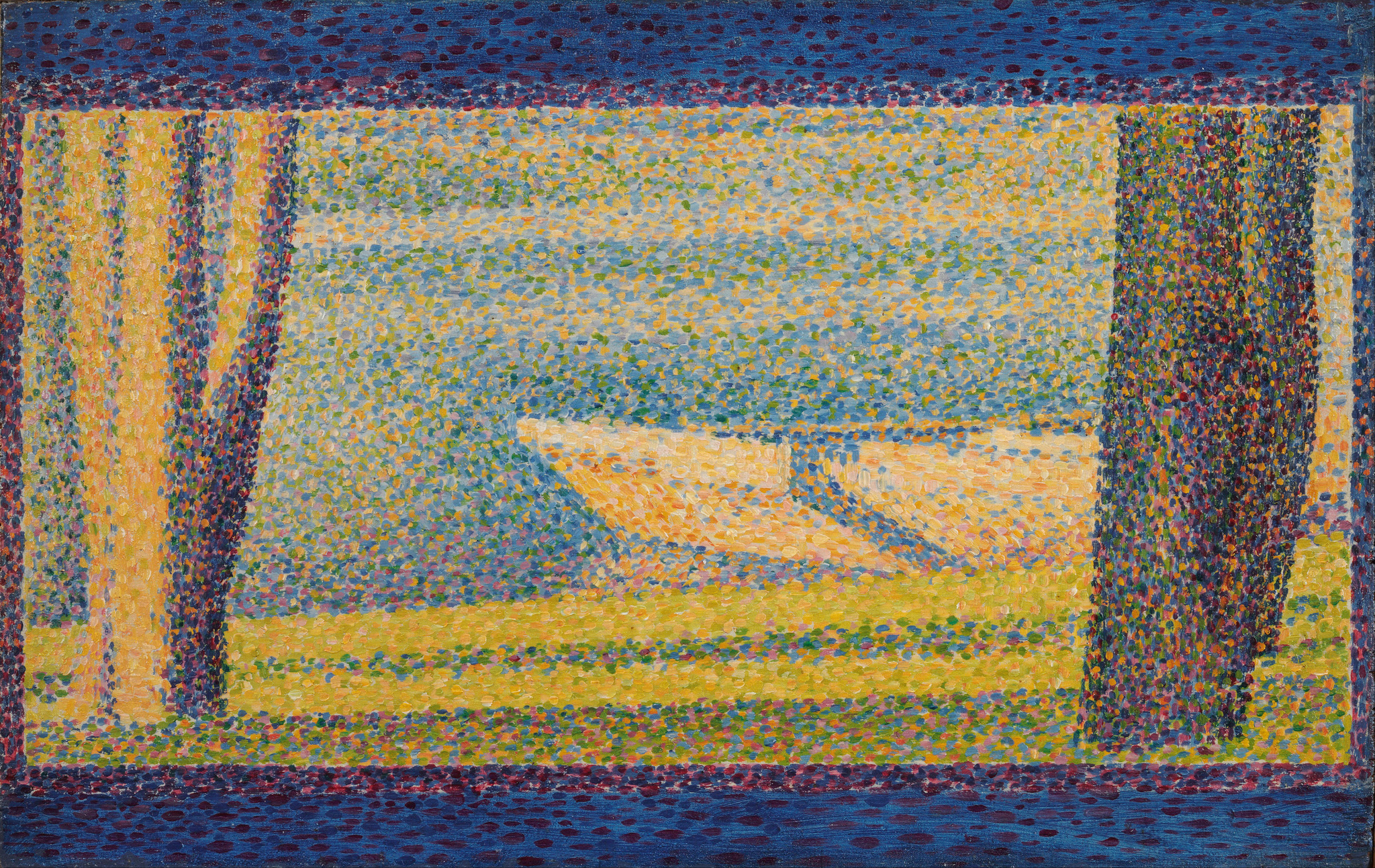
Moored Boats and Trees is a small oil on wood by Seurat from 1890: two pale boats lie between tree trunks on the bank, the water behind them glitters in tiny dots, and the whole scene is surrounded by a blue dotted border that the painter added himself. The original, 25 x 16 cm, is held by the Philadelphia Museum of Art under number 2008-181-1. We make it as a fine art reproduction, hand-painted in oils on canvas, in eight sizes or to your own measurements, and before dispatch you receive a photograph of the finished work to approve.
| Title: | Moored Boats and Trees |
| Other titles: | – (»Moored Boats and Trees« is the title the museum itself uses) |
| Painter: | Georges Seurat (1859–1891) |
| Year painted: | 1890 |
| Original size: | 25 cm x 16 cm |
| Original technique: | Oil on wood |
| Painting style: | Tiny dots of colour, with a painted dotted border |
| Located at: | Philadelphia Museum of Art, Philadelphia (inv. no. 2008-181-1) |
| Our reproduction: | hand-painted in oils on canvas, 8 sizes from 25 x 16 cm to 150 x 100 cm, custom sizes on request |
Moored Boats and Trees – Georges Seurat
What does the painting show?
There are no people in it. The leading roles go to two boats and the trees along the water. The boats are pale, almost creamy yellow, and lie side by side in the middle of the scene. On the left stand two trunks, one light, built of yellow and orange dots, the other darker, a violet blue. On the right a broad dark trunk rises from the bottom edge of the painting all the way to the top. Across the front runs a strip of bank in yellows and greens, crossed by violet shadows. The museum’s title says no more than what we see: moored boats and trees.
What is on the panel?
A horizontal wooden panel, 25 cm wide and 16 cm high according to the museum record. The whole surface is built of small, dense dots of colour. The water behind the boats is made of blue, green, yellow and pink points that grow lighter towards the top, so it looks as if light is breaking on it. Yellow and white dots dominate the boats, and the shadows on them are bluish. Around the entire scene runs a dark blue border, also made of dots, in which red and violet points appear among the blue; it is wider at the top and bottom than at the sides. This border is not a frame: it is painted on the panel itself and belongs to the work.
Why does this painting matter?
Because in a very small format it shows the whole of Seurat’s way of painting. Georges Seurat, the French painter, built every surface here, from the water to the trunks, out of separate dots of colour that merge into a bright scene when seen from a distance. On a panel the size of a postcard, this kind of pointillism is visible at first glance, with no magnification needed. The work’s journey adds to its significance: according to the museum record, Henri Matisse bought it in 1916, and it stayed in his family until 2008. For a buyer it is a calm, colourful scene that brings a great deal of light into a small space.
What does the scene mean?
A quiet moment by the water, with no story and no people. The boats are tied up and at rest, the trees stand like columns on either side, and the water shimmers in the background. The trunks to the left and right act like stage wings, opening a view onto the boats between them. The colours are light and warm; yellow leads, while blue and violet supply the shade. At home the scene feels calm and summery, and it suits a room where you want to rest your eyes.
What happened to the original?
The museum publishes the panel’s complete history. Its first recorded owner was Alfred Tobler in Berlin, who sold it on 11 March 1914 to the Paris gallery Bernheim-Jeune, where it was entered under stock number 20222. On 14 June 1916 the gallery sold it to Henri Matisse (1869–1954), who lived in Paris and Nice. After his death it passed by inheritance to his son Pierre Matisse (1900–1989) of New York, and from him to his daughter Jacqueline Matisse Monnier (born 1931). In 2008 she gave it to the museum in Philadelphia in memory of Anne d’Harnoncourt. Every detail here is summarised from the museum’s record.
What place does this painting have among Seurat’s works?
The museum dates it to 1890. The same year produced the painting we offer as The Channel of Gravelines, Petit Fort-Philippe, whose original is held by the Indianapolis Museum of Art at Newfields. Our painting The Channel at Gravelines, Evening also belongs to the summer of 1890. Anyone fond of boats will find another subject in our range, Boats, Low Tide, Grandcamp. Moored Boats and Trees, by contrast, is a small panel that gathers the entire scene into an area of 25 x 16 cm.
How is our hand-painted version made?
With a brush and oil paint, never with a printer. Our painter works from a high-resolution image of the original and places the dots one by one, just as they sit on the panel. Here the pointillist technique is not decoration but the essence of the painting, so we keep it throughout: in the water, on the boats, on the trunks and in the shadows. Seurat’s painted blue border is painted too, as part of the picture, because it belongs to the original. Since everything is done by hand, no two canvases are ever exactly alike, and each hand-painted copy stays unique. We have no photographs of our own of a finished canvas of this subject yet; once we have painted it for the first time, we will photograph it and put the photos here.
Which size suits which wall?
If you are not sure which to choose, take 60 x 40 cm. Our smallest size, 25 x 16 cm, is exactly the size of the original, which measures 25 x 16 cm, so it is the closest match in our range. The format is horizontal, so it sits nicely above a narrow chest of drawers or a bed, or within a group of smaller works. 50 x 30 and 60 x 40 cm are the most popular choices for a hallway or bedroom; 70 x 45 and 80 x 50 cm hold their own above a desk; 90 x 60 cm is a living-room size, while 120 x 75 and 150 x 100 cm turn the little panel into a large, bright painting. Each canvas painting of this subject is made to order.
Custom size, stretcher bar and frame
If none of the eight sizes suits your wall, we paint the work to your measurements and keep the proportions of the original, so the boats, trunks and border stay in balance; that is our custom size painting service. You can order the painting in three forms: as a rolled canvas without a stretcher, stretched on a wooden stretcher bar and ready to hang, or framed; you choose the form when you order. You pick the frame in our 3D app, which shows gold, silver, black, white and wooden profiles on this subject; it is meant only for choosing a frame. Because the painting already has its own painted border, a thin, simple frame suits it well. If you want to see the painting on your own wall, our room-visualisation service is available as a separate order.
Delivery and guarantee
Each piece is painted to order in our studio in Slovenia, so allow 15 to 45 days, depending on the size. It ships in the form you chose when ordering — rolled, stretched or framed — protected for transport, within Slovenia and across the EU with no customs duty. Before dispatch you receive a photograph of the finished work to approve, and every order is covered by our returns policy. All of Seurat’s subjects are in the Georges Seurat gallery, and our article about Georges Seurat also describes what a good reproduction of a famous painting looks like.
Frequently asked questions
Where is the original?
At the Philadelphia Museum of Art, under number 2008-181-1. Jacqueline Matisse Monnier gave it to the museum in 2008 in memory of Anne d’Harnoncourt.
Are there any people in the painting?
No. The panel shows only two boats, trees and water.
What year is the original from?
The museum dates it to 1890.
Is this a print?
No. The work is painted by hand, in oil on canvas; the dots and brushstrokes can be seen and felt.
Is the blue border part of the painting?
Yes. Seurat painted the dotted border on the panel itself, and we paint it as well.
Which size should I choose?
For a hallway or bedroom, 60 x 40 cm; for the size of the original, 25 x 16 cm. The detailed guide is above.
Can I have a size that is not on the list?
Yes, we paint to measure and keep the side ratio of the original.
Who once owned the original?
According to the museum record, among others Henri Matisse, who bought it on 14 June 1916, then his son Pierre Matisse and Pierre’s daughter Jacqueline Matisse Monnier.
What is this style called?
Painting with separate dots of colour, which today is classed as neo-impressionism.
Is the original for sale?
No. The panel is in the museum’s public collection in Philadelphia and is not for sale, but you can have its subject at home as one of our hand-painted canvases.
Is it suitable as a gift?
Yes. A calm scene by the water fits almost any home, and a work after a well-known master is a gift that lasts. If you would rather leave the choice to the person receiving it, there is our gift voucher.
- Subject: two pale moored boats among trees by the water, with a painted blue border – 1890
- Original: 25 x 16 cm, oil paint on wood, Philadelphia Museum of Art, Philadelphia (inv. no. 2008-181-1)
- Ours: a hand-painted oil painting reproduction, eight sizes from 25 x 16 to 150 x 100 cm, as a rolled canvas, stretched on a stretcher bar or framed — your choice
- Worth knowing: from 1916 the panel belonged to Henri Matisse and then to his family