


Description
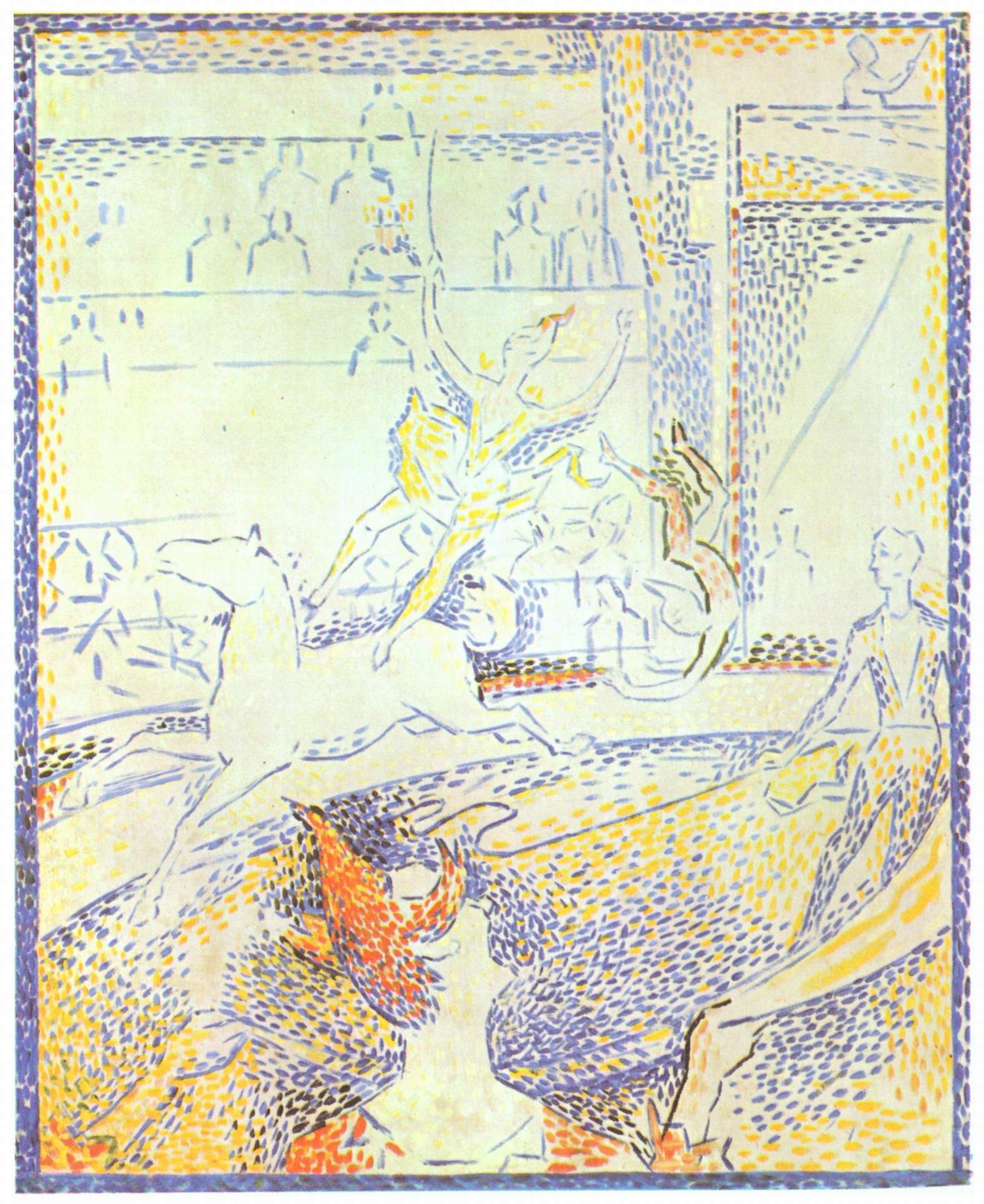
Sketch for The Circus is Seurat’s preparatory painting of 1891: on a light, almost white ground a bareback rider stands on a galloping white horse, an acrobat somersaults in the air above her, and in the foreground a clown in orange turns his back to us. The Musée d’Orsay records it as a sketch for the large canvas The Circus; the original, 46.2 x 55.2 cm, is held there under number RF 1937 123. We make it as a canvas painting, hand-painted in oils, in eight sizes or to your own measurements, and you receive a photograph of the finished work for approval before dispatch.
| Title: | Sketch for The Circus |
| Other titles: | Le Cirque – esquisse pour le RF 2511 |
| Painter: | Georges Seurat (1859–1891) |
| Year painted: | 1891 |
| Original size: | 46.2 cm x 55.2 cm |
| Original technique: | Oil on canvas |
| Painting style: | Neo-Impressionism – a sketch in dots and dashes |
| Located at: | Musée d’Orsay, Paris (inv. no. RF 1937 123) |
| Our reproduction: | hand-painted in oil on linen, 8 sizes from 38 x 45 cm to 120 x 140 cm, custom sizes on request |
Sketch for The Circus – Georges Seurat
Who is in the painting?
Circus performers whom the museum record does not name. Left of centre a rider in a short skirt stands on a white horse galloping round the ring. Above her an acrobat turns in the air with arms and legs spread wide. On the right stands a tall, slim figure who looks like the ringmaster, and at the bottom in the middle a clown in an orange-red costume, turned away from us, looks into the ring and leads our eye there too. Up in the stands sit rows of spectators, suggested with only a few blue lines. These are not portraits but types from an evening at the circus, of the kind Seurat watched in the circuses of Paris.
What is on the canvas?
An upright canvas with a very light, creamy white ground, on which the figures are set down in blue outlines. The paint is laid in small dots and short dashes: yellow and orange for light, blue for outlines and shadows. Along the edge of the canvas runs a band of blue dots that Seurat painted himself; it is part of the picture, not a frame. Much of the surface is left almost bare, so the sketch is very airy, light and pale – which is how it is meant to be. The composition is already precisely set: the curve of the ring, the diagonal of horse and acrobat and the vertical of the figure on the right match the final canvas.
Why does this sketch matter?
Because it shows the last great idea of a painter who died young. The Circus was his last large painting, which he was still working on in 1891, the year of his death. In his last years this French painter believed that the direction of lines could express a mood – rising lines joy, falling lines sadness – and a circus full of acrobats flying upwards was the ideal subject for it. The sketch is full of that movement, but the colour is still sparse, so you can see the skeleton of the picture, almost like a drawing. Pointillism is used here as drawing with dots rather than as a filled surface. For a buyer it is a bright, cheerful subject that looks like a drawing in colour on a wall.
What does the scene mean?
The joy and speed of a night at the circus, caught in a carefully worked-out form. The rider, the horse and the acrobat fly, while the clown and the audience are still; that contrast between movement and rest is the real subject. Neo-impressionism set out to study colour and line scientifically, and here the method serves entertainment rather than seriousness. The sketch also keeps something the finished painting does not have: the light and lightness of the white ground. On a wall it looks bright, playful and modern, almost like a poster.
What happened to the original?
The museum publishes the sketch’s route. It was first in the collection of the critic Félix Fénéon in Paris, then until 1937 in the collection of the fashion designer Jacques Doucet. In 1937 the State accepted it as a gift from his widow, who was carrying out his wishes; the gift was confirmed on 7 December. The sketch was assigned to the Louvre, hung in the Jeu de Paume from 1947 to 1959, and in 1977 was assigned to the Musée d’Orsay. Those details are the museum’s; we add none of our own.
Where does this sketch sit in Seurat’s work?
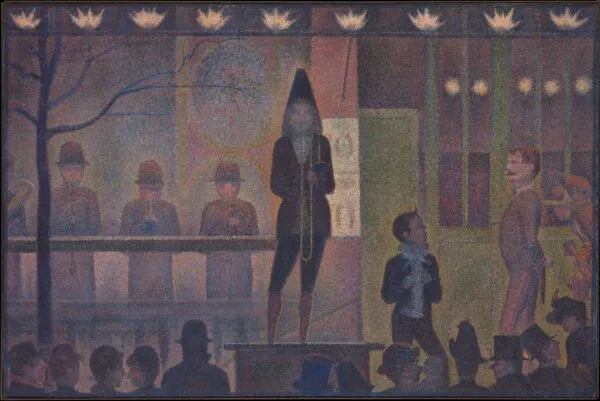
It is the preparation for the large canvas The Circus, held by the same museum, the Musée d’Orsay; both are in our gallery as separate products. Seurat had painted the circus and night-time entertainment before: Invitation to the Sideshow (La Parade de Cirque) shows a performance in front of a tent under gas lamps, and Le Chahut shows cancan dancers. Together they form the group of Seurat’s night scenes from his last years.
How is our hand-painted version made?
With a brush and oil paint, never a printer. Our painter works from an image of the original and keeps what matters most in this sketch: the light ground, the blue outlines and the sparse dots and dashes that never quite fill the figures. The dotted technique is used with restraint here, like drawing; the painter must not add colour the original does not have. Seurat’s band of blue dots along the edge is painted too, because it is part of the picture. Because everything is done by hand, every hand-painted copy is a one-off. We do not yet hold our own photographs of a finished canvas of this subject; the first time it is painted we will photograph it, and the photographs will appear here.
Which size for which wall?
If you are not sure which to choose, take 60 x 70 cm. The size closest to the original is 50 x 60 cm, which is 3.8 cm wider and 4.8 cm taller than it; the original’s exact size is not in our range. The format is upright, so it fits well between two windows, on a narrow wall or above a chest of drawers. 38 x 45 cm suits a hallway or a child’s room; 50 x 60 and 60 x 70 cm a bedroom or study; 70 x 85 and 80 x 100 cm fill a living-room wall on their own, and 90 x 110, 100 x 120 and 120 x 140 cm are for tall walls, where the light sketch works almost like a fresco. Every oil painting reproduction of this subject is made to order.
Custom size, stretcher bar and frame
If none of the eight sizes fits your wall, we paint to your measurements and keep the ratio of the original, so the horse, the acrobat and the ring stay in balance; that is our custom size painting service. You can order the painting in three forms: as a rolled canvas without a stretcher, stretched on a wooden stretcher bar and ready to hang, or framed; you choose the form when you order. You choose a frame in our 3D frame viewer, which shows gold, silver, black, white and natural wood profiles on this subject; it is for choosing a frame and nothing else. For a view of your own wall there is our room-visualisation service, ordered separately.
Delivery and guarantee
Every canvas is painted to order in our studio in Slovenia, so allow 15 to 45 days depending on the size. We ship it in the form you chose when ordering — rolled, stretched or framed — protected for transport, across the EU customs-free. Before dispatch you approve a photograph of the finished work, and our returns policy covers every order. All of Seurat’s subjects are in the Georges Seurat gallery, and our article about Georges Seurat explains what a good fine art reproduction needs.
Frequently asked questions
Where is the original?
In the Musée d’Orsay in Paris, under number RF 1937 123, given in 1937 by Jacques Doucet’s widow.
Who are the people in the sketch?
A rider on horseback, an acrobat in the air, a clown, a figure who looks like the ringmaster, and the audience; the museum record names none of them.
Is this the same work as The Circus?
No. This is a smaller sketch, 46.2 x 55.2 cm; the large finished canvas The Circus is a separate work in the same museum. Both are in our gallery as separate products.
Is this a print?
No. The work is painted by hand in oil on canvas; the strokes and dots can be seen and felt.
Which size should I choose?
For most walls, 60 x 70 cm; for the size closest to the original, 50 x 60 cm. The full guide is above.
Can I have a size that is not listed?
Yes. We paint to measure and keep the side ratio of the original.
Is the blue band around the edge a frame?
No. Seurat painted the band of blue dots himself, and it is part of the picture; that is why we paint it too.
What is the sketch about, in one sentence?
That the speed of a night at the circus can be caught in a few blue lines and scattered dots of colour on a white ground.
Is the original for sale?
No. The sketch is in the public collection of the Musée d’Orsay and is not for sale; a hand-painted canvas from us lets you have it at home.
How high should I hang it?
Centre at eye level, about 145–150 cm from the floor; large upright sizes can hang a little higher.
Is it suitable as a gift?
Yes. A cheerful circus subject makes a welcome gift, even for a child’s room. If you would rather leave the choice to the person receiving it, there is our gift voucher.
- Subject: a rider on a white horse, an acrobat in the air and a clown in the circus ring – 1891
- Original: 46.2 x 55.2 cm, oil paint on canvas, Musée d’Orsay (inv. no. RF 1937 123)
- Ours: a famous painting recreated by hand in oils, eight sizes from 38 x 45 to 120 x 140 cm, as a rolled canvas, stretched or framed — your choice
- Worth knowing: the band of blue dots along the edge was painted by Seurat himself – it is part of the picture, not a frame