

Description
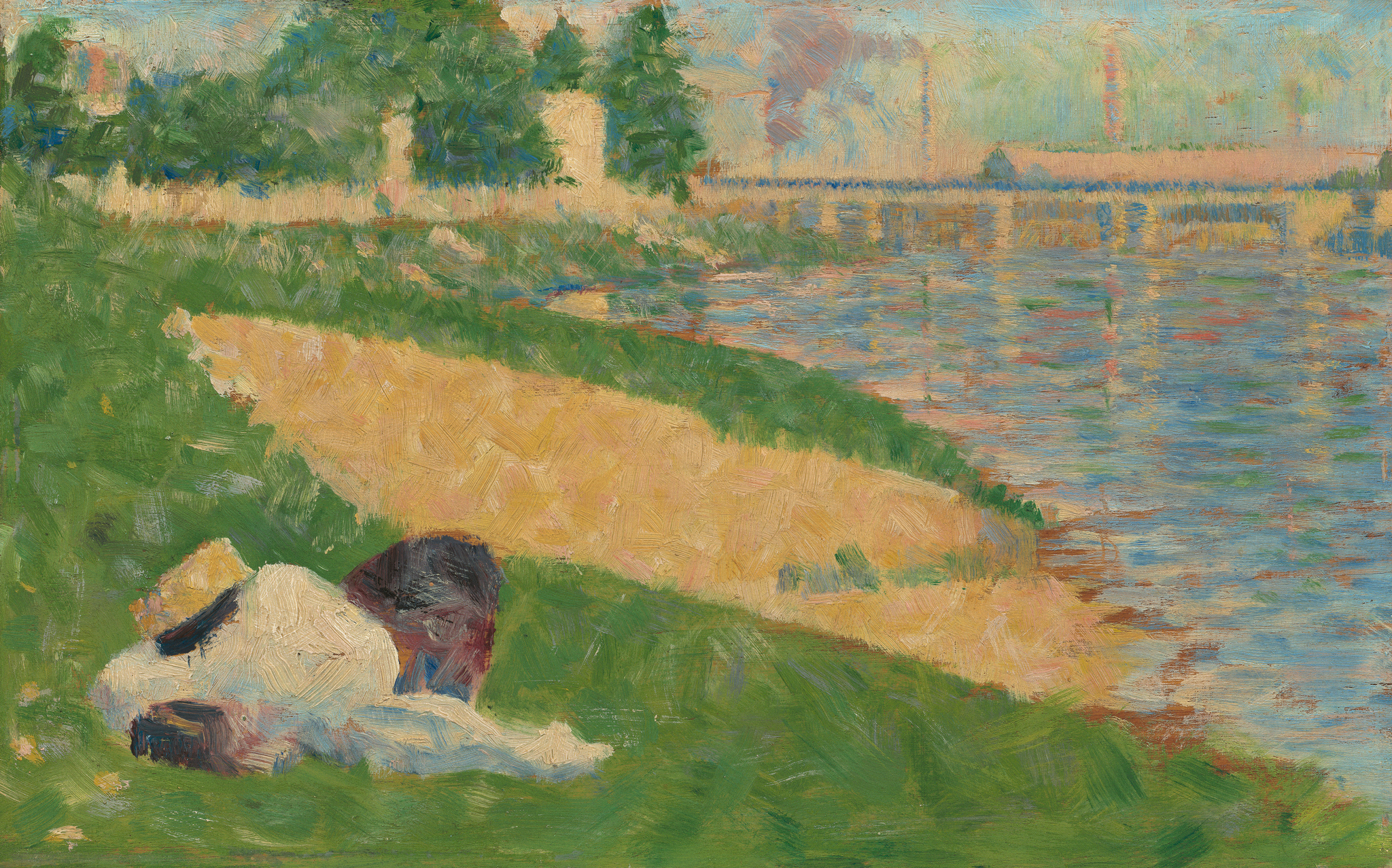
The Seine with Clothing on the Bank is an oil study that Seurat painted on a small wooden panel in 1883–1884: white clothes and a straw hat lie on a green bank of the Seine, behind them a bright sandy beach sweeps round in a curve, and in the distance a bridge crosses the river, with factory chimneys rising beyond it. The original, 26.35 x 17.15 cm, is held by the National Gallery of Art in Washington under number 2014.18.56. Our version is a canvas painting, hand-painted in oils, available in eight sizes or to your own measurements, and a photograph of the finished work comes to you for approval before dispatch.
| Title: | The Seine with Clothing on the Bank |
| Other titles: | The Seine with Clothing on the Bank (Study for »Bathers at Asnières«) |
| Painter: | Georges Seurat (1859–1891) |
| Year painted: | 1883–1884 |
| Original size: | 26.35 cm x 17.15 cm |
| Original technique: | Oil on wood |
| Painting style: | Oil study – short strokes, not yet dots |
| Located at: | National Gallery of Art, Washington (inv. no. 2014.18.56) |
| Our reproduction: | hand-painted in oils on canvas, 8 sizes from 25 x 16 cm to 150 x 100 cm, custom sizes on request |
The Seine with Clothing on the Bank – Georges Seurat
What does the painting show?
A bank of the Seine in summer sunshine, where only the clothes have stayed behind. At the lower left a heap of white clothes lies on the grass, and beside it a straw hat and a darker piece of clothing. Behind them a bright sandy beach stretches in a wide curve down to the water, and on the right the river opens up in blue and pink reflections. In the background a long bridge crosses the river, factory chimneys rise beyond it, and at the upper left stand green trees and pale buildings. The museum lists the work as a study for Bathers at Asnières; there are no people in it, and only the discarded clothes speak of them.
What is on the panel?
A horizontal wooden panel 26.35 cm wide. The green bank is painted in dense, short strokes of yellowish green and blue, the beach in warm orange and creamy strokes, and the water in horizontal patches of blue, violet and pink in which the bridge is reflected. The clothes are bright white and bluish shapes, and the straw hat is a yellow fleck. The strokes can be seen one by one and do not yet turn into dots. The light is strong and even; the whole scene breathes summer. Almost the entire panel lies in sunshine, with few shadows, so it feels open and airy.
Why does this study matter?
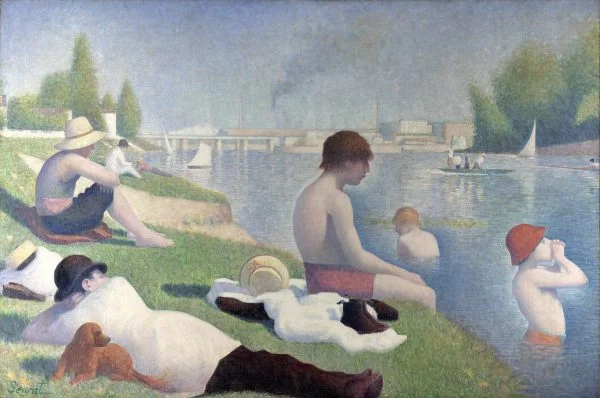
Because it is one of the preparatory studies for Seurat’s first large painting, Bathers at Asnières. On the riverbank the French painter made a series of small panels, each devoted to one question; here he studied the place without people – the bank, the beach, the water and the industry in the background. The pointillism he is known for today had not developed yet; neo-impressionism later grew out of observations like these. It is a bright summer scene that looks fresh and calm on a wall.
What does the scene mean?
A summer day by the river in which we do not see the people but can sense them. The discarded clothes and the straw hat tell us that someone is in the water or close by; the place itself stays empty and quiet. In the background the bridge and the chimneys remind us that this is an industrial suburb, where workers came down to the river on their days off. Seurat tells no story; he simply shows the place and the light. At home the painting brings summer into the room, and the bright beach gives it warmth.
What happened to the original?
The museum publishes the panel’s history. It was first with the dealers Bernheim-Jeune in Paris, then with Alex Reid & Lefevre in London. By 1930 at the latest it was owned jointly by the New York firm De Hauke & Co. and Percy Moore Turner of London; De Hauke’s half then passed to Jacques Seligmann & Co., which sold that half to Turner in 1935. Later it belonged to William A. Cargill of Scotland; at the sale of his estate at Sotheby’s in London on 11 June 1963 it was bought for Paul Mellon. In 1999 he bequeathed it to the National Gallery of Art. Every detail here is taken from the museum’s record.
What place does this study have among Seurat’s works?
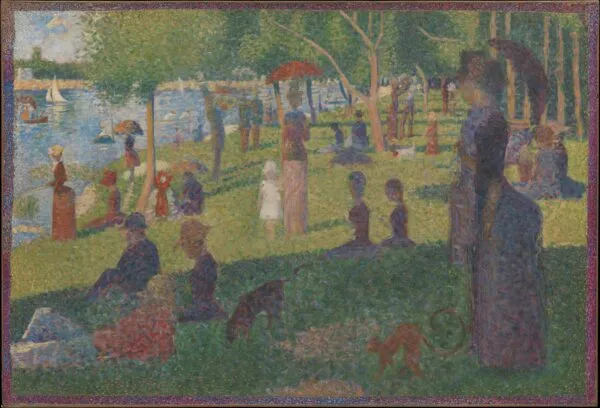
It is one of the preparatory studies for the large canvas Bathers at Asnières, held by the National Gallery in London. We also offer other studies for the same painting: Study for Bathers at Asnières (Kansas City), Study for Bathers at Asnières (London) with boys on the bank, and The Rainbow: Study for Bathers at Asnières. They are all separate products, so you can build a group of views of the same place.
How is our hand-painted version made?
With a brush and oil paint, never with a printer. Our painter works from a high-resolution image of the original and keeps what makes this study special: short, dense strokes, the strong light and the bright beach. A pointillist technique would be wrong here, because the panel was painted before Seurat developed it. Because everything is done by hand, no two canvases are ever quite identical, and every hand-painted copy stays unique. We do not yet have our own photographs of a finished canvas of this subject; as soon as we paint it for the first time, we will photograph it and publish the photographs here.
Which size for which wall?
If you are not sure which to choose, take 60 x 40 cm. The size in our range closest to the original is 25 x 16 cm, which is 1.35 cm narrower and 1.15 cm shorter than the original. The format is horizontal, so it sits nicely above a narrow chest of drawers, above a bed or in a group of smaller works. 50 x 30 and 60 x 40 cm suit a hallway or bedroom; 70 x 45 and 80 x 50 cm hold their own above a desk; 90 x 60 cm is the size for a living room, and 120 x 75 and 150 x 100 cm are meant for large walls, where the bright beach comes into its own. Every oil painting reproduction of this subject is made to order.
Custom size, stretcher bar and frame
If none of the eight sizes suits your wall, we paint to your measurements and keep the proportions of the original, so the bank and the river stay in balance; that is our custom size painting service. You can order the painting in three forms: as a rolled canvas without a stretcher, stretched on a wooden stretcher bar and ready to hang, or framed; you choose the form when you order. You choose a frame in our 3D frame viewer, which shows gold, silver, black, white and wooden profiles on this subject; it is intended only for choosing the frame. A preview of the painting on your own wall is available through our room-visualisation service, which you order separately.
Delivery and guarantee
Every canvas is painted to order in our studio in Slovenia, so allow 15 to 45 days depending on the size. We ship it in the form you chose when ordering — rolled, stretched or framed — protected for transport, within Slovenia and across the EU with no customs duty. Before dispatch you receive a photograph of the finished work for approval, and our returns policy covers every order. All of Seurat’s subjects are in the Georges Seurat gallery, and our article about Georges Seurat explains when a fine art reproduction is really good.
Frequently asked questions
Where is the original?
In the National Gallery of Art in Washington, under number 2014.18.56, in the Collection of Mr. and Mrs. Paul Mellon.
Are there people in the painting?
No. Only clothes and a straw hat lie on the bank; the museum record mentions no people, and there are none in the scene.
Is this the same work as Clothes on the Grass?
No. Both studies show discarded clothes on a riverbank, but they are separate panels in different museums; we offer them as separate products.
Is this a print?
No. The work is painted by hand in oil on canvas; you can see and feel the brushstrokes.
Which size should I choose?
For a hallway or bedroom, 60 x 40 cm; for the size closest to the original, 25 x 16 cm. The detailed guide is above.
Can I have a size that is not on the list?
Yes. We paint to measure and keep the side ratio of the original.
What is in the background across the river?
A long bridge and factory chimneys, which show that we are in an industrial suburb of Paris.
What does the painting say in one sentence?
That a few clothes left on a sunny bank are enough to tell us it is summer and someone has gone into the water.
Is the original for sale?
No. The panel is in the public collection of the museum in Washington and is not for sale. We paint it by hand for anyone who wants this riverbank at home.
How high should I hang it?
With its centre at eye level, about 145–150 cm from the floor. Hang the smaller sizes lower, closer to where you sit.
Is it suitable as a gift?
Yes, a bright summer subject pleases almost everyone. If you would rather leave the choice to the person receiving it, there is our gift voucher.
- Subject: white clothes and a straw hat on a bank of the Seine, with a bridge and factory chimneys behind – 1883–1884
- Original: 26.35 x 17.15 cm, oil paint on wood, National Gallery of Art, Washington (inv. no. 2014.18.56)
- Ours: a small study for a famous painting, hand-painted in oils on canvas, eight sizes from 25 x 16 to 150 x 100 cm, as a rolled canvas, stretched or framed — your choice
- Worth knowing: there are no people in the picture – only the clothes on the bank speak of the bathers