



Description
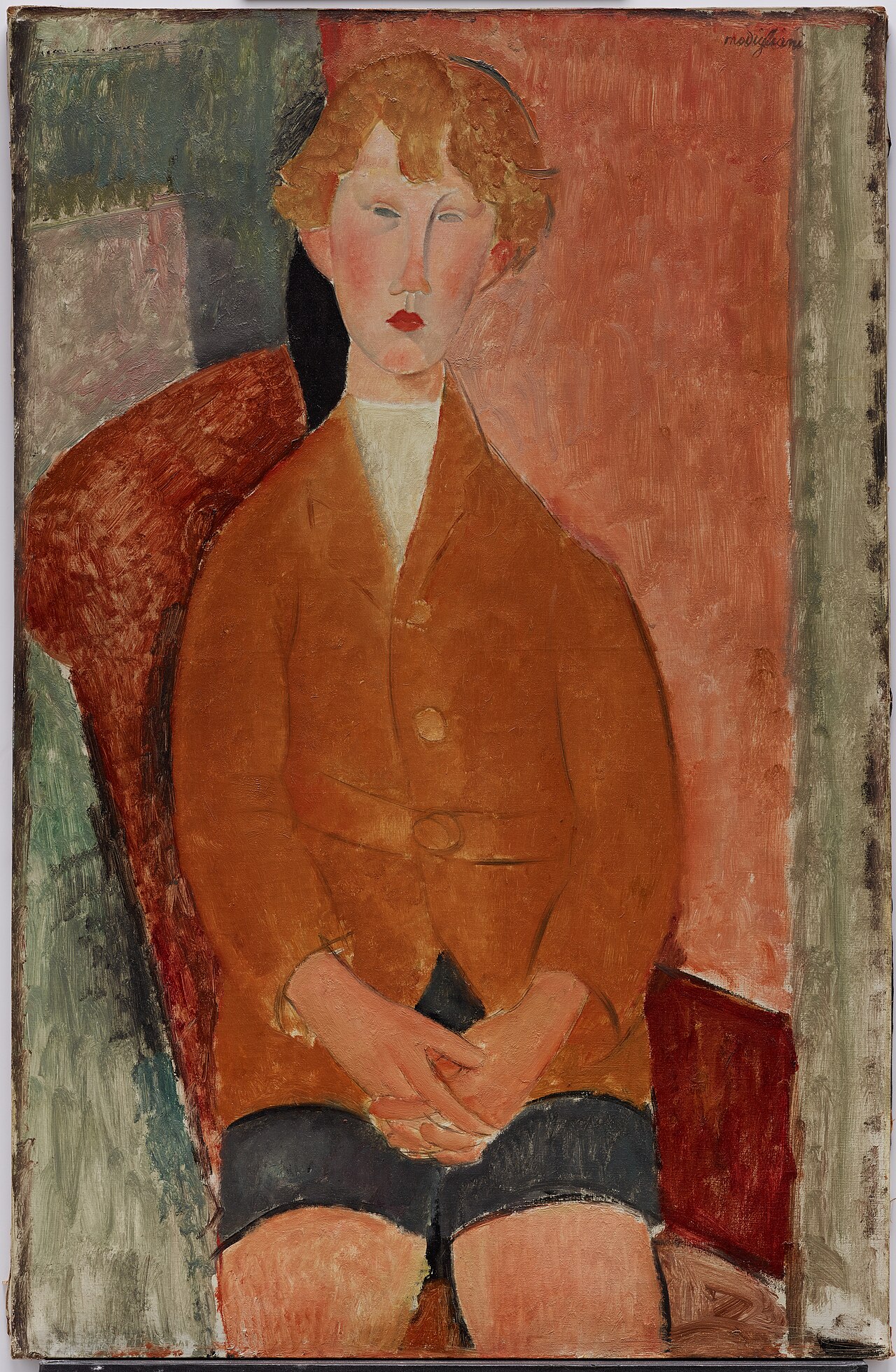
Boy in Short Pants is a canvas of about 1918 in the Dallas Museum of Art, under the number 1977.1. A boy sits square to us in a wide ochre-brown jacket and dark short trousers, his hands clasped in his lap, against a salmon-pink wall. With us it is made as a hand-painted copy, oil on canvas, to order, in eight sizes or in a size you give us; before dispatch we send you a photograph of the finished canvas.
| Title: | Boy in Short Pants |
| Other titles: | Garçon au pantalon court — Le garçon en culottes, the French catalogue titles |
| Painter: | Amedeo Modigliani (1884–1920) |
| Year of creation: | about 1918 — the museum’s dating; Ceroni no. 255 gives 1918, Lanthemann no. 370 gives 1919 |
| Original size (width × height): | 64.8 × 99.7 cm — the catalogue canvas; the museum publishes only a sight and a framed size |
| Original technique: | oil on canvas |
| Painting style: | expressionism, École de Paris |
| Located: | Dallas Museum of Art (inv. 1977.1, gift of the Leland Fikes Foundation, Inc.) |
| Our reproduction: | hand-painted copy, oil on canvas, eight sizes or a custom size |
Boy in Short Pants – Amedeo Modigliani
What is on the canvas?
A boy sits facing us, filling the middle of the picture from the knees up. His hair is a mass of reddish-blond curls over a high pale forehead; the face is a long oval with a flush of pink on each cheek, a small red mouth, a nose drawn in a single line, and eyes reduced to narrow blue-grey slits with almost nothing in them. He wears a loose ochre-brown jacket with two round buttons, its shoulders sloping into one soft oval mass, and a white collar shows at the neck. Below the jacket are the dark navy short trousers of the title, and bare knees. He sits in a red-brown upholstered chair whose back rises behind his left shoulder. The wall behind him is a broad salmon pink; a grey-green strip runs down the right edge and a grey-green panel fills the upper left. The signature stands in the top right corner.
The museum’s own label, and what it points at
The Dallas label is short and it names a source. It says that Modigliani, like his contemporaries Henri Matisse, Pablo Picasso, Georges Braque and André Derain, greatly admired African masks, and that their influence can be seen here in the stylised treatment of the boy’s face. It calls the colours acid yellow-green, and it says the work carries the iconic elegance Modigliani often bestowed on his bohemian acquaintances, along with the sitter’s air of detachment. We pass that on as the museum’s reading, because it is the museum’s. What makes it useful is what it tells a copyist: the face is built as a mask and not modelled as a head, and a hand that softens it into a likeness loses the picture. The same flat mask governs The Boy and Boy in a Striped Sweater on this shelf.
The record of the original, and a size the museum does not publish
Here the museum is unusually reticent. It publishes two measurements and neither of them is the canvas: a sight size of 38 3/4 × 25 in. (98.43 × 63.5 cm), which is what the frame lets you see, and a framed size of 50 × 35 1/4 × 2 1/4 in. The canvas figure comes from the catalogues instead: 64.8 × 99.7 cm, which is 25 1/2 × 39 1/4 in. The two are related exactly — the sight opening is half an inch less in each direction, a quarter of an inch of frame rebate along each of the four sides. Not every catalogue agrees: Wayne in 2002 and Klein in 2004 give 100.3 × 64.8 cm, and Pfannstiel in 1956 printed 92 × 60 cm and dated the work 1917, which nothing later supports. The museum’s own photograph settles which shape belongs to the canvas: the file is marked as the unframed front, and its proportion sits 0.44 per cent from the catalogue canvas and 1.17 per cent from the sight opening. The museum records the signature at the upper right, and it is legible there. Its own site is a program that draws the page inside your browser, and it answers a made-up object number with exactly the same page it answers this one with, so the link above is registered against the museum’s own object record, which carries the accession, the medium, the credit line, both measurements and the label. The work also has its own Wikidata entry. The whole selection is in the Amedeo Modigliani gallery, and we have written a longer article about the painter.
Where has the picture been?
The published chain has gaps and the catalogues mark them with question marks rather than filling them in. The first named owner is Léopold Zborowski in Paris — the eighth chain on this shelf to begin with him, and he is on the shelf himself as Portrait of Léopold Zborowski. After him the Menier collection in Paris, then a gap, then a Christie’s sale in London on 2 December 1975, Acquavella Galleries in New York, the Leland Fikes collection in Dallas, and the Leland Fikes Foundation, which gave the work to the museum in 1977. The earliest printed appearance is in a German magazine, Deutsche Kunst und Dekoration, in July 1925. The picture travels too: Buffalo and Fort Worth in 2002 and 2003, Toronto and Washington in 2004 and 2005, Villeneuve d’Ascq and Budapest in 2016, Helsinki that winter, and Tate Modern in London in 2017. Zborowski was one of the dealers of the École de Paris, and the road from him to Texas runs through a Paris collection, a London saleroom and one Dallas family. The painting is on view, in the museum’s twentieth-century European gallery on the second floor. Modigliani painted a good deal of this kind in the south of France in these months, of which The Young Apprentice is another.
How is our hand-painted version made?
A painter paints it, with a brush, in oil on canvas, to your order. Every canvas painting takes some weeks, and each copy comes out slightly its own; that is the consequence of a person working rather than a machine. The picture hangs on one relation: an ochre-brown mass in the middle against a salmon-pink wall. The jacket has to stay brown and warm without turning orange, and the wall has to stay pink without turning red, because if the two meet in the middle the figure stops standing away from the wall. The greens are only at the edges, a strip on the right and a panel at the upper left, and they are what keeps the pink from going sweet. The face wants two flushes of pink and nothing else modelled; the eyes are slits and stay slits. The hands are one knot of fingers in the lap, and they are the hardest passage in the work. Before dispatch you receive a photograph of the finished canvas and approve it. It is never a print.
Which size for which wall?
For this motif we suggest 90 × 140 cm. On proportion 130 × 200 cm is very nearly exact, 0.008 per cent from the original’s shape, with 99 × 151 cm at 0.9 and 90 × 140 cm at 1.1; but 130 × 200 cm is a very large picture, and the original is a canvas about two thirds of a metre across. The composition is frontal and quiet and it holds a wall you pass close to — a hallway, a landing, the space beside a bookcase. The palette is warm, so it sits well on white, on pale grey and on green, and it fights a strong terracotta or a deep red wall. A post-impressionist painting in a size that is not on the list is no trouble: we make it to order.
Frequently asked questions
Where is the original?
In the Dallas Museum of Art, accession number 1977.1, a gift of the Leland Fikes Foundation, Inc. It hangs in the twentieth-century European gallery.
Who is the boy?
No record names him. He is one of the local children and young workers Modigliani painted in the south of France towards the end of the war.
Why does the museum give two measurements?
Because both of them describe the framed object: what the frame lets you see, and the frame itself. The canvas size, 64.8 × 99.7 cm, comes from the catalogues.
How closely does it follow the original’s proportions?
The original measures 64.8 × 99.7 cm. The closest of our sizes is 130 x 200 cm, which departs from the original’s proportions by 0.01%.
- Subject: a boy seated square to us, wide ochre-brown jacket, dark short trousers, hands clasped, salmon-pink wall
- Original: 64.8 × 99.7 cm, oil on canvas, about 1918, Dallas Museum of Art, inv. 1977.1
- Ours: hand-painted oil on canvas, eight sizes or a custom size, with a photograph to approve before dispatch
- Worth knowing: the museum publishes a sight size and a framed size but no canvas measurement, and its label names African masks as the source of the face
The eyes on this canvas are painted without pupils. We counted all 76 Modigliani works on this shelf: 53 are like that, 17 are not – work by work.