




Description
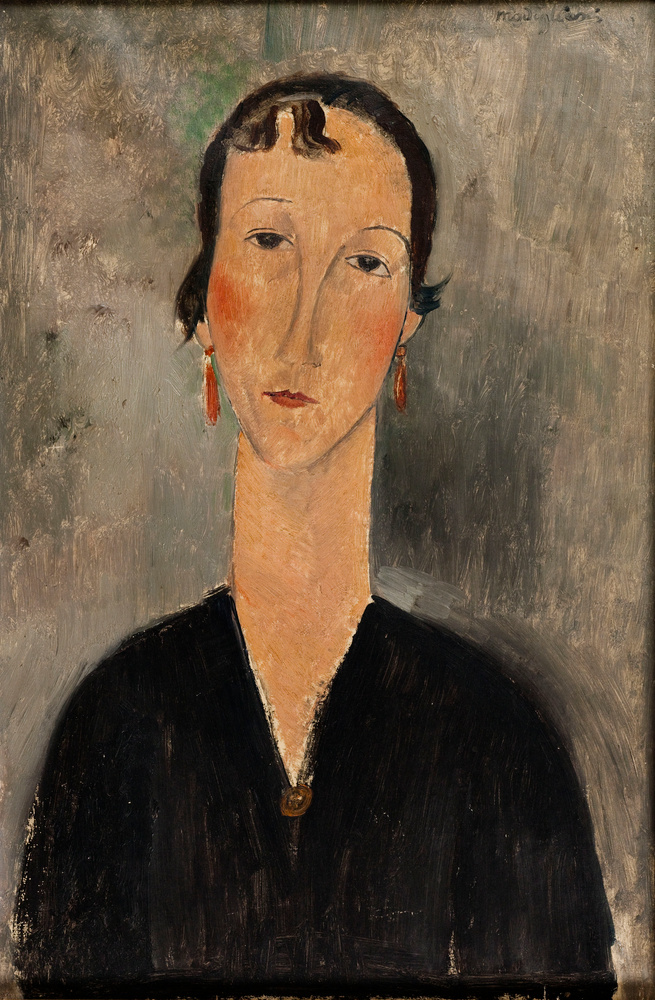
Woman with Earrings is a canvas the Musée d’Art moderne de Paris dates to about 1917, under the number AMVP 1400. A long oval face is seen straight on above a very long neck, with a coral drop earring at each ear and a mottled grey wall behind. With us it is made as a hand-painted copy, oil on canvas, to order, in eight sizes or in a size you give us; before dispatch we send you a photograph of the finished canvas.
| Title: | Woman with Earrings |
| Other titles: | Femme aux boucles d’oreilles, the museum’s own title |
| Painter: | Amedeo Modigliani (1884–1920) |
| Year of creation: | about 1917 — the museum writes “vers 1917”, and we keep the hedge |
| Original size (width × height): | 43.5 × 65 cm — from Wikidata and a catalogue file; the museum publishes no measurements |
| Original technique: | oil on canvas; the museum’s own field says only “oil paint” |
| Painting style: | expressionism, École de Paris |
| Located: | Musée d’Art moderne de Paris (inv. AMVP 1400, bequest of Dr Maurice Girardin, 1953) |
| Our reproduction: | hand-painted copy, oil on canvas, eight sizes or a custom size |
Woman with Earrings – Amedeo Modigliani
What is on the canvas?
The sitter is shown to just below the chest, frontally, against a mottled grey wall that turns warmer and slightly green at the upper left and darker towards the right edge. Dark brown hair is parted at the centre and cut short about the face, with a few spiky strands falling over the forehead. The face is a long ochre oval carrying two strong patches of pink-red on the cheeks, laid on flat rather than blended. The two eyes are not painted alike: one is a dark almond with a clear pupil, the other paler and flatter. The nose is long and drawn with a single contour, the mouth small and red. A coral-orange drop hangs from each ear — the feature the title takes its name from. The neck is very long and columnar, and it runs into a near-black V-necked garment closed at the point of the V by one small round button. The signature stands at the upper right. The same frontal bust and long neck govern Adrienne (Woman with Bangs), and for the same figure set against a plain wall there is The Italian Woman.
Why does the museum add a note about the attribution?
Because its own record carries one, and we do not hide it. Under its historical comment the museum writes that the work was long attributed to Modigliani and that it is thought today to be a genuine one. That is two statements at once: the attribution was open for a long time, and the museum’s present view is that the picture is his. We report both in the shape the museum gives them, and we do not turn “is thought” into “is”. For an order it changes nothing — what our painter works from is this canvas, however the catalogues eventually settle — but a buyer is entitled to read what the museum reads. It helps to know that Modigliani worked inside the École de Paris, the loose company of foreign painters in Montparnasse whose pictures were sold fast, dispersed early and catalogued late; attributions in that circle have had to be argued rather than inherited. The signature is on the photograph, modigliani at the upper right, and the museum records a mark in that same corner.
The record of the original, and the measurement it does not give
The museum’s record is full in every field but one. It gives the date, the technique, the inventory number AMVP 1400, the mode of acquisition, the donor and the day the picture entered the collection, and it releases its own photograph under CC0. It gives no measurements at all. The figures we print, 43.5 cm wide by 65 cm high, come from the work’s Wikidata entry and from a published Modigliani catalogue file, which we opened this run and which gives the same 65 × 43.5 cm — two sources that agree with each other, and neither of them the museum. We measured the museum’s photograph as a third check: three published sizes of it agree on a shape of 0.655, against 0.669 from those figures. That is about two per cent apart, which is close, but it is not the same number, and we would rather say so than offer a corroboration that is not one. Two more of this museum’s Modiglianis stand on this shelf, Head of a Woman and Woman with Blue Eyes. The whole selection is in the Amedeo Modigliani gallery, and we have written a longer article about the painter.
Where has the picture been?
The museum’s acquisition line is short and exact: a bequest, from Dr Maurice Girardin, entered on 2 July 1953. Before that the catalogue file places the canvas in Girardin’s own collection in Paris, acquired somewhere between 1920 and 1925 — and it marks that span with a question mark of its own, which we keep rather than quietly dropping. So the honest shape of the story is this: a Paris collector held the picture from the early 1920s, probably; he left it to the city’s museum of modern art in 1953; and nothing is published about the years between the painter’s studio and that collection. It is a short provenance, and we would rather print a short one that is true than a long one that has been filled in.
How is our hand-painted version made?
A painter paints it, with a brush, in oil on canvas, to your order. Every canvas painting takes some weeks, and each copy comes out slightly its own; that is the consequence of a person working rather than a machine. On this motif almost everything rests on the face, because there is nothing else in the picture to carry it: a grey wall, a dark garment and one small button. The two cheek patches are the strongest colour after the earrings, and they have to stay flat patches with an edge rather than soften into blended shading — blended, the face turns conventional and the work loses its character. The eyes must be left unlike each other; painting them into a matching pair is the commonest way this motif goes wrong. The earrings are small and they are the title, so they are painted last and kept exact. Before dispatch you receive a photograph of the finished canvas and approve it. It is never a print.
Which size for which wall?
For this motif we suggest 60 × 90 cm. On proportions there is no single winner here and we will not invent one: six of our eight sizes share the same 2:3 shape, and all six sit 0.38 per cent from the original’s proportions — 40 × 60, 54 × 81, 60 × 90, 80 × 120, 100 × 150 and 120 × 180 cm are equally close. The two that differ are 90 × 130 cm, 3.4 per cent off, and 70 × 110 cm, 4.9 per cent off. The original is a small canvas and the picture keeps that intimacy, so it holds a narrow wall, a stairwell or the space beside a door better than a broad one; at 80 × 120 cm it becomes a room’s main picture and the face reads from across it. The grey ground is quiet, which means it sits well on a coloured wall as long as the colour is not also grey. A post-impressionist painting in a size that is not on the list is no trouble: we make it to order.
Frequently asked questions
Where is the original?
In the Musée d’Art moderne de Paris, inventory number AMVP 1400, bequeathed by Dr Maurice Girardin in 1953.
Is the attribution certain?
The museum notes that the work was long attributed to Modigliani and is thought today to be genuine. We pass on both halves of that sentence exactly as it stands.
How large is the original?
43.5 × 65 cm, according to Wikidata and a catalogue file that agree with each other. The museum itself publishes no measurements.
How closely does it follow the original’s proportions?
The original measures 43.5 × 65 cm. The closest of our sizes is 40 x 60 cm, which departs from the original’s proportions by 0.38%.
- Subject: a woman to the chest, frontal, long neck, coral drop earrings, near-black V-necked garment with one button, mottled grey wall behind
- Original: 43.5 × 65 cm, oil on canvas, about 1917, Musée d’Art moderne de Paris, inv. AMVP 1400
- Ours: hand-painted oil on canvas, eight sizes or a custom size, with a photograph to approve before dispatch
- Worth knowing: the museum publishes no measurements and adds a note that the work was long attributed to Modigliani and is now thought genuine — we print both
The eyes on this canvas do have pupils. Of the 76 Modigliani works on this shelf 17 are like that, and 53 have no pupils – work by work.