







































Description
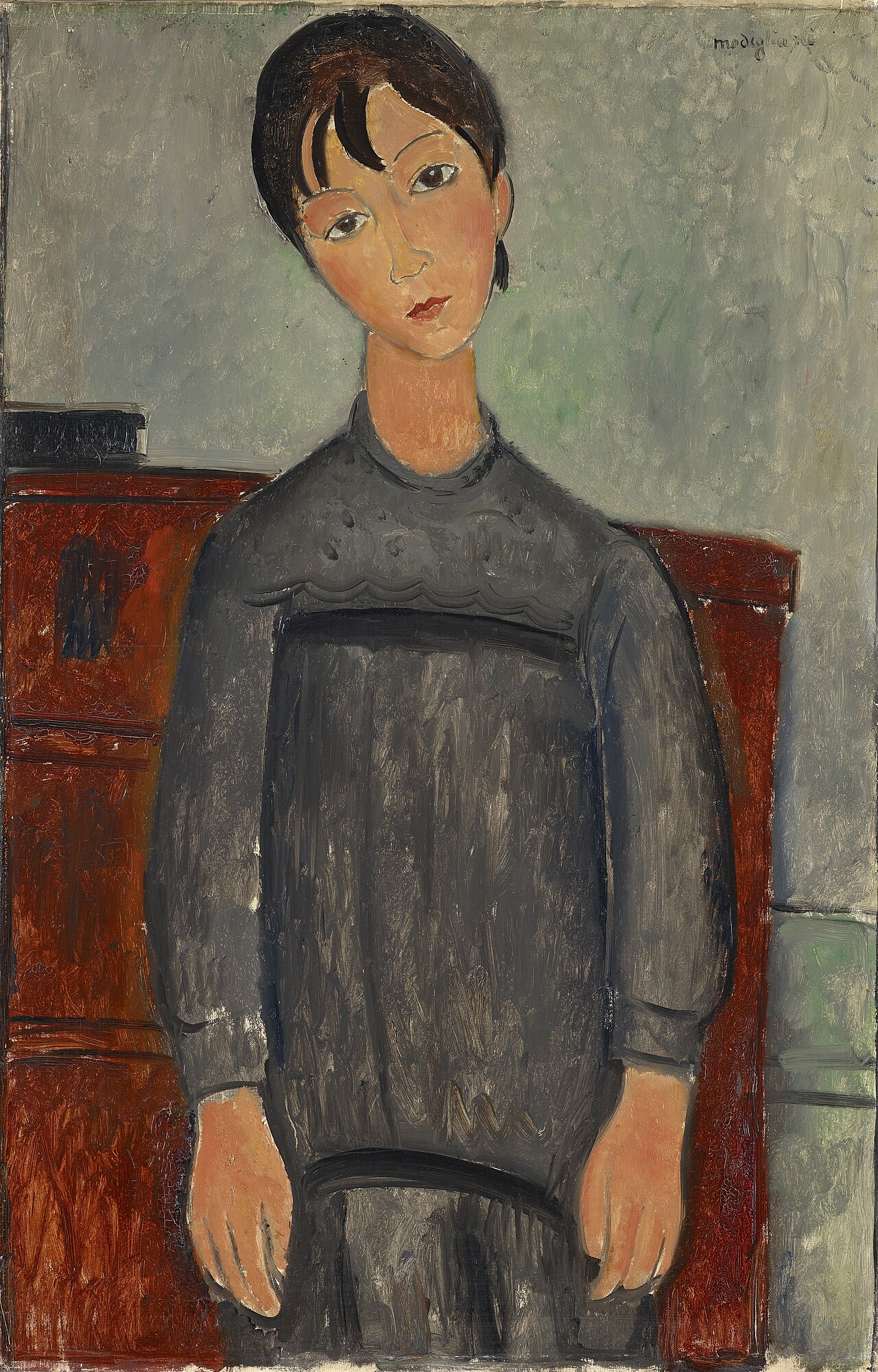
Girl Standing in Black Pinafore is a canvas of 1918 in the Kunstmuseum Basel, under the number G 1975.1. A girl stands three-quarter length in a dark grey-blue garment, her hands resting on the back of a chair in front of her, against a red-brown interior. With us it is made as a hand-painted copy, oil on canvas, to order, in eight sizes or in a size you give us; before dispatch we send you a photograph of the finished canvas.
| Title: | Girl Standing in Black Pinafore |
| Other titles: | Mädchen in schwarzer Schürze · Fillette debout en tablier noir, the museum’s own forms |
| Painter: | Amedeo Modigliani (1884–1920) |
| Year of creation: | 1918 — the museum’s year; signed upper right, modigliani |
| Original size (width × height): | 60.5 × 92.5 cm — the museum also measures it 60.4 × 92.5, and records that the canvas is not quite square |
| Original technique: | oil on canvas |
| Painting style: | expressionism, École de Paris |
| Located: | Kunstmuseum Basel (inv. G 1975.1, gift of Georgette Denise Simon) |
| Our reproduction: | hand-painted copy, oil on canvas, eight sizes or a custom size |
Girl Standing in Black Pinafore – Amedeo Modigliani
What is on the canvas?
A girl stands to three-quarter length, frontal, filling the height. Her dark hair is bobbed and cut in a heavy fringe, with one lock falling over the forehead and a dark curl beside the visible ear. The face is a warm apricot oval with rosy cheeks, thin arched brows, a nose drawn in one line and a small red mouth; the eyes are large dark almonds with pupils, and they look a little to her left rather than at us. The neck is long. She wears a dark grey-blue garment with long sleeves, a scalloped yoke across the chest above a wavy embroidered band, a dark horizontal band below that, and further marks lower down. Both arms hang straight and her long-fingered hands rest on the curved back of a chair that crosses in front of her at hip height. To the left stands a red-brown piece of furniture with panels and something dark on top; behind her a red-brown chair back or panelling; to the right a pale grey-green wall. The signature is at the upper right, and the museum records it in exactly that place.
Is it a pinafore at all?
The museum itself says perhaps not, and that is worth more than any title. In its own catalogue note it observes that the same model appears in another Modigliani, seemingly in the same dress, and concludes from the comparison that she may not be wearing a pinafore at all but a dress with transverse appliqués — and that in the Basel picture she is leaning on a chair. Look at the photograph and the note holds up: what crosses her chest is a scalloped yoke and a band of embroidery, running right across the garment rather than being tied round it, and there is no strap over the shoulder and no tie at the waist. So the picture is sold under a name its own museum quietly doubts. We keep the title, because it is the title the work is known and catalogued by, and we print the doubt beside it, because the museum published it and a buyer is entitled to know what they are looking at.
The record of the original, and three sets of measurements
The museum gives the size three times over, which is unusual and useful. The nominal figure is 92.5 × 60.5 cm. Then a second, closer measurement: 92.5 × 60.4 cm, with a note that the right-hand height is 92.4 and the width at the top 60.6 — that is, the canvas is not a perfect rectangle, and the museum says so rather than rounding it away. The third figure, 113 × 80.5 × 8 cm, is the special glass it hangs behind. We print the painting, width first, so on our page it reads 60.5 × 92.5 cm. The support is oil on canvas, the year is 1918, the signature is at the upper right, and the credit line is a gift from Georgette Denise Simon. The museum releases its image of the work as public domain. The work also has its own Wikidata entry. The whole selection is in the Amedeo Modigliani gallery, and we have written a longer article about the painter.
Where has the picture been?
This is the fullest and best-dated provenance on the shelf, and every station of it comes from the museum. It begins with Léopold Zborowski in Paris, the dealer, on a date the museum does not know — he is on this shelf himself, in Portrait of Léopold Zborowski, and he owned Lolotte too. Zborowski is where a great many École de Paris pictures start, and this shelf keeps running into him. On 23 June 1933 the picture was sold at the Hôtel Drouot in Paris, in a sale of modern paintings, as lot 69, and bought there by Dr Roland Ziegler of Basel, who kept it until his death in 1962. It passed to his wife, Jacqueline Ziegler-Simon, until her death in 1974; then to her sister, Georgette Denise Simon; and in 1975 Georgette Simon gave it to the Kunstmuseum Basel in memory of the Zieglers. Six owners, five dates, one auction with its lot number — and the museum standing behind all of it.
How is our hand-painted version made?
A painter paints it, with a brush, in oil on canvas, to your order. Every canvas painting takes some weeks, and each copy comes out slightly its own; that is the consequence of a person working rather than a machine. The difficulty of this motif is that most of it is one dark garment, and the garment must not go flat. In the original it is worked in long vertical strokes of grey, blue and black that stay visible, so it reads as cloth with light moving in it rather than as a silhouette; painted smooth it becomes a black shape with a head on top. The second thing is the face, which is warm and rounded against all that grey and carries the whole picture — the cheeks are pink, not red, and the eyes look off to the side and must not be turned towards the viewer. The chair back that crosses in front of her is what makes her stand rather than float, so it is kept firm. Before dispatch you receive a photograph of the finished canvas and approve it. It is never a print.
Which size for which wall?
For this motif we suggest 71 × 107 cm. On proportion the nearest of our sizes is 130 × 200 cm, at 0.6 per cent from the original’s shape, but that is a very large picture for a standing child; 71 × 107 cm follows at 1.5 per cent and is closer to the original’s own scale, which is a canvas about sixty centimetres across. After those come 90 × 140 cm at 1.7 and 40 × 60 cm at 1.9. The picture is tall and quiet and it suits a narrow wall, a stairwell or a space between doors; the red-brown interior warms a cool room. Because the figure is nearly life-size at 130 × 200 cm, that size works only where you can stand well back from it. A post-impressionist painting in a size that is not on the list is no trouble: we make it to order. For another young sitter on this shelf see The Young Apprentice.
Frequently asked questions
Where is the original?
In the Kunstmuseum Basel, inventory number G 1975.1, given by Georgette Denise Simon in memory of Roland and Jacqueline Ziegler-Simon.
Is she really wearing a pinafore?
The museum doubts it. Its own note suggests a dress with transverse appliqués rather than a pinafore. We keep the catalogued title and print the doubt.
Why does the museum give two sizes?
Because the canvas is not a perfect rectangle: the right-hand height is 92.4 cm and the top width 60.6, so a single figure would be an approximation.
How closely does it follow the original’s proportions?
The original measures 60.5 × 92.5 cm. The closest of our sizes is 130 x 200 cm, which departs from the original’s proportions by 0.62%. The catalogues do not agree on the size and give 60.5 × 92.5 cm; 60.4 × 92.5 cm; the comparison above starts from the first of them.
- Subject: a girl standing three-quarter length in a dark grey-blue garment, hands on a chair back, a red-brown interior behind her
- Original: 60.5 × 92.5 cm, oil on canvas, 1918, Kunstmuseum Basel, inv. G 1975.1
- Ours: hand-painted oil on canvas, eight sizes or a custom size, with a photograph to approve before dispatch
- Worth knowing: the museum doubts its own title — she may not be wearing a pinafore at all — and it publishes a provenance in which every owner is dated
The eyes on this canvas do have pupils. Of the 76 Modigliani works on this shelf 17 are like that, and 53 have no pupils – work by work.