







































Description
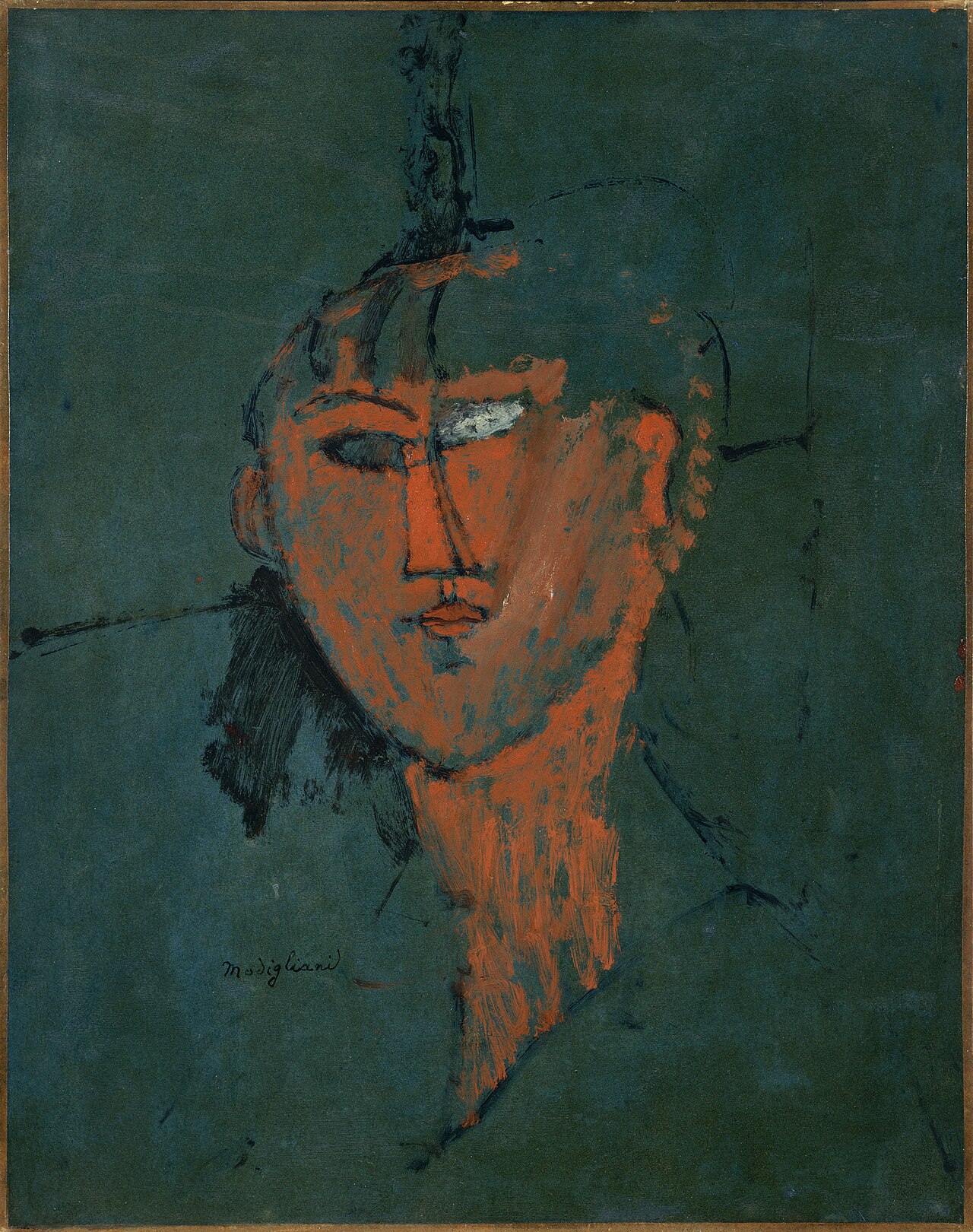
The Red Head is a head painted in oil on cardboard, held by the Musée national d’art moderne at the Centre Pompidou in Paris under the number AM 4286 P. A face and the suggestion of shoulders are laid in brick red against a dark blue-green ground, with no room and no setting around them. With us it is made as a hand-painted copy, oil on canvas, to order, in eight sizes or in a size you give us; before dispatch we send you a photograph of the finished canvas.
| Title: | The Red Head |
| Other titles: | Tête rouge (the museum’s own title) · Roter Kopf |
| Painter: | Amedeo Modigliani (1884–1920) |
| Year of creation: | the museum dates it [1915], in square brackets — attributed, not documented |
| Original size (width × height): | 42.5 × 54 cm |
| Original technique: | oil on cardboard (huile sur carton) — not on canvas |
| Painting style: | expressionism, École de Paris |
| Located: | Musée national d’art moderne, Centre Pompidou, Paris (inv. AM 4286 P, bought 1964) |
| Our reproduction: | hand-painted copy, oil on canvas, eight sizes or a custom size |
The Red Head – Amedeo Modigliani
What is on the cardboard?
We see a head and the suggestion of shoulders, and nothing else. Face and neck are laid in a strong brick red, brushed on in short visible strokes so that the blue-green underneath breathes through all the way. The face is asymmetric: the left eye is a dark closed slit, the right a pale white-blue patch under a black brow. The nose is narrow and wedge-shaped, the mouth small and orange. A black wedge of hair stands at the left of the head, and a thin black bar runs out from it towards the left edge. At the lower right a shoulder is sketched in with a few strokes. The ground is a single dark blue-green with no depth in it. In the photograph of the work you can see bare, unpainted support left along the left and top edges — the picture was not carried to the edges, and that is part of how it looks. The signature stands at the lower left.
How does the museum read this head?
Unusually for this shelf, the museum publishes a full reading, and we give it as the museum’s rather than as ours. Its note groups the work with the comparable figures Modigliani painted in 1915 and, on the strength of its sketch-like Cézannian handling, sets it beside the Portrait of Pablo Picasso and the Portrait of Henri Laurens of the same year — both, like this one, oils on cardboard. It then says that the violence of the blood-red colour follows the Fauve chromatics of Matisse and Derain, and that the morphology — a fine oval face, asymmetry, a wedge-shaped nose, blocked-up eyes, a tiny mouth — is more or less inspired by Fang masks from Gabon. In the museum’s words these things unrealise the head and turn it into a mask, given the enigmatic and magical presence of a tribal mask. That is the institution speaking, not us. What we can say on our own account is only what anyone can see: the face behaves like a mask rather than like a portrait of someone we could name. The museum gives no name either — it classes the subject simply as a woman, and files the work under the École de Paris.
The record of the original, and a year in square brackets
The original is not on canvas. The museum gives the technique as huile sur carton, oil on cardboard, and measures it 54 cm high and 42.5 cm wide; we give width first, so on our page it reads 42.5 × 54 cm. The number is AM 4286 P and the museum states plainly how it arrived: bought in 1964, at the sale of the André Lefèvre collection. Before 1964 the museum publishes nothing about who owned it, so neither do we. The date is the careful part. The museum prints the year inside square brackets — Tête rouge [1915] — and those brackets are the museum saying the year is attributed rather than documented. We keep the brackets’ meaning rather than quietly dropping them: the museum dates it to 1915. The work is catalogued as Ceroni 1950, and the museum records the image as public domain. It also has its own Wikidata entry.
The motif among the painter’s works
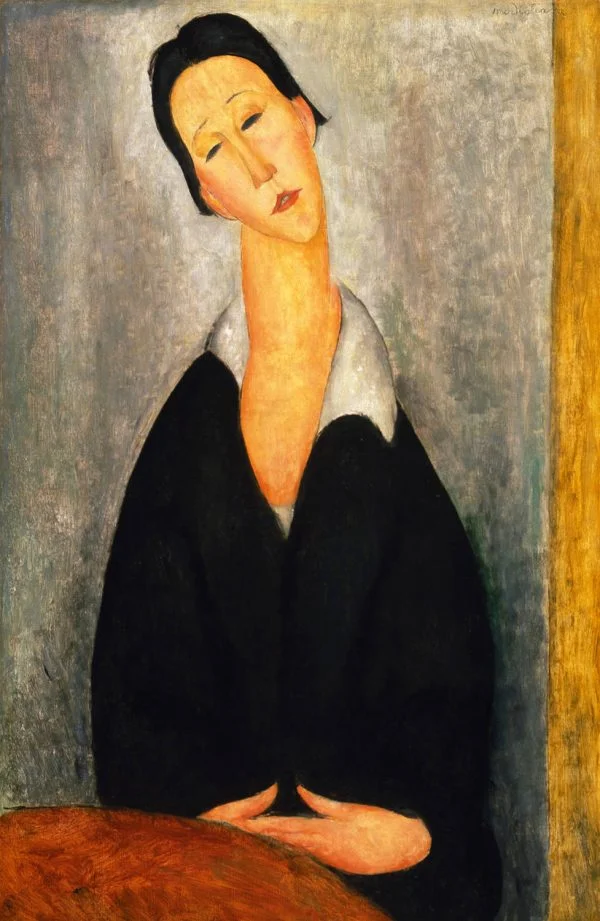
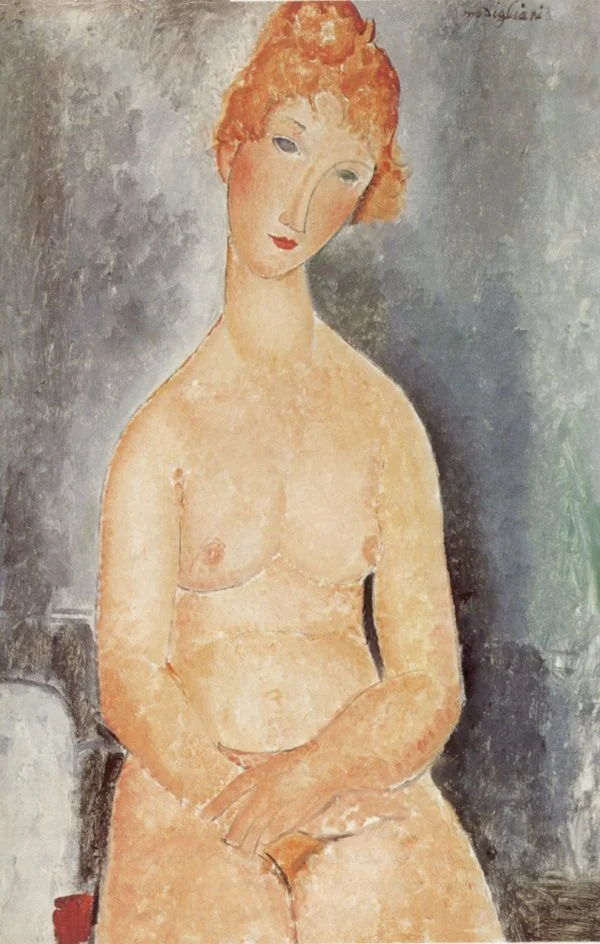
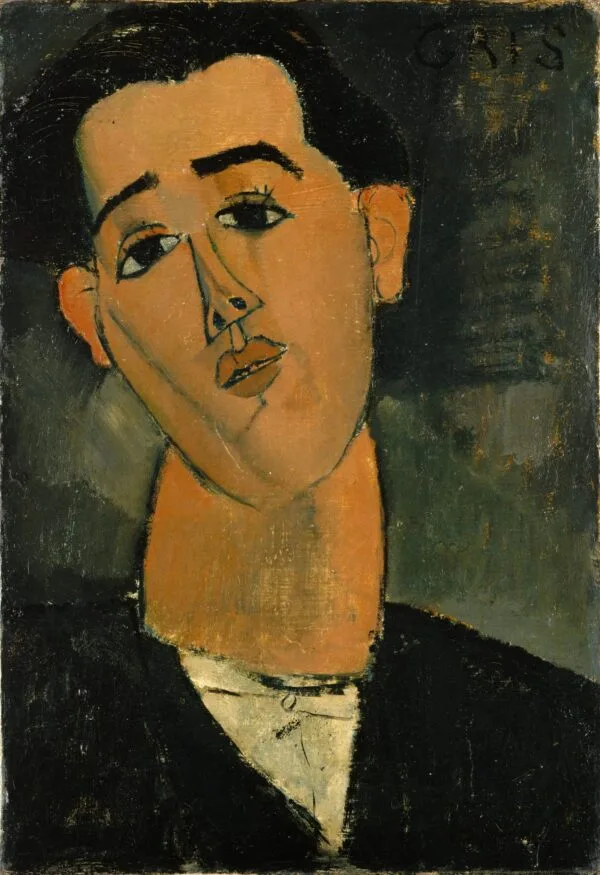
This is the one head on our shelf with no name attached to it, which makes the named faces around it read differently. From the same Paris circle we carry Portrait of Moïse Kisling and Madame Kisling — the same years, the same rooms, except that those two are people the record can name. From 1915 itself the shelf also holds Madam Pompadour, where the year is not attributed at all but painted onto the picture by the artist. Set beside this one, that contrast is the whole difference between a documented date and a hedged one. The whole selection is in the Amedeo Modigliani gallery, and we have written a longer article about the painter.
How is our hand-painted version made?
A painter paints it, with a brush, in oil on canvas, to your order. Note the difference honestly: the original is on cardboard and ours is on canvas, because canvas is what a painting to hang on a wall is made on. Every canvas painting takes some weeks, and each copy comes out slightly its own; that is the consequence of a person working rather than a machine. On this motif the difficulty is that the red must stay broken. It is not a flat field: the blue-green has to keep showing through the strokes, and if the red is laid on evenly the head goes dead and loses the speed the original has. The two eyes are deliberately unlike each other and must stay unlike — evening them out would quietly turn a mask back into a portrait. Before dispatch you receive a photograph of the finished canvas and approve it. It is never a print.
Which size for which wall?
For this motif we suggest 60 × 70 cm. It is small at its original measurement but very strong in colour, so it carries an enlargement well and works as a single accent on an otherwise quiet wall; it sits best against a neutral ground — white, sand or light grey — where the red competes with nothing. Two of our sizes are worth naming separately. Of the eight, 70 × 90 cm follows the proportions of the original most closely. But 43 × 53 cm is the closest to the original’s actual measurements: within five millimetres on the width and a centimetre on the height, which is as near to the real thing as this shelf gets. Because it is a head with no setting, it also takes being looked at from close up and suits a small room. A post-impressionist painting in a size that is not on the list is no trouble: we make it to order.
Frequently asked questions
Where is the original?
In the Musée national d’art moderne at the Centre Pompidou, Paris, inventory number AM 4286 P, bought in 1964.
Who is the sitter?
Nobody knows. The museum names no one; it records the subject only as a woman, and we do not invent a name for her.
Why is the year written in brackets?
Because the museum is telling you the date is attributed rather than documented. We report the brackets instead of printing 1915 as if it were settled.
How closely does it follow the original’s proportions?
The original measures 42.5 × 54 cm, and that is exactly the size we list: 43 x 53 cm. The proportions are the original’s, with no deviation.
- Subject: a head and the suggestion of shoulders in brick red on a dark blue-green ground, the two eyes deliberately unalike, no setting at all
- Original: 42.5 × 54 cm, oil on cardboard, dated [1915] by the museum, Centre Pompidou, inv. AM 4286 P
- Ours: hand-painted oil on canvas, eight sizes or a custom size, with a photograph to approve before dispatch
- Worth knowing: the original is on cardboard, not canvas, and our 43 × 53 cm comes within a centimetre of its real measurements
The eyes on this canvas are painted without pupils. We counted all 76 Modigliani works on this shelf: 53 are like that, 17 are not – work by work.