





Description
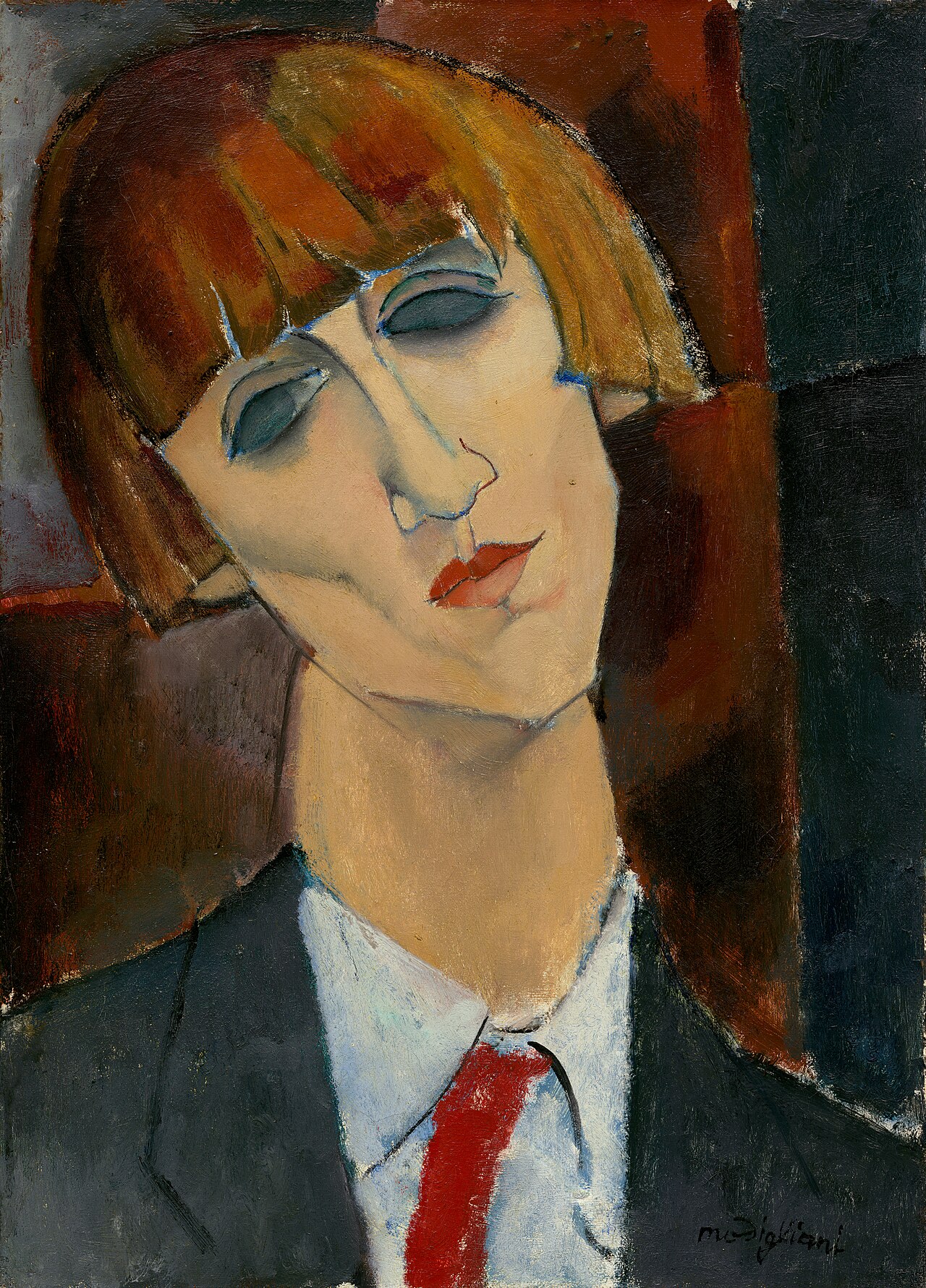
Madame Kisling is a small portrait held by the National Gallery of Art in Washington in the Chester Dale Collection, under accession number 1963.10.175. The sitter is the wife of the painter Moïse Kisling, Modigliani’s friend from Montparnasse. With us it is made as a hand-painted copy, oil on canvas, to order, in eight sizes or in a size you give us; before dispatch we send you a photograph of the finished canvas.
| Title: | Madame Kisling |
| Other titles: | Madame Kisling (the only title the National Gallery of Art’s record gives) |
| Painter: | Amedeo Modigliani (1884–1920) |
| Year of creation: | about 1917 (the NGA record reads “c. 1917”) |
| Original size (width × height): | 33 × 46 cm |
| Original technique: | oil on canvas |
| Painting style: | expressionism, École de Paris |
| Located: | National Gallery of Art, Washington – Chester Dale Collection (inv. 1963.10.175) |
| Our reproduction: | hand-painted copy, oil on canvas, eight sizes or a custom size |
Madame Kisling – Amedeo Modigliani
What is on the canvas?
Head and shoulders, cropped close, the figure slightly turned. The face is a pale oval with a long straight nose and a small red mouth; the neck is lengthened in Modigliani’s way, the chin a little raised. The hair is dark and combed smoothly back so that the forehead stays clear. The eyes are almond-shaped and set high. The ground is one even dark field without detail, which leaves all the attention on the face. The canvas is small — at 33 × 46 cm one of the smallest on this shelf — and that smallness is part of the effect: the portrait looks like something painted in a single sitting.
Who was Madame Kisling?
The National Gallery of Art’s record titles the work simply Madame Kisling and gives the sitter no first name, so neither do we. She was the wife of the Polish painter Moïse Kisling, who shared a studio with Modigliani and supported him in the years when he sold almost nothing. Kisling’s own portrait is on this shelf, Portrait of Moïse Kisling, and the two canvases together are a rare thing: husband and wife from the same circle, painted by the same hand, side by side. The circle that couple belonged to is the one we now call the École de Paris.
The record of the original, and how the canvas travelled
The original is oil on canvas; the National Gallery of Art measures it 46.2 × 33.2 cm and dates it about 1917 — the record reads “c. 1917”, and because the museum hedges the date we do not write it as a bare year. ⚠️ This page previously gave 1917 with no hedge; that is corrected here against the record of the institution that holds the work. The museum also gives the whole route of the canvas, hedge included: probably Etienne Bignou in Paris, then the Leicester Galleries in London, who sold it on 20 April 1927 to Chester Dale of New York, and in 1963 it came to the National Gallery of Art with Dale’s bequest. A footnote explains where that “probably” comes from: according to Dale’s papers in the curatorial records, the Leicester Galleries bought the work from a private collector whom Dale identified as Bignou. The work also has its own Wikidata entry.
The motif among the painter’s works
Chester Dale bought Modigliani in the twenties, and his bequest brought the Washington gallery several canvases at once; beside this one our shelf carries Léon Bakst, Adrienne (Woman with Bangs) and Café Singer. Of these, Madame Kisling is the most stripped down: no ornament, no props, only a head against a dark wall. If you want to see how Modigliani painted the same people at a larger size, the comparison with the husband’s portrait is the most instructive one. The whole selection is in the Amedeo Modigliani gallery, and we have written a longer article about the painter.
How is our hand-painted version made?
A painter paints it, with a brush, in oil on canvas, to your order. Every canvas painting takes some weeks, and each copy comes out slightly its own; that is not a fault but the consequence of a person working rather than a machine. On this motif the ground is the hard part: it looks like a single dark field but it is painted in several thin layers, and laid on flat it makes the face in front of it go rigid. Before dispatch you receive a photograph of the finished canvas and approve it. It is never a print.
Which size for which wall?
For this motif we suggest 50 × 70 cm. The original is markedly small, but the face is built from a few quiet planes and carries enlargement: 60 × 90 cm reads just as calmly on a main wall. For a narrow hallway or the wall beside a door, 40 × 60 cm is enough. If you want a post-impressionist painting in a size that is not on the list, we make it to order.
Frequently asked questions
Where is the original?
In the National Gallery of Art in Washington, Chester Dale Collection, accession number 1963.10.175.
Which size should I choose?
For a bedroom or hallway 40 × 60 cm; for a living-room wall 50 × 70 cm or 60 × 90 cm.
How closely does it follow the original’s proportions?
The original measures 33 × 46 cm, and that is exactly the size we list: 33 x 46 cm. The proportions are the original’s, with no deviation.
- Subject: head and shoulders of the painter Moïse Kisling’s wife, dark hair combed back, lengthened neck, an even dark ground
- Original: 33 × 46 cm, oil on canvas, about 1917, National Gallery of Art, Washington, inv. 1963.10.175
- Ours: hand-painted oil on canvas, eight sizes or a custom size, with a photograph to approve before dispatch
- Worth knowing: the museum hedges the date with “c.”, so we do not print a bare year either
The eyes on this canvas are painted without pupils. We counted all 76 Modigliani works on this shelf: 53 are like that, 17 are not – work by work.