




Description
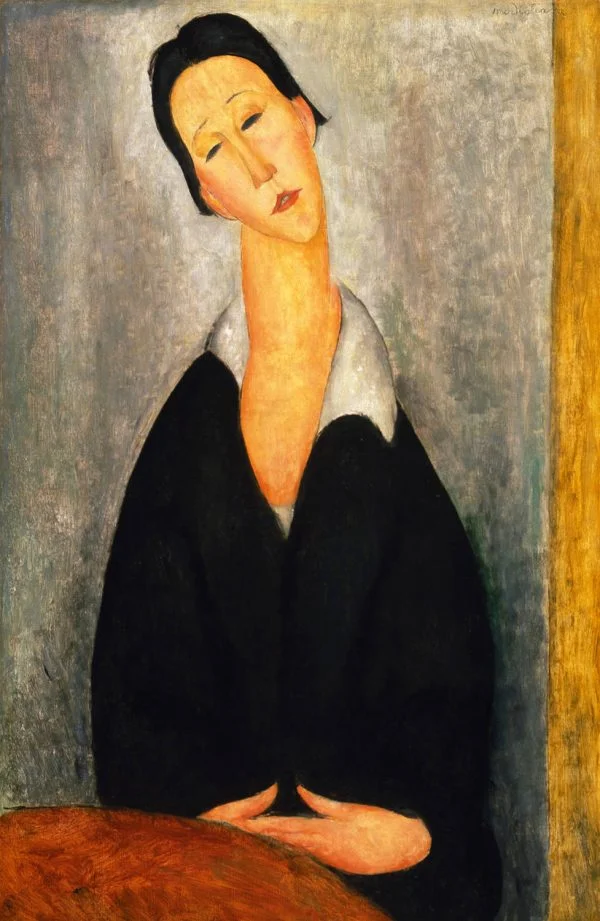
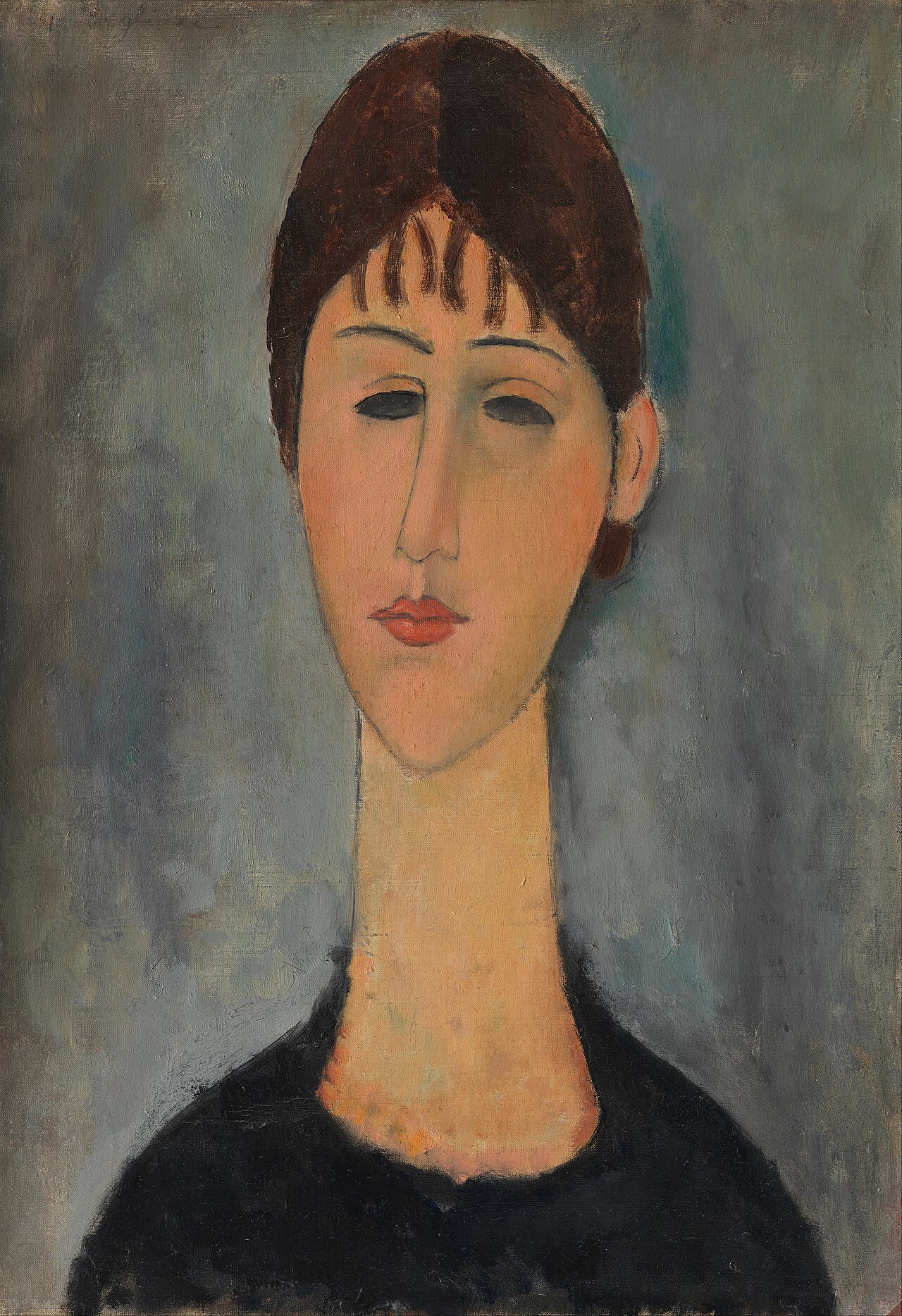
Young Woman (Oslo) is a canvas of 1918 in the Nasjonalmuseet in Oslo, under the number NG.M.02128. A young woman is seen frontally, head and shoulders, dark hair drawn back from a long cream face, against a soft grey ground. With us it is made as a hand-painted copy, oil on canvas, to order, in eight sizes or in a size you give us; before dispatch we send you a photograph of the finished canvas.
| Title: | Young Woman (Oslo) |
| Other titles: | Ung kvinne — Portrait de Madame Zborowska — Jeune fille, the museum’s and the catalogues’ titles |
| Painter: | Amedeo Modigliani (1884–1920) |
| Year of creation: | 1918 — the museum prints the year in brackets; Pfannstiel dated it 1916 to 1917 |
| Original size (width × height): | 37.7 × 54.7 cm — the museum’s measurement; the catalogues round it to 38 × 55 |
| Original technique: | oil on canvas |
| Painting style: | expressionism, École de Paris |
| Located: | Nasjonalmuseet, Oslo (inv. NG.M.02128, gift of the Friends of the National Gallery, 1947, room 067) |
| Our reproduction: | hand-painted copy, oil on canvas, eight sizes or a custom size |
Young Woman (Oslo) – Amedeo Modigliani
What is on the canvas?
A young woman, head and shoulders, facing us square on and filling the canvas from the chest up. Her hair is dark brown, centre-parted and smoothed back over the ears, with a short fringe drawn as separate strands over the forehead; one ear shows at the right. The face is a long oval in warm cream and apricot, the brows two long dark strokes, the nose one straight line, the mouth small and full in orange-red, the chin pointed. The eyes are narrow dark almonds, heavy-lidded and cast down, with no white showing. The neck is very long and columnar and is broader at its base than the head is. She wears a plain dark, almost black garment with a round neckline that fills the bottom of the picture. Behind her there is no architecture at all — only a soft brushed grey and grey-green, lighter round the head, with a patch of teal behind the right shoulder. The signature is at the top left.
A museum that names her in one line and unnames her in the next
The catalogue field headed subject, person on the museum’s own page reads: Zborowska, Anna, depicted person. Two paragraphs above, in its own essay on the same page, the museum writes that the portrait has often gone under the title Portrait of Mme Zborowska, that she was married to the Polish poet and dealer Léopold Zborowski, Modigliani’s close friend and agent — and then that individualising features were not the artist’s manner, and that this is probably an unknown model. So the record names her and the text takes the name back, and both are the museum’s. We print the museum’s title, Young Woman, and set both statements beside it. The Zborowskis are on this shelf in their own right, as Madame Hanka Zborowska and Portrait of Léopold Zborowski, and a reader can compare the faces and reach their own view.
The record of the original
The museum gives oil on canvas, 54.7 × 37.7 cm, accession NG.M.02128, a gift from the Friends of the National Gallery in 1947, and it is on display in room 067 of the collection presentation, in the section the museum calls Expression. The date it prints in brackets — (1918) — which is a museum’s way of saying attributed rather than documented; Pfannstiel’s catalogue put the work at the end of 1916 or in 1917 and called it simply Jeune fille, while Lanthemann and Parisot give 1918. The compilations round the size to 55 × 38 cm and mark that with a question mark too; we print the museum’s measured figure. The canvas is signed modigliani at the top LEFT — which breaks a run, because the six works before this one on this shelf are all signed at the upper right. The museum’s essay also places the painter: in Paris from 1906, a year as Constantin Brancusi’s assistant, whose sense of form it traces in the mask-like portraits, a living earned drawing café guests in the hope of commissions in oil, an interest in African sculpture that gave the elongated figures their modernity, and a palette held back in the manner of Cubism. That makes Oslo the fourth museum on this shelf to name African art in its own words, after Dallas, Grenoble and Yale — the third of them is on the shelf as Woman with a White Collar. The work also has its own Wikidata entry. The whole selection is in the Amedeo Modigliani gallery, and we have written a longer article about the painter.
Where has the picture been?
Less is published here than anywhere else on this shelf, and the catalogues say so with their own question marks: Bernheim-Jeune in Paris, then a gap nobody has filled, then Oslo in 1947. Bernheim-Jeune is the third chain on this shelf to run through that house, after the Grenoble canvas and Young Man with a Cap in Detroit; it was one of the galleries through which the École de Paris reached public collections. What is known for certain is the last step and the people who paid for it: not a dealer, not a bequest, but the museum’s own friends, who bought the picture and gave it, in 1947. The museum has shown it steadily since — in the long collection displays of 2007 to 2011 and 2011 to 2019, and again in 2021.
How is our hand-painted version made?
A painter paints it, with a brush, in oil on canvas, to your order. Every canvas painting takes some weeks, and each copy comes out slightly its own; that is the consequence of a person working rather than a machine. This is the quietest picture on the shelf to copy and the least forgiving. There is nothing to hide behind: no boards, no chair, no pattern, only a grey ground brushed in many directions, and it has to stay alive rather than becoming a flat wash. The face is built from very few tones, cream into apricot, and the drawing does the rest — two brow strokes, one nose line, a small mouth. The neck is deliberately too long and too wide at the base; correcting it destroys the picture. The eyes are dark and lowered and have no whites. Before dispatch you receive a photograph of the finished canvas and approve it. It is never a print.
Which size for which wall?
The original is small, about 38 by 55 cm, so every size we make is an enlargement of it. For this motif we suggest 90 × 130 cm, which sits 0.45 per cent from the original’s shape; 110 × 160 cm is nearer still at 0.25 and is the size for a large wall, while 70 × 100 cm is the smallest sensible step and runs 1.6 per cent out. Because the ground is a plain grey it hangs almost anywhere, and it is one of the few pictures here that will hold its own on a strong colour: the face is warm enough to carry against deep green or blue. It wants to be seen at eye level; the lowered eyes only work if you are level with them. A post-impressionist painting in a size that is not on the list is no trouble: we make it to order.
Frequently asked questions
Where is the original?
In the Nasjonalmuseet in Oslo, accession number NG.M.02128, on display in room 067.
Who is the woman?
The museum’s record names Anna Zborowska and the museum’s own text says the sitter is probably unknown. We print both and the museum’s neutral title.
Why do the catalogues call her Madame Zborowska?
Because Lanthemann and Parisot entered the work under that name. The museum has moved away from it without deleting it from its record.
How closely does it follow the original’s proportions?
The original measures 37.7 × 54.7 cm. The closest of our sizes is 110 x 160 cm, which departs from the original’s proportions by 0.25%. The catalogues do not agree on the size and give 37.7 × 54.7 cm; 38 × 55 cm; the comparison above starts from the first of them.
- Subject: a young woman seen frontally, dark hair drawn back, very long neck, plain dark garment, soft grey ground with no setting at all
- Original: 37.7 × 54.7 cm, oil on canvas, 1918, Nasjonalmuseet, Oslo, inv. NG.M.02128
- Ours: hand-painted oil on canvas, eight sizes or a custom size, with a photograph to approve before dispatch
- Worth knowing: the museum names Anna Zborowska in its catalogue field and calls the sitter probably unknown in its essay, and the signature here is at the top left
The eyes on this canvas are painted without pupils. We counted all 76 Modigliani works on this shelf: 53 are like that, 17 are not – work by work.