





Description
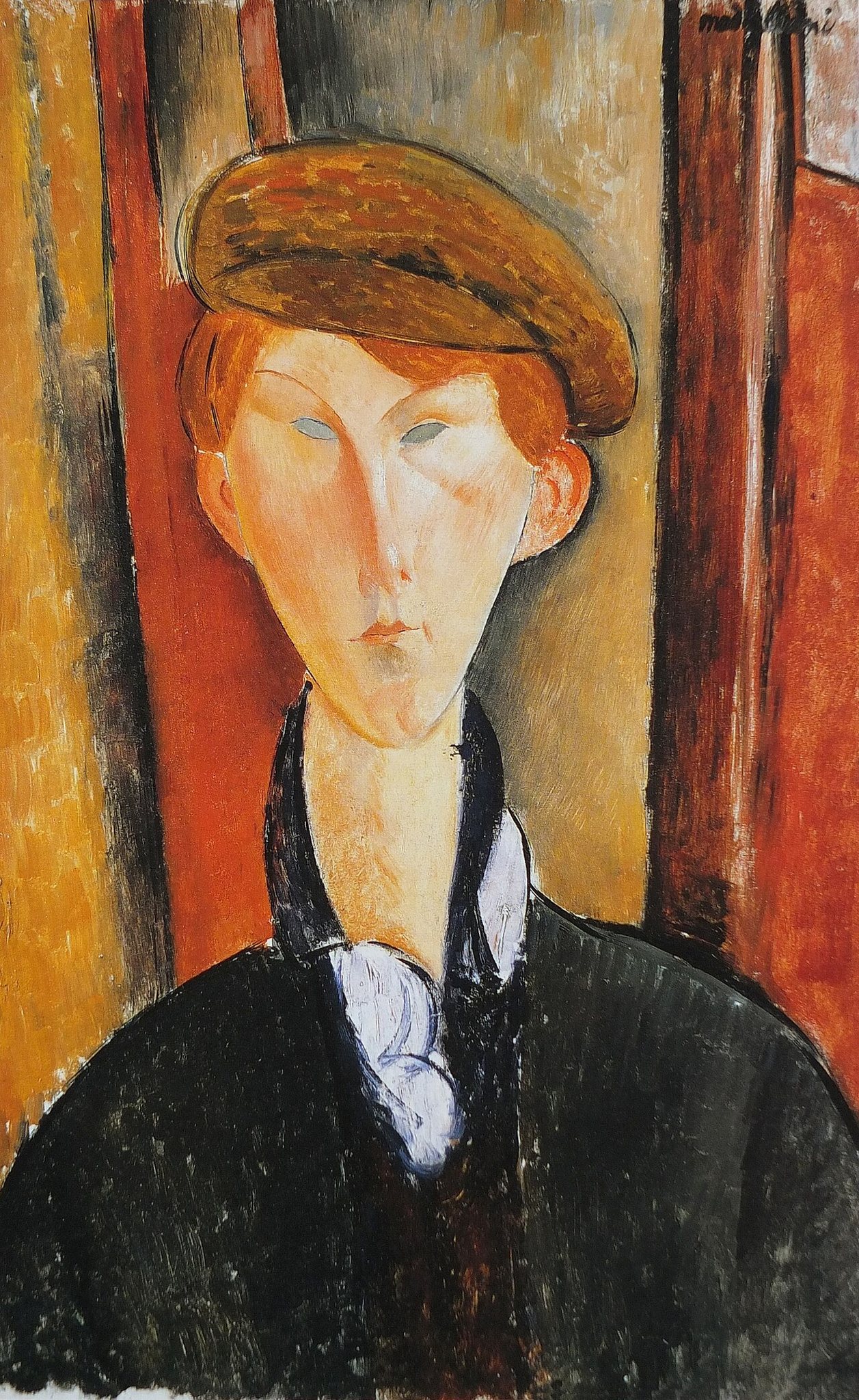
Young Man with a Cap is a canvas of 1919 in the Detroit Institute of Arts, under the number 70.185. A young man is seen head and shoulders in a soft ochre cap, a dark jacket and a white knotted scarf, against ochre and orange-red boards. With us it is made as a hand-painted copy, oil on canvas, to order, in eight sizes or in a size you give us; before dispatch we send you a photograph of the finished canvas.
| Title: | Young Man with a Cap |
| Other titles: | Jeune homme à la casquette — Boy with cap — Young boy, the catalogue titles |
| Painter: | Amedeo Modigliani (1884–1920) |
| Year of creation: | 1919 — the year the catalogues give; the museum dates it only to the early twentieth century |
| Original size (width × height): | 37.8 × 61 cm (14 7/8 × 24 in.), the museum’s unframed measurement |
| Original technique: | oil on canvas |
| Painting style: | expressionism, École de Paris |
| Located: | Detroit Institute of Arts (inv. 70.185, bequest of Robert H. Tannahill, not on view) |
| Our reproduction: | hand-painted copy, oil on canvas, eight sizes or a custom size |
Young Man with a Cap – Amedeo Modigliani
What is on the canvas?
A young man, head and shoulders, turned very slightly to our left and filling most of a narrow upright canvas. He wears a soft flat cap, mottled ochre and brown, set well back so the brim clears the forehead; reddish-blond hair shows under it at the temples and over the ears, which are large and pink. The face is long and pale cream-orange with a rose flush low on the cheeks, the nose is one long line with a dark edge, the mouth is small and closed and turns down a little, and the eyes are narrow grey-blue slits without pupils. The neck is long. Below it a dark, almost black jacket opens over a white scarf knotted at the throat and falling down the chest in one bright shape — the only real light in the picture. Behind him the wall is built of uprights: an ochre-yellow panel streaked with dark at the left, a strong orange-red band behind his shoulder, warm ochre behind the head, dark brown at the right. The signature is at the top right corner.
A museum that will not put a year on it
Under Artwork Date the Detroit record says, in full: early 20th century. No year, no circa, no range. The catalogues are readier — the 2002 Paris exhibition catalogue entered it as 1919, and that is the year we print — but the compilations themselves waver, offering 1916 to 1919 with a question mark. What is worth noticing is that the museum’s own subject tags include Nice, which is where Modigliani worked in 1918 and 1919; the tag narrows what the date field will not. We print 1919 and say where it comes from, and we print the museum’s refusal beside it, because a shop that quietly rounds a museum’s silence up to a year is not telling you what is known. The same run of southern portraits is on this shelf as Boy in Short Pants and The Boy.
The record of the original
The museum measures the canvas itself and the frame separately: unframed 24 × 14 7/8 in., which is 61 × 37.8 cm, and framed 78.6 × 55.6 × 7.3 cm. Medium oil on canvas, department of European modern art to 1970, credit line the bequest of Robert H. Tannahill, accession 70.185, copyright public domain, and — a plain fact the record states and we pass on — not on view. Pfannstiel’s catalogue prints 62 × 38 cm and calls the picture simply Young boy; that is 1.1 per cent from the museum’s shape, and we use the museum’s, since it measured the object. The canvas is signed modigliani at the upper right, the sixth work running on this shelf signed in that corner. The museum’s own pages answer automated readers with a refusal, and answer a made-up object slug with the same refusal, so the link above is registered against an archived copy of the museum’s page, which carries the title, medium, both measurements, the credit line, the accession and the provenance. The work also has its own Wikidata entry. The whole selection is in the Amedeo Modigliani gallery, and we have written a longer article about the painter.
Where has the picture been?
The museum lists three stations, and the first of them cannot be read literally. It gives G. J. Demotte of New York, with his dates, 1877 to 1923, and then has Robert H. Tannahill of Grosse Pointe Farms acquiring the picture in February 1932 — nine years after the man died. The catalogues supply what the museum’s line compresses: it was the Demotte Gallery in New York, which kept his name after him, that showed the painting in 1931 and sold it on. The same gallery appears on this shelf in the chain of Jeanne Seated with Her Arm on the Chair Back. The catalogues also add two earlier owners the museum does not carry, both with their own question marks: Bernheim-Jeune in Paris about 1929, and the collection of Louis Libaude, who is the first named owner of Flower Vendor as well. Bernheim-Jeune, Libaude, Demotte: the dealers and collectors of the École de Paris moved this picture from Paris to Michigan in about three years. Tannahill held it from 1932 until his death and left it to the museum in 1970; Art News had illustrated it on 20 February 1932, within weeks of his buying it.
How is our hand-painted version made?
A painter paints it, with a brush, in oil on canvas, to your order. Every canvas painting takes some weeks, and each copy comes out slightly its own; that is the consequence of a person working rather than a machine. The picture is warm all through except in one place, and the copyist has to keep that arrangement: ochre, orange-red and brown behind, cream and rose in the face, and then the jacket almost black and the scarf almost white. If the jacket is lightened the head stops sitting forward; if the scarf is greyed the picture loses its only accent. The cap is not one colour but a mottle of ochre over brown, laid on in short strokes, and it should stay broken. The eyes are slits and take no pupils. The ears are large on purpose. Before dispatch you receive a photograph of the finished canvas and approve it. It is never a print.
Which size for which wall?
For this motif we suggest 40 × 65 cm, which is close to the original’s own size — the canvas is 37.8 × 61 cm — and sits 0.69 per cent from its shape. The same 0.69 per cent belongs to 80 × 130 cm, which is the size to take when the wall needs presence, with 50 × 80 cm just behind at 0.86. It is a narrow upright picture and it hangs well in a narrow place: between two windows, beside a door, in the strip of wall at the end of a shelf. The ground is warm ochre and red, so it agrees with cream, with oak and with warm white, and it fights a cold grey-blue wall. A post-impressionist painting in a size that is not on the list is no trouble: we make it to order.
Frequently asked questions
Where is the original?
In the Detroit Institute of Arts, accession number 70.185, bequeathed by Robert H. Tannahill in 1970. The museum records it as not on view.
Who is the young man?
No record names him. The museum’s own tags place the picture in Nice, where Modigliani painted local sitters in his last years.
Why does the museum not give a year?
Because its date field says only early 20th century. The catalogues give 1919, which is the year we print, and we print the museum’s wording beside it.
How closely does it follow the original’s proportions?
The original measures 37.8 × 61 cm. The closest of our sizes is 40 x 65 cm, which departs from the original’s proportions by 0.69%.
- Subject: a young man in a soft ochre cap, dark jacket and white knotted scarf, against ochre and orange-red boards
- Original: 37.8 × 61 cm, oil on canvas, 1919, Detroit Institute of Arts, inv. 70.185
- Ours: hand-painted oil on canvas, eight sizes or a custom size, with a photograph to approve before dispatch
- Worth knowing: the museum dates the picture only to the early twentieth century, and its provenance names a dealer who had been dead nine years when the sale was made
The eyes on this canvas are painted without pupils. We counted all 76 Modigliani works on this shelf: 53 are like that, 17 are not – work by work.