







































Description
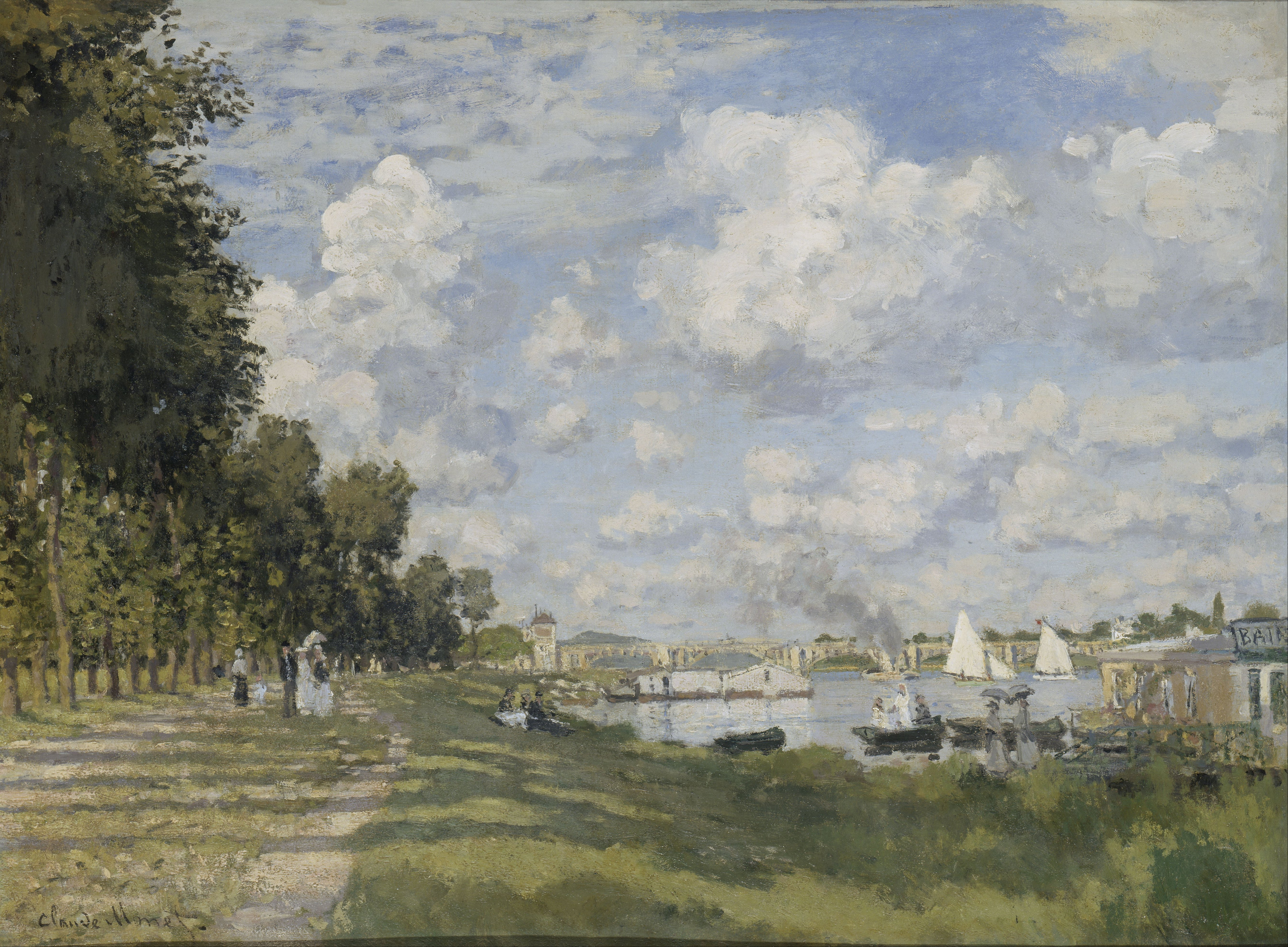
The Argenteuil Basin is an oil painting reproduction of a river scene the museum dates to around 1872: a shaded line of trees runs down beside the path to the water, figures with parasols walk along it, a wooden bathing house stands across the basin. The original measures 81 x 60 cm, is oil on canvas, and belongs to the Musée d’Orsay in Paris under inventory number RF 2010, where it arrived in 1911 with the bequest of Count Isaac de Camondo. We paint it in eight sizes or to your measure, with a photograph of the finished work for approval before dispatch.
| Title: | The Argenteuil Basin |
| Other titles: | Le Bassin d’Argenteuil · Das Becken von Argenteuil |
| Painter: | Claude Monet (1840–1926) |
| Year painted: | Around 1872 (the museum writes “vers 1872”, so approximate) |
| Original size: | 81 cm x 60 cm |
| Original technique: | Oil on canvas |
| Painting style: | Impressionism |
| Located at: | Musée d’Orsay, Paris (inv. no. RF 2010) |
| Our reproduction: | Hand-painted oil on canvas, eight sizes or to your measure |
The Argenteuil Basin – Claude Monet
What is on the canvas?
The canvas lies on its side and the sky takes almost the whole upper half: white cumulus over pale blue, breaking into flecks towards the right. Below it is the bank. Along the left edge stands a row of tall trees, the trunks lined up like columns, the crowns throwing broad bars of shadow across a sandy path. Small figures walk on it: two in light dresses with parasols, a darker one beside them. The grassy slope falls to the water, two figures sit on it, an empty dark boat at the edge. Right of centre a second boat carries people, one with a parasol, a low floating stage moored alongside. At the far right a wooden building stands over the water, BAINS half-readable on its white sign. Beyond the water, white sails, a low bridge on piers, a small tower and a factory chimney. At lower left is the signature “Claude Monet”.
Why does the sky take so much room?
Because the scene is about light on water, and that comes from above. Monet drops the horizon below a third of the height and gives the rest to the clouds. Bank, trees and bathing house are pressed into a single horizontal band that carries everything. The scene is calm as a result, although much small activity goes on in it — a walk, rowers, bathers, the bridge — and none of it asks for attention. Only the trees at the left edge reach the top, and that keeps the scene from drifting away.
What does the scene mean?
Argenteuil was a Sunday place: the train brought Parisians out, the river offered sailing, rowing and a bathing house. Monet came in 1871 and stayed until 1878, so this is the view from his own bank. Yet a factory chimney stands on the same canvas, and the bridge is new. The painter neither hides nor stresses them. An impressionist painting of these years often does exactly that: instead of a story it shows an afternoon in which leisure and industry share one bank.
Where did Monet stand?
On the left bank, on the walk under the trees, looking across the wide stretch of river they called the basin. That is why the row of trees is near enough for the bottom edge to cut it, the bathing house small and far off. The record gives no place of creation, only title, technique, measurements and acquisition, so we claim no more than the scene says: the painter was on the path, not the water.
What does the museum record say?
The Musée d’Orsay lists the work as Le Bassin d’Argenteuil, oil on canvas, RF 2010. It writes the date as “vers 1872” — around 1872, not firmly 1872. Our table puts width first, so we read 81 x 60 cm. That figure did not match the museum’s, but it matched one of our own sizes exactly, and has been corrected against the source. Wikidata also gives 80 cm; where the museum and a database disagree, the museum stands. The acquisition is recorded as the bequest of Count Isaac de Camondo, 1911.
The motif among the Monet works we sell
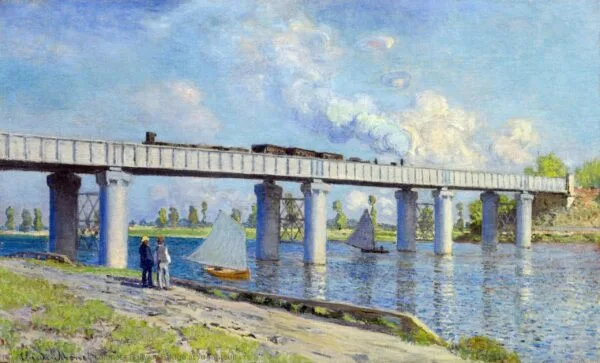
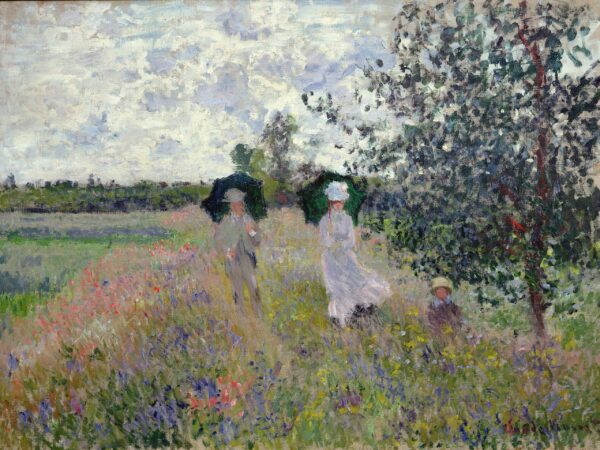
Mind the name: before ordering any Monet reproduction, note that the title Le Bassin d’Argenteuil belongs to several canvases that do not resemble one another. The National Gallery of Ireland in Dublin hangs one of 1874, 65 x 55 cm, which it calls Argenteuil Basin with a Single Sailboat: an autumn scene, golden orange foliage filling the right two thirds, one small sail at the far side. No trees in a row, no path, no bathing house, no bridge. The same is true at the RISD Museum, where sailing boats rest against dense woodland. Ours is the only one with the walk and the bathing house. Our other Monet subjects sit on the same reach: Boats at Rest at Petit-Gennevilliers shows moored boats close up, The Railway Bridge at Argenteuil and Bridge at Argenteuil the two structures that crossed it, and The Promenade near Argenteuil the same bank without the water. The crowded bathing place on the Seine near Bougival, painted in the summer of 1869 with boats, strollers and swimmers, is Bathers at La Grenouillère.
How is our hand-painted version made?
Each order is brushed in oil onto canvas stretched over a wooden bar, so what you buy is a hand-painted oil painting: nothing printed, nothing prepared in advance. Most of the work is in the sky and the shadows. The clouds must stay soft and go on in one breath or they harden, and the bars of shadow must be strong enough for the path to read as sunlit. The small figures come last, because too broad a stroke ages them. You still receive a photograph of your own canvas before dispatch: what you would not approve does not leave the workshop.
Which size for which wall?
Short answer: 80 x 60 cm above a chest of drawers, 100 x 75 cm above a sofa, 150 x 110 cm for a large empty wall. Eight sizes are made. 50 x 40 cm and 65 x 49 cm suit a hallway; 70 x 55 cm and 80 x 60 cm a chest of drawers or a guest bed; 90 x 70 cm and 100 x 75 cm a sofa; 120 x 90 cm and 150 x 110 cm a high wall or a dining room. Worth knowing: our 80 x 60 cm is a centimetre short of the original’s width. As a painting for living room walls this subject carries warm and cool light equally, blue sky and warm sand sitting in it together.
How high to hang the painting: the centre about 150 cm from the floor. Keep the low horizon below eye level, or the sky presses down and the path loses depth.
Custom size, stretcher bar and frame
If none of the eight sizes fits, we paint the work in the size you set — send us the width and the height and we will quote price and lead time. A custom size is the only way to get exactly 81 to 60. The canvas is stretched over a wooden bar and the edges are painted, so it needs no frame to look finished. A warm wooden moulding suits it and carries on the sandy path; a cool silver frame takes the summer out of it.
Delivery and guarantee
A canvas painting travels to sixteen countries of the European Union — among them Slovenia, Austria, Germany, Italy and Hungary — wrapped in protective film and firmly packed. Production takes 15 to 45 days, nearer the upper end at the largest size. You receive a photograph of the finished canvas before dispatch; if anything is wrong we put it right while the work is in the workshop. Other Monet subjects are in the Claude Monet gallery, and we write about how a painting is made on our blog.
If the painting is a gift and you are unsure of the size, there is a gift voucher: the recipient chooses the size and the subject.
Frequently asked questions
Where is the original?
In Paris, at the Musée d’Orsay, inv. RF 2010; it arrived in 1911 with the Camondo bequest.
Are there any people in the painting?
Yes, but none is named: walkers with parasols, two figures on the grass, a small party in the boat. The record names nobody, and neither do we.
What does the painting say in one sentence?
That a Sunday afternoon on the Seine can be a walk, a sail and a factory chimney at once.
Is the original for sale and what is it worth?
No. It has been in a French public collection since 1911, and we do not quote a value.
- Subject. A shaded row of trees along the path on the left bank of the Seine, walkers with parasols, an empty boat on the bank, the bathing house signed BAINS across the water, a bridge and a chimney behind.
- Original. Oil on canvas, 81 x 60 cm, around 1872; Musée d’Orsay, inv. no. RF 2010, bequest of Count Isaac de Camondo, 1911.
- Ours. Eight sizes from 50 x 40 to 150 x 110 cm or made to your measure; the 80 x 60 cm is one centimetre off the original.
- Worth knowing.