


Description
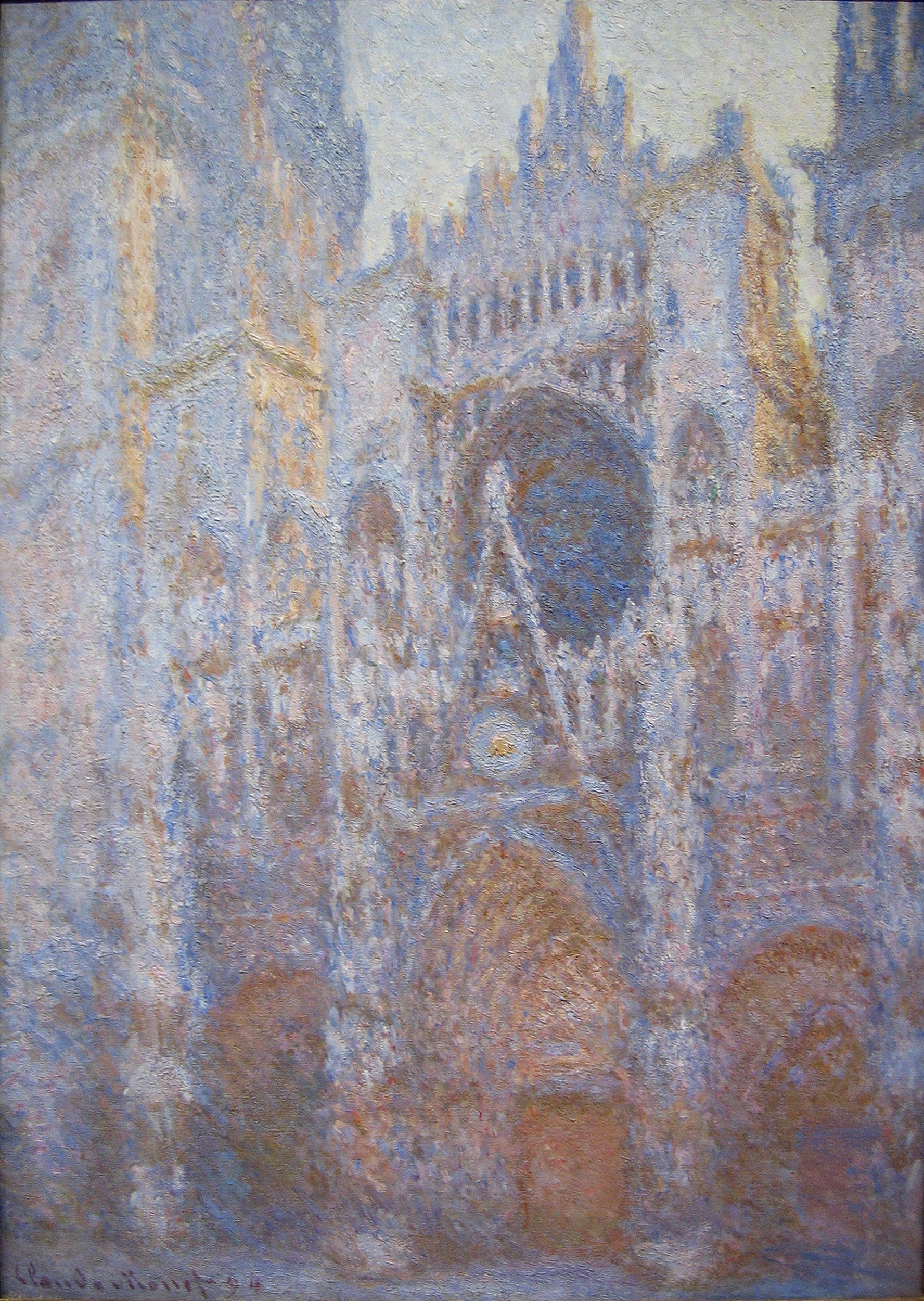
Rouen Cathedral, Portal is a hand-painted Monet reproduction of the canvas in the National Gallery of Art, Washington: the façade fills the whole height of the canvas and is turned slightly to the left, a dark round rose window hangs above the great portal with the point of the gable cutting across it, and of the sky only a band along the top edge is left. The original measures 65.9 x 100.1 cm, is oil on canvas and carries the accession number 1963.10.49. The museum dates it to 1894, and the signature at the lower left reads »Claude Monet 94«. We paint it in eight sizes or to your own measurement, with a photograph of the finished work for approval before dispatch.
| Title: | Rouen Cathedral, Portal |
| Other titles: | Rouen Cathedral, West Façade (the museum’s present name); Rouen Cathedral, Portal (the older name, which the Wikidata record Q17436687 also carries); in the Wildenstein catalogue the work is number 1351 |
| Painter: | Claude Monet (1840–1926) |
| Year painted: | 1894 per the museum record; the canvas is signed »Claude Monet 94«, which agrees |
| Original size: | 65.9 cm x 100.1 cm |
| Original technique: | Oil on canvas |
| Painting style: | Impressionism |
| Located at: | National Gallery of Art, Washington (inv. 1963.10.49) |
| Our reproduction: | Hand-painted oil on canvas, eight sizes or made to measure |
Rouen Cathedral, Portal – Claude Monet
What is on the canvas?
We look up at a church front that fills the whole height of this upright canvas. The wall is turned a little to the left, so the right-hand side falls back into depth. At the centre is the main entrance: a rectangular door inside stepped pointed arches that rise into a narrow, tall triangular gable.
The point of that gable overlaps the round rose window above it. The rose is dark, almost blue-grey, the darkest area on the canvas, and exactly as wide as the portal beneath it. Spires rise at either side and are cut off by the upper edge.
Of the sky only a band along the top edge is left, broken into dabs of white and pale blue. The stone is not grey: azure blue, peach, grey-violet and camel brown, separate strokes close up, a wall again as you step away.
One thing the museum record does not mention, and the canvas gives up easily: between the point of the gable and the crown of the great arch sits a small round window, a pale ring with a warm golden centre.
What is written on the canvas?
At the lower left, just above the edge, the signature stands in dark red-brown. It reads Claude Monet and then two digits, 94. No apostrophe before them, and no thousand.
The museum says the same, writing »lower left: Claude Monet 94« in its field for inscriptions. Transcription and canvas agree on the corner, the name and the year. That is not a given: on the neighbouring canvas in the same museum not even the corner agrees.
Why does this page say 1894 when it used to say 1893?
The museum’s page carries the year 1894 under the title.
The institution that holds the work comes before the database, and this time a third witness is on its side: the canvas. The signature ends in 94, not 93; the museum transcribes it that way and we read it that way. Two testimonies against one, so the table now says 1894.
What does the museum record say about the size?
The work is held by the National Gallery of Art in Washington under accession number 1963.10.49. It publishes the measurements as height by width, 100.1 x 65.9 cm; our table puts width first, hence 65.9 x 100.1 cm here. With the frame it gives 88.3 x 121.6 cm.
Two canvases the museum itself has swapped
The same museum holds a second Rouen façade, numbered 1963.10.179 and titled Rouen Cathedral, West Façade, Sunlight. It measures 100.1 x 65.8 cm, one millimetre narrower than ours, is also dated 1894, also came from the Chester Dale collection, and hangs in the same Gallery 80. Measurements cannot tell them apart.
That this is no theoretical danger the museum says itself, in its own bibliography. The 1980 exhibition catalogue printed the wrong plate under number 28, that of 1963.10.179. Its own European Paintings catalogue of 1985 printed the plate for 1963.10.49 with the entry for 1963.10.179 and the other way round. Both notes are the museum’s; neither is our reading.
Four things separate them, all four from the texts the museum publishes on both records under the heading “Visual Description”. Ours: signed lower left without an apostrophe, a dark rose window, a sky of white and pale blue dabs, no figures. The other: signed lower right with an apostrophe before the year, a rose window that is not dark, a sky of unbroken pale lapis blue, and a few tiny strokes near the lower left corner which the museum reads as small figures. Our photograph agrees with the first on all four.
Which of our Rouen cathedrals is which?
We sell six Rouen façades. Five are in Paris and this one in Washington, which is the quickest way to keep them apart.
In the Paris museum are Rouen Cathedral, Grey Weather under number RF 1999, 65.4 x 100.2 cm; Rouen Cathedral, Morning Sun under RF 2000, 63 x 92.2 cm; Rouen Cathedral, the Portal from the Front under RF 2779, 74 x 107 cm; Rouen Cathedral, the Portal and Saint-Romain Tower under RF 2001, 73.2 x 106.5 cm; and Rouen Cathedral, Portal and Tower Saint-Romain in Full Sunlight under RF 2002, 73.5 x 107 cm.
Go by the accession number and not by the title. In this series the titles repeat; the numbers do not.
Whose was it before it came to Washington?
The museum publishes a chain of owners and names the auction in it. The canvas passes from the painter to James F. Sutton (died 1915) in New York; his wife inherits it; it comes to the Sutton sale at the American Art Association in New York on 26 October 1933, as lot 58, where Wilbur L. Cummings of Greenwich, Connecticut buys it; in 1935 he sells it to Chester Dale (1882–1962) in New York; in 1963 the museum receives it under Dale’s bequest.
Four private owners, then, between the painter and the museum. It was first shown publicly in 1895 at Durand-Ruel in Paris, as number 20, and a year later at The American Art Galleries in New York, in a show titled Marvelous Paintings of Cathedral Rouen by Claude Monet; the museum notes that its catalogue number is uncertain.
How is our hand-painted version made?
Every order is painted individually by an artist, in oil on cotton or linen. That is how every canvas painting leaves us, with no print and no machine step. This oil painting reproduction is demanding in the stone: the wall must stay a mosaic of separate strokes, or the façade collapses into an even grey plane.
The second test is the rose window. It must stay the darkest point on the canvas, or the middle lightens and the building loses its weight. An impressionist painting will not take a high gloss, so ours is finished matt.
Which size for which wall?
Eight sizes run from 40 x 60 to 130 x 200 cm, and this time there is more than one answer. By size the closest is 70 x 110 cm, 4.1 cm wider and 9.9 cm taller than the canvas in Washington. By proportion the closest is 99 x 151 cm, at 1.5253 against 1.5190.
For a narrower wall there is 60 x 90 cm, for a stairwell 130 x 200 cm. As a painting for the office the subject works: it has neither a face nor a gaze demanding attention. All sizes are listed with the product in our Claude Monet gallery.
How high to hang the painting: centre about 150 cm above the floor, so the portal stays at eye level and the rose window above it.
Custom size, stretcher bar and frame
For a size not on the list, made to measure is the only route; send us the width and the height. A frame is not included; the museum’s own measures 88.3 x 121.6 cm, a good deal wider than the canvas.
Delivery and guarantee
Making it takes two to three weeks, a few days more at the largest sizes. If it arrives damaged or differs noticeably from the approved photograph, we replace it or refund the price. A hand-painted copy is not a factory product and small differences in the brushwork are to be expected; damage is not.
If the painting is a gift and you are unsure of the size, there is a voucher: the recipient chooses the size and the subject.
Frequently asked questions
Where is the original?
In Washington, at the National Gallery of Art, number 1963.10.49, Gallery 80 on the main floor of the West Building.
Which building does it show?
The west front of Rouen cathedral in Normandy, seen close up and cropped at the sides.
Why did Monet paint Rouen Cathedral so many times?
He was not after the building but the light on it. In 1892 and 1893 he painted the west façade about thirty times, at different hours and in different weather, working on several canvases at once and switching as the light changed. He finished them in his studio in 1894.
How many times did Monet paint Rouen Cathedral?
More than thirty times, in 1892 and 1893; 28 of the canvases show the west façade. He finished them in his studio in 1894 and chose twenty for the show at Durand-Ruel in Paris in May 1895.
How big is the original?
65.9 x 100.1 cm, oil on canvas: a tall upright format in which the façade fills the whole height.
- Subject. Rouen cathedral’s west front across the whole height of the canvas, a dark rose window, cut by the gable point, above the portal.
- Original. Oil on canvas, 65.9 x 100.1 cm, 1894; National Gallery of Art, Washington, accession 1963.10.49, signed at the lower left.
- Ours. Eight sizes; 70 x 110 cm is closest by size, 99 x 151 cm by proportion.
- Worth knowing. The same museum holds an almost identical canvas, one millimetre narrower, and once swapped the two plates in its own catalogue.