







































Description
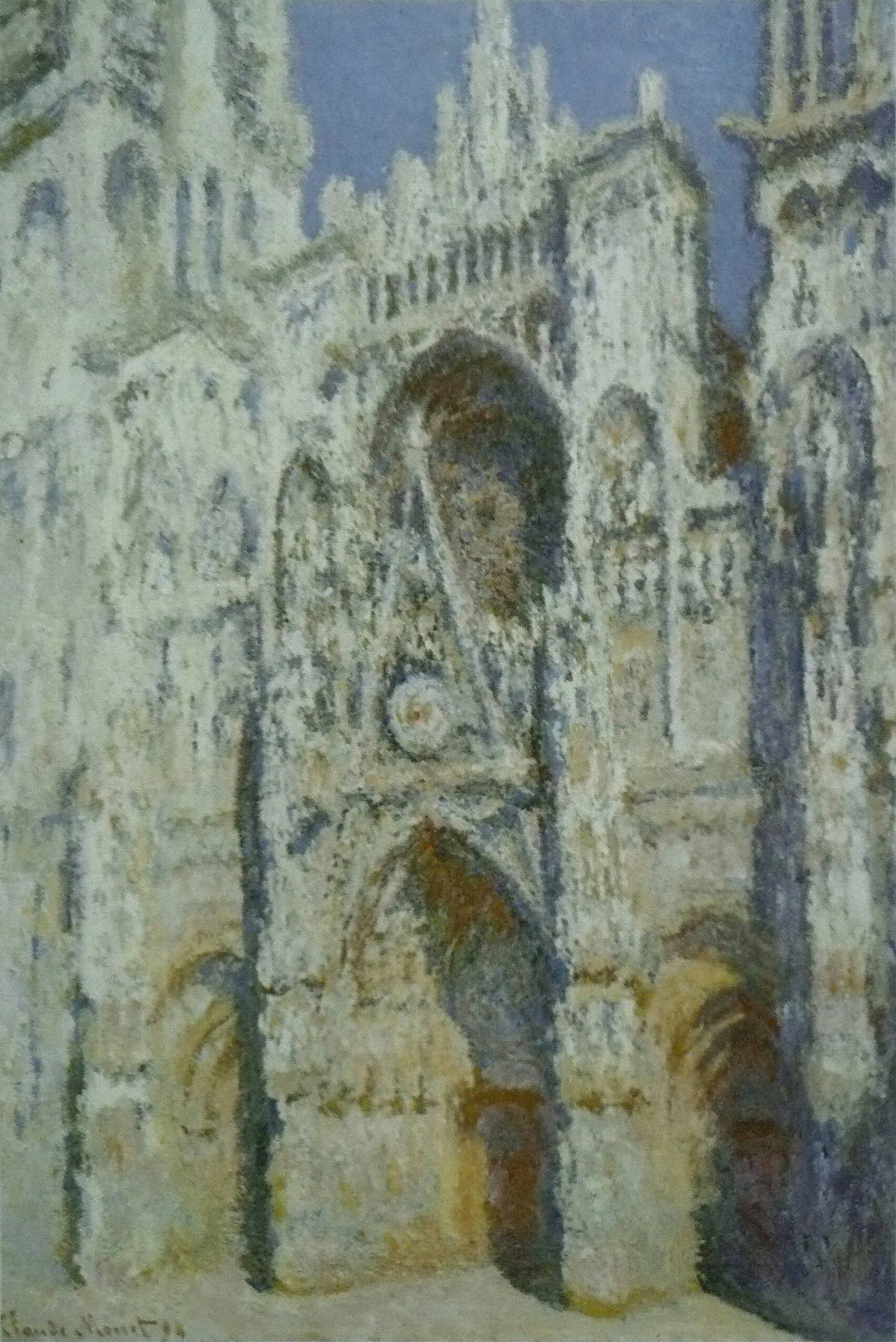
Rouen Cathedral, Portal and Tower Saint-Romain in Full Sunlight is a hand-painted Monet reproduction of the canvas in the Musée d’Orsay in Paris: the front is painted from close up and the stone reaches all four edges, deep blue sky shows only in the gaps at the top, and the centre is taken by the great portal with the dark rose window above it. The original measures 73.5 x 107 cm, is oil on canvas and carries the accession number RF 2002. The museum dates it to 1893, and the signature at the lower left reads »Claude Monet 94«. We paint it in eight sizes or to your own measurement, with a photograph of the finished work for approval before dispatch.
| Title: | Rouen Cathedral, Portal and Tower Saint-Romain in Full Sunlight |
| Other titles: | La Cathédrale de Rouen. Le Portail et la Tour Saint-Romain, plein soleil ; Harmonie bleue et or (the museum’s full name for it, with both parts); in the Wildenstein catalogue the work is number 1360 |
| Painter: | Claude Monet (1840–1926) |
| Year painted: | 1893 per the museum record, without reservation; the canvas is signed »Claude Monet 94«, so the two years differ |
| Original size: | 73.5 cm x 107 cm |
| Original technique: | Oil on canvas |
| Painting style: | Impressionism |
| Located at: | Musée d’Orsay, Paris (inv. RF 2002) |
| Our reproduction: | Hand-painted oil on canvas, eight sizes or made to measure |
Rouen Cathedral, Portal and Tower Saint-Romain in Full Sunlight – Claude Monet
What is on the canvas?
This is the midday hour. The stone is white, cream and gold, with cool blue-grey strokes in the hollows, and the sun strikes it so squarely that the tracery almost dissolves into light. Sky shows only in the gaps at the top, and there it is deep blue.
The centre of the lower half is the main portal: a deep pointed arch in blue-brown shadow with a warm ochre patch in its mouth. Above it a narrow triangular gable, whose point cuts across the dark rose window. Between that point and the crown of the arch sits a small round window, a pale ring with a darker centre.
At the left the Saint-Romain tower rises and is cut off by the upper edge; at the right a second mass with arcading and another, darker arch in warm brown. Along the bottom runs a pale ochre band of ground, and there are no figures.
We say so because the difference matters.
What is written on the canvas?
At the lower left, across the pale stone at the foot, the signature stands in dark olive strokes: Claude Monet, and then two digits, 94.
The museum’s own plate reads the same, and the signature there is just as clear. So the question here is not whether the signature is there, but what to do with it, because it does not agree with the museum’s year.
Why does the table say 1893 when the canvas says 94?
Because they are two sources and they diverge. The museum dates the work to 1893, without reservation and without a span, and that year goes in the table because the institution holding the work comes first. The canvas’s year is the painter’s, and it is recorded here.
This is not an isolated case, and we counted it. On Morning Sun RF 2000 we record none. Why the years diverge we do not claim; the museum’s record does not say.
What does the museum record say about the size?
The work is held by the Musée d’Orsay in Paris under accession number RF 2002. It publishes the measurements as height then width, 107 and 73.5 cm; our table puts width first, so you read 73.5 x 107 cm here. With the frame it gives 119.8 and 86.5 cm.
The museum publishes no chain of owners, only the mode of acquisition: bequest of Count Isaac de Camondo, 1911. A single line is not a chain, so it gets no section of its own here; inventing the rest would be worse than not having it.
Harmonie bleue et or, and what the second half of the title means
The museum’s name for the work has two parts, divided by a semicolon. The first says what is on the canvas and in what light: the portal and the Saint-Romain tower, in full sunlight. The second names the colour: Harmonie bleue et or, a harmony of blue and gold.
A second part like that is not ornament; it recurs across this series. The companion canvas in the same museum carries Harmonie blanche, white harmony, and is the morning one. Our table gives the full name with both parts because that is the museum’s; our product title renders the first part.
Two canvases from one bequest, and we sell both
The museum holds a second Rouen front extraordinarily close to ours: RF 2001 measures 73.2 x 106.5 cm against our 73.5 x 10⁷, three millimetres in width and five in height. Both are dated 1893, both came in with the same Camondo bequest of 1911, and both carry a 94 signature. By the numbers they can hardly be separated.
By eye they can, and the difference is distance. On the museum’s plate of RF 2001 the painter stood further back and further left: the tower’s left edge cuts sharply against a pale, empty sky filling the whole left band, and a low street house with a dark roof and a blue front stands at its foot. Our canvas has neither – the stone runs to the left edge, with no sky at the side and no house. Ours is pressed against the front; the other stands a step back.
And one more difference the museum states itself: our second part is plein soleil, full sunlight, the other’s effet du matin, morning effect. Rouen Cathedral, the Portal and Saint-Romain Tower is that second canvas here.
Which of our Rouen cathedrals is which?
We sell six Rouen fronts, five in Paris and one in Washington. Besides the pair above, the Paris museum holds Rouen Cathedral, Grey Weather under number RF 1999, 65.4 x 100.2 cm; Rouen Cathedral, Morning Sun under RF 2000, 63 x 92.2 cm; and Rouen Cathedral, the Portal from the Front under RF 2779, 74 x 107 cm.
The sixth is held by the National Gallery of Art in Washington: Rouen Cathedral, Portal under number 1963.10.49, 65.9 x 100.1 cm. It is the only one of the six where the museum’s year and the canvas agree, because that museum dates it to 1894. Go by the accession number, not the title.
How is our hand-painted version made?
Every order is painted individually by an artist, in oil on cotton or linen. That is how every canvas painting leaves us, with no print and no machine step. This oil painting reproduction is demanding in its light: the white stone must stay built of separate strokes, or the front becomes a smooth white wall and the midday goes out of it.
The second test is the shadow. The blue-grey hollows must stay cool beside the warm stone, or the canvas tips into an even yellow. An impressionist painting will not take a high gloss, so ours is finished matt.
Which size for which wall?
Eight sizes run from 38 x 55 to 120 x 170 cm. By size the closest is 70 x 100 cm, 3.5 cm narrower and 7 cm shorter. By proportion the closest is the smallest, 38 x 55 cm at 1.4474 against 1.4558; among the larger ones 90 x 130 cm at 1.4444.
For a large wall there is 120 x 170 cm. As a painting for the office the subject works: it is bright and does not press itself on you. All sizes are listed with the product in our Claude Monet gallery.
How high to hang the painting: centre about 150 cm above the floor, so the portal stays at eye level and the rose window above it.
Custom size, stretcher bar and frame
For a size not on the list, made to measure is the only route; send us the width and the height. A frame is not included; the museum’s own measures 86.5 x 119.8 cm, a good deal wider than the canvas.
Delivery and guarantee
Making it takes two to three weeks, a few days more at the largest sizes. If it arrives damaged or differs noticeably from the approved photograph, we replace it or refund the price. A hand-painted copy is not a factory product and small differences in the brushwork are expected; damage is not.
If the painting is a gift and you are unsure of the size, there is a voucher: the recipient chooses the size and the subject.
Frequently asked questions
Where is the original?
In Paris, at the Musée d’Orsay, under accession number RF 2002.
Which building does it show?
The west front of Rouen cathedral in Normandy, close up, at midday.
How many times did Monet paint Rouen Cathedral?
More than thirty times, in 1892 and 1893; 28 of the canvases show the west façade. He finished them in his studio in 1894 and chose twenty for the show at Durand-Ruel in Paris in May 1895.
Why did Monet paint Rouen Cathedral so many times?
He was not after the building but the light on it. In 1892 and 1893 he painted the west façade about thirty times, at different hours and in different weather, working on several canvases at once and switching as the light changed. He finished them in his studio in 1894.
- Subject. The Rouen front at midday, stone to all four edges, deep blue sky only in the gaps at the top, the portal in shadow and the dark rose window above it.
- Original. Oil on canvas, 73.5 x 107 cm; the museum says 1893, the canvas says 94; Musée d’Orsay, Paris, inv. RF 2002, Camondo bequest 1911.
- Ours. Eight sizes; 70 x 100 cm is closest by size, 90 x 130 cm by proportion among the large ones.
- Worth knowing. The museum holds an almost identical canvas, three millimetres narrower, from the same bequest and year; what separates them is the distance the painter stood at.