


Description
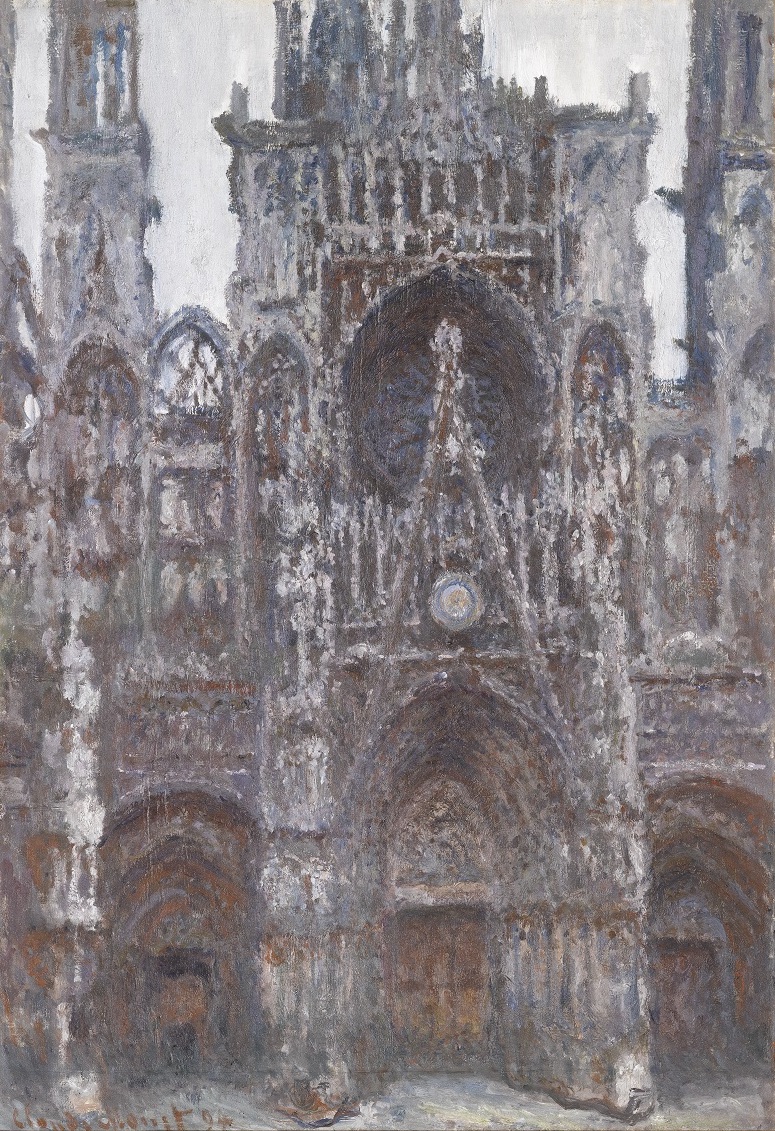
Rouen Cathedral, the Portal from the Front is a hand-painted reproduction of one of Monet’s views of the Rouen façade: the front fills the canvas edge to edge, the deeply recessed portal opens below, a pale round rose window stands above it, and of the sky only two narrow strips remain in the upper corners. The original measures 74 x 107 cm, is oil on canvas and is held by the Musée d’Orsay in Paris under accession number RF 2779. The museum dates it to 1892, without reservation. We paint it in eight sizes or to your own, with a photograph of the finished work for approval before despatch.
| Title: | Rouen Cathedral, the Portal from the Front |
| Other titles: | La Cathédrale de Rouen. Le Portail vu de face ; Harmonie brune (the name in the museum record, with both parts) |
| Painter: | Claude Monet (1840–1926) |
| Year painted: | 1892 by the museum record; the canvas reads “Claude Monet 94” |
| Original size: | 74 cm x 107 cm |
| Original technique: | Oil on canvas |
| Painting style: | Impressionism, a series |
| Located at: | Musée d’Orsay, Paris (acc. no. RF 2779) |
| Our reproduction: | Hand-painted oil on canvas, eight sizes or made to measure |
Rouen Cathedral, the Portal from the Front – Claude Monet
What is on the canvas?
The façade and nothing else. It reaches all four edges, and of the sky only two narrow triangles remain in the upper corners. At the bottom centre the great portal opens: a pointed arch set deep into the wall, with a series of receding arches one behind another and a dark door at the back. Above the main arch hangs a pale round rose window, and above that rises the pierced gable with stone flowers. The colours are greyish violet in the upper half, warm brown and brick in the portals below. The paint is thick and grainy, so the surface of the canvas is almost as rough as the stone it shows. There are no figures. At the lower left a signature is written in a reddish colour.
What does “Harmonie brune” mean?
It is the second part of the name the museum itself gives the work. Its record reads “La Cathédrale de Rouen. Le Portail vu de face ; Harmonie brune” — two names separated by the museum’s own semicolon: the first says what is painted and from where, the second in what key of colour. All five Rouen cathedrals this museum holds carry such a second part: harmonie brune, harmonie grise, harmonie bleue, harmonie blanche and harmonie bleue et or. That second part is what tells the canvases apart, which is why we print it in the table beside the first.
How is the work dated, and what does the canvas say?
The museum dates it to 1892, with no range and no cautious “around”, so we give the year without reservation. The canvas itself says something else: at the lower left, in a reddish colour, a signature we read as “Claude Monet 94”. The museum record lists no inscription — the field is empty — so the reading is ours, from the museum’s own photograph, and not a transcription from the record. We publish both facts, each with its source: the year is the museum’s, the signature comes from the photograph.
What does the museum record say about the size?
The work is held by the Musée d’Orsay under accession number RF 2779. It gives the measurements in the order height by width, 107 x 74 cm; our table puts the width first, so here you read 74 x 107 cm. With its frame the whole measures 87 x 120 cm. For this work Wikidata agrees with the museum in everything — the year and both measurements — which we note deliberately, because on neighbouring works of this series it did not.
How did the work reach the museum?
In a single line, and the line is the museum’s: “Achat a Claude Monet, 1907” — bought directly from Claude Monet in 1907, fifteen years after the canvas was made and nineteen before the painter died. That sets it apart from the other four Rouen cathedrals in the same collection, which came with the bequest of Count Isaac de Camondo in 1911. The museum publishes no longer chain of owners for this canvas, so we assemble none either.
Five Rouen cathedrals in one museum, and why size cannot tell them apart
The Musée d’Orsay holds five canvases from the series. Ours is RF 2779, 74 x 107 cm. Beside it stand RF 1999 “temps gris ; harmonie grise”, 65.4 x 100.2 cm; RF 2000 “soleil matinal ; harmonie bleue”, 63 x 92.2 cm; RF 2001 “le Portail et la Tour Saint-Romain, effet du matin ; harmonie blanche”, 73.2 x 106.5 cm; and RF 2002 “plein soleil ; harmonie bleue et or”, 73.5 x 107 cm. That last is five millimetres from ours in width and nothing at all in height — by size, then, they cannot be separated. The museum’s own name separates them: ours is the portal “from the front”, that one is the portal and the Saint-Romain tower.
Which of our Rouen canvases is this?
The one the museum calls harmonie brune, and the one it bought from the painter. The Claude Monet gallery carries five more views of the same façade, each with its own key of colour or its own hour: Rouen Cathedral, Morning Sun; Rouen Cathedral, Grey Weather; Rouen Cathedral, the Portal and Saint-Romain Tower; Rouen Cathedral, Portal and Tower Saint-Romain in Full Sunlight; and Rouen Cathedral, Portal. They are close in proportion and not in colour, which is the point of them.
How is our hand-painted version made?
Every order is painted individually by a painter, in oils on cotton or linen canvas. A canvas painting is made here with no print, no transfer and no machine step in between. This motif is demanding because of the paint itself: the stone here is not drawn but built up in thick layers, and if the painter smooths them the façade turns papery. The colour is therefore laid in coats left to dry part way, so that the next one stays on top. Every hand-painted oil painting that leaves our workshop is a little its own. Before despatch you receive a photograph of the finished work for approval.
Which size for which wall?
Eight sizes are available, from 38 x 55 to 120 x 170 cm. By size the closest to the original is 70 x 100 cm: four centimetres narrower and seven shorter. By proportion the smallest and the third largest are almost identical to it — 38 x 55 cm and 90 x 130 cm differ from the original’s proportion by less than a thousandth. So if you want the right proportion at a large size, the choice is 90 x 130 cm and not 100 x 150 cm, which is bigger but more elongated. The scene is tall and narrow, so it fills a narrow wall. In a hallway 60 x 90 cm works; as a painting for living room walls, 90 x 130 cm.
How high to hang the painting: the centre about 145 cm above the floor, and above furniture the lower edge 20 to 30 cm above it. We write more about hanging on our blog.
Made to measure, stretcher and frame
If you want the proportion of the original exactly, or its true size, made to measure is the only route: send us the width and the height in centimetres. The canvas can be stretched on a wooden stretcher and delivered ready to hang, or we can send it rolled in a tube. The frame is not included in the price. A narrow frame in muted gold or dark wood suits this scene and does not compete with the stone. The museum keeps its own original in a frame with which the whole measures 87 x 120 cm.
Delivery and guarantee
Making the work normally takes two to three weeks, a few days longer at the largest sizes, because the oil has to dry between layers. If the work arrives damaged, or differs noticeably from the approved photograph, we replace it or refund the price. A hand-painted copy is not a factory product and small differences in the stroke are to be expected; damage or the wrong motif are not. We deliver within the European Union.
If the painting is a gift and you are unsure of the size, there is a gift voucher: the recipient chooses the size and the subject.
Frequently asked questions
Where is the original?
In Paris, at the Musée d’Orsay, under accession number RF 2779. The museum bought it in 1907 directly from Claude Monet.
What year is the work from?
The museum gives 1892, without reservation, and so do we.
Why did Monet paint Rouen Cathedral so many times?
He was not after the building but the light on it. In 1892 and 1893 he painted the west façade about thirty times, at different hours and in different weather, working on several canvases at once and switching as the light changed. He finished them in his studio in 1894.
How many times did Monet paint Rouen Cathedral?
More than thirty times, in 1892 and 1893; 28 of the canvases show the west façade. He finished them in his studio in 1894 and chose twenty for the show at Durand-Ruel in Paris in May 1895.
- Motif. The Rouen façade edge to edge, the deeply recessed portal below, a pale rose window above it; greyish violet at the top, warm brown in the portals.
- Original. Oil on canvas, 74 x 107 cm, dated by the museum to 1892; Musée d’Orsay, acc. no. RF 2779, bought from the painter in 1907.
- Ours. Eight sizes; 70 x 100 cm is closest by size, 38 x 55 and 90 x 130 cm by proportion.
- Worth knowing. The museum holds five canvases of the series; RF 2002 is five millimetres from ours in width and nothing in height, so size does not separate them.