













Description
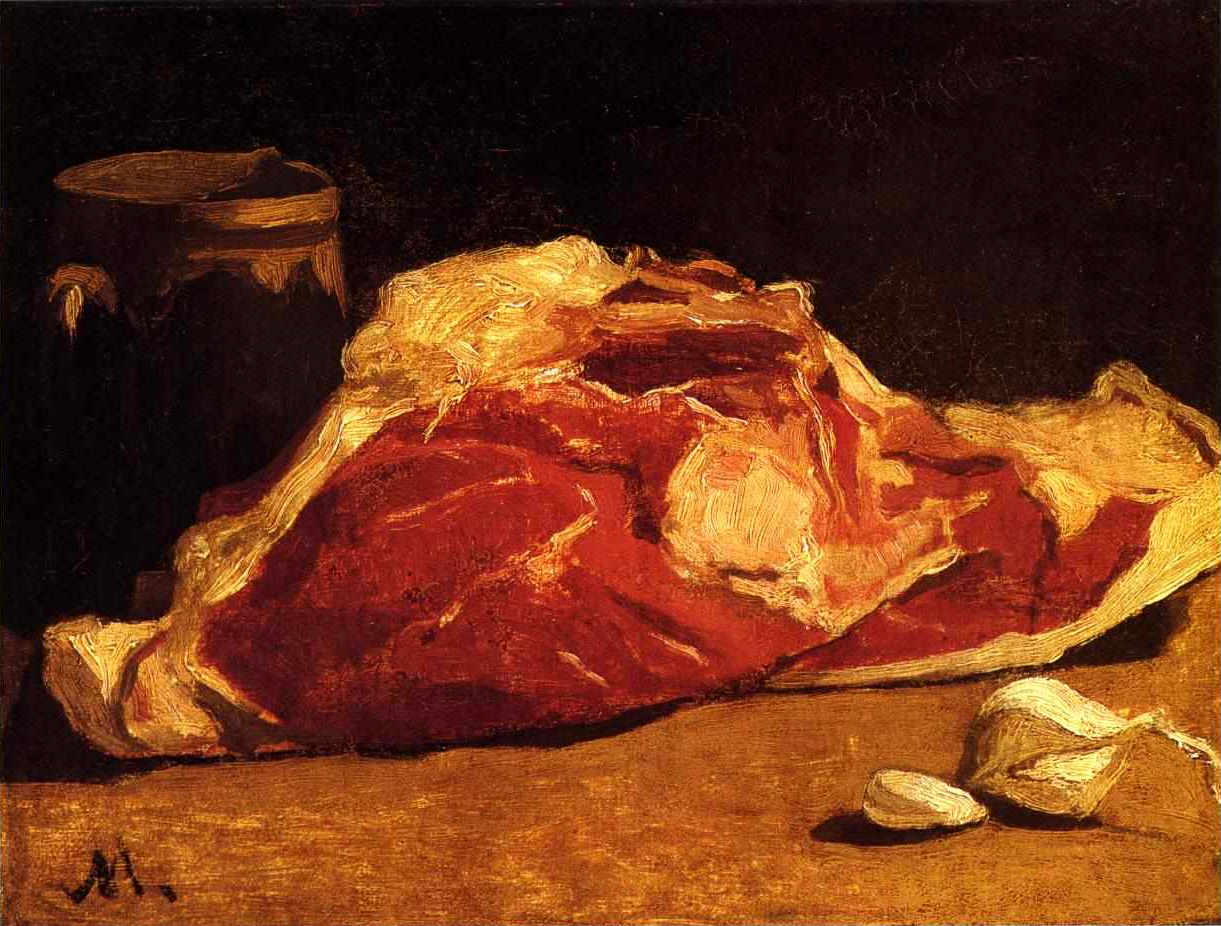
Still Life with Meat is a hand-painted reproduction of an early scene by Monet: a large piece of beef lies on white paper opened out on a table, a dark earthenware jar stands behind it at the left, and two cloves of garlic lie on the table at the lower right. The original measures 33 x 24 cm, is oil on canvas and is held by the Musée d’Orsay in Paris under accession number RF 1675. The museum dates it cautiously, “vers 1864”, that is around 1864. We paint it in eight sizes or to your own, with a photograph of the finished work for approval before despatch.
| Title: | Still Life with Meat |
| Other titles: | Nature morte : le quartier de viande (the name in the museum record) |
| Painter: | Claude Monet (1840–1926) |
| Year painted: | Around 1864; the museum gives “vers 1864” and not a single year |
| Original size: | 33 cm x 24 cm |
| Original technique: | Oil on canvas |
| Painting style: | Early work, before Impressionism |
| Located at: | Musée d’Orsay, Paris (acc. no. RF 1675) |
| Our reproduction: | Hand-painted oil on canvas, eight sizes or made to measure |
Still Life with Meat – Claude Monet
What is on the canvas?
The centre is taken by a large piece of beef laid on white paper that is opened out across the table and creases upward at its edges. The meat is dark red, edged along the top by white fat and rind, and towards the right a pale pink cut surface opens. Behind it at the left stands an earthenware jar with a dark glaze; the light catches only its mouth and one flank. At the lower right two cloves of garlic lie on the table, the only bright notes in that part of the scene. The table is ochre brown and plain, the ground behind almost black. At the lower left a monogram is written in a dark colour.
How is the work dated?
The museum dates it “vers 1864”, which is a cautious “around”. Here the usual case is reversed: Wikidata gives 1864 as an exact year, without reservation, and the museum is the more cautious of the two. Where a database and a museum part company we follow the museum, which holds the work and measures it itself. On other works by Monet that we sell it went the other way.
What does the museum record say about the size?
The work is held by the Musée d’Orsay under accession number RF 1675. It gives the measurements in the order height by width, 24 x 33 cm; our table puts the width first, so here you read 33 x 24 cm. For this canvas the museum publishes no framed measurement, as it does for some others, so we give none. The size agrees with Wikidata to the whole centimetre.
How did the work reach the museum?
In a single line, and the line is the museum’s: “Donation Etienne Moreau-Nelaton, 1906” — the gift of Étienne Moreau-Nélaton, 1906. The record says no more than that: no earlier owner, no sale, no exhibition. The museum publishes no longer chain for this canvas, so we assemble none either.
A monogram instead of a signature
The canvas carries no full signature. The museum record lists no inscription on the canvas — the field is empty, which is not unusual at this museum. On the museum’s own photograph, however, a small dark monogram can be made out at the lower left, on the table top itself: a capital M with a short stroke after it. No year stands beside it. We say it the way we came to it: the monogram is seen on the photograph, not transcribed from the record.
Two early still lifes in one collection
The Musée d’Orsay’s collection holds a second early still life by Monet, and the two are easy to tell apart. Ours is RF 1675: landscape format, 33 cm wide against 24 high. The other is Nature morte au faisan, numbered MNR 637, upright format at 62.5 x 76 cm, and the museum dates it just as cautiously, “vers 1861”. On it a dead pheasant lies on a carved table top, a glass of red wine stands behind it and a wicker basket at the right. The museum does not keep it in Paris: it gives the musée des Beaux-Arts in Rouen as its location, so the two canvases do not hang together.
Why does this not look like a Monet?
Because it is early, and because it is painted differently. The paint is dense and opaque, the colours are mixed on the palette and laid in broad areas, the ground is evenly dark, and the shadows are brown rather than blue. None of what Monet is recognised by later — the broken stroke, the coloured shadow, light eating into the contour — is on this canvas. The museum dates it to around 1864 and its other early still life to around 1861, and both are dark in the same way.
How is our hand-painted version made?
Every order is painted individually by a painter, in oils on cotton or linen canvas. A canvas painting is made here with no print, no transfer and no machine step in between. This motif is demanding because of the meat: its red has to stay substance and must not become a flat area, so it is built in glazes with the layer beneath showing through. The white fat and the creased paper are the opposite task — they must be laid on thickly and in one stroke, or they lose their edge. Every hand-painted oil painting that leaves our workshop is a little its own. Before despatch you receive a photograph of the finished work for approval.
The museum record lists no inscription. A small monogram with a capital M can be made out at the lower left of the photograph, with no year; we see that on the photograph, we do not transcribe it from the record.
Which size for which wall?
Here something holds that does not hold for most works by Monet: the original is smaller than every size we offer. At 33 x 24 cm it is a table-top canvas, and our smallest size of 53 x 38 cm already exceeds it by twenty centimetres in width. Every version of ours is therefore an enlargement, and with this motif that is an advantage — at a larger size the meat and the creased paper break back into the separate strokes they were painted with. By proportion 90 x 65 cm is the closest. For a dining room or kitchen 70 x 50 cm works well; as a painting for living room walls, 120 x 90 cm. Related motifs are in the Claude Monet gallery: Apples and Grapes, Bazille and Camille, The Green Wave and The Luncheon.
How high to hang the painting: the centre about 145 cm above the floor, and above furniture the lower edge 20 to 30 cm above it. We write more about hanging on our blog.
Made to measure, stretcher and frame
If you want the proportion of the original exactly, or its true size, made to measure is the only route: send us the width and the height in centimetres. The canvas can be stretched on a wooden stretcher and delivered ready to hang, or we can send it rolled in a tube. The frame is not included in the price. A dark wooden or muted gold frame suits this scene and holds up the dark ground. For this canvas the museum publishes no framed measurement, so we claim nothing about its frame.
Delivery and guarantee
Making the work normally takes two to three weeks, a few days longer at the largest sizes, because the oil has to dry between layers. If the work arrives damaged, or differs noticeably from the approved photograph, we replace it or refund the price. A hand-painted copy is not a factory product and small differences in the stroke are to be expected; damage or the wrong motif are not. We deliver within the European Union.
If the painting is a gift and you are unsure of the size, there is a gift voucher: the recipient chooses the size and the subject.
Frequently asked questions
Where is the original?
In Paris, at the Musée d’Orsay, under accession number RF 1675, where it arrived in 1906 as the gift of Étienne Moreau-Nélaton.
What year is the work from?
The museum gives “around 1864” and not a single year.
What does the work say in one sentence?
That Monet began in the dense, dark painting of the old masters, and that the light he is known for was won rather than inherited.
Why did the young Monet paint still lifes?
In the early 1860s still lifes sold well to Paris dealers and collectors, because the 18th-century painter Chardin was back in fashion. This piece of meat is one of Monet’s first food paintings, done in the dark, sober manner of the old masters.
- Motif. A large piece of beef on white paper opened out, a dark earthenware jar behind it at the left, two cloves of garlic at the lower right; the ground almost black.
- Original. Oil on canvas, 33 x 24 cm, dated by the museum to “around 1864”; Musée d’Orsay, acc. no. RF 1675, Moreau-Nélaton gift 1906.
- Ours. Eight sizes, every one larger than the original; by proportion 90 x 65 cm is closest to it.
- Worth knowing. The same collection holds a second early still life, MNR 637 with a dead pheasant, dated just as cautiously — but kept in Rouen, not in Paris.