










Description
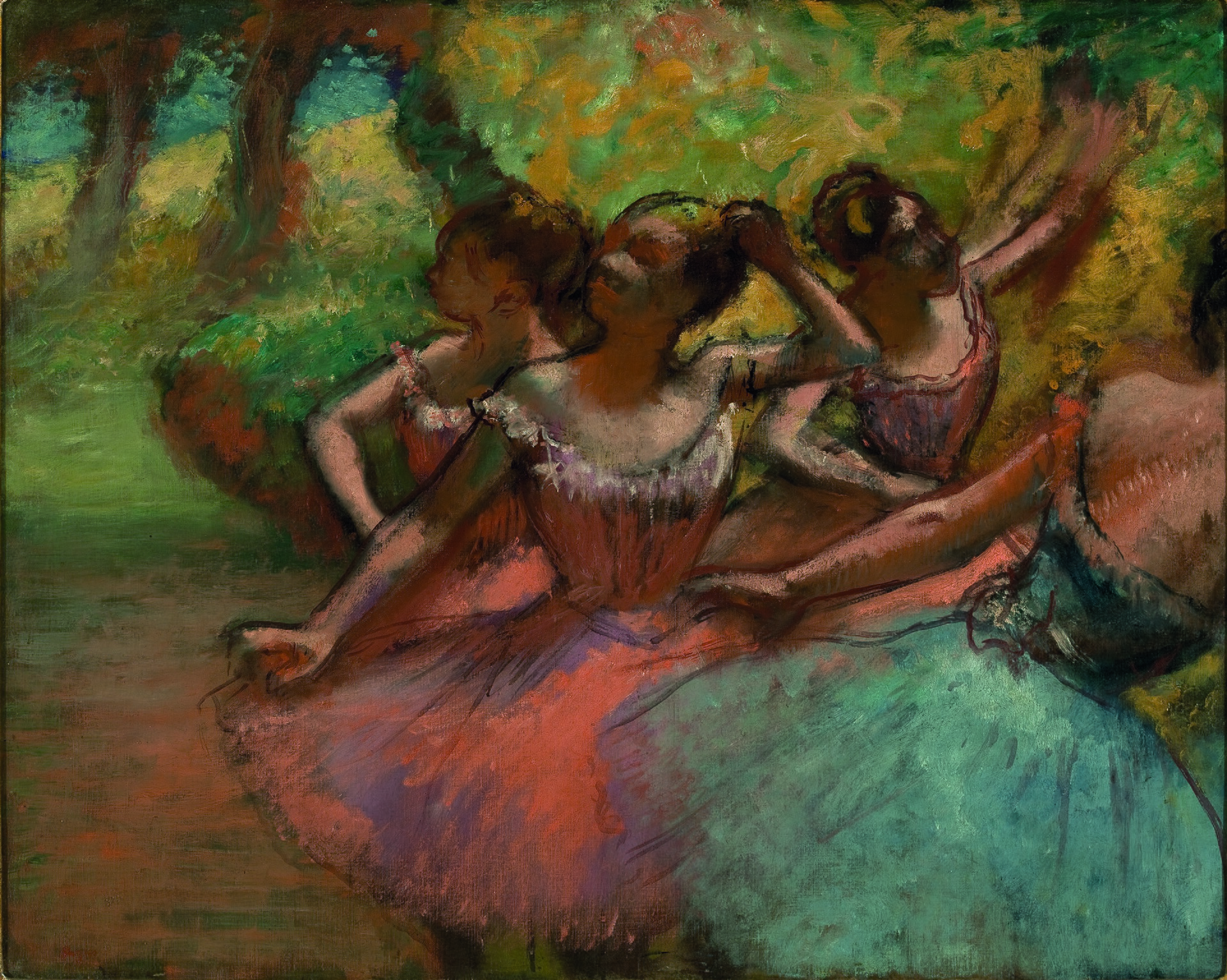
Four Ballerinas on Stage crowds four dancers into the right two thirds of the canvas, seen close to, with the one at the far right cut by the edge. All lean and bend to the left with outstretched arms, so the bodies form a diagonal from the lower left towards the upper right. The skirts are red and violet on the one in front, turquoise green on the one at the right and pale violet on the third; the bodices are red-orange, purple and yellow-green; the hair is reddish brown, pinned high and dressed with pale flowers. The left third is stage scenery — green and yellow foliage, the trunk of a tree, a blue-green opening at the upper left — and at the lower left the floor is dark olive green. The colour is laid on thick and very freely, almost as pastel, and it carries the picture more than the drawing does. The original is 92 x 73 cm, dated 1885-90, and it hangs in the São Paulo Museum of Art under inventory number MASP.00082. We make it by hand, in seven sizes from 50 x 40 to 150 x 110 cm or to your own measurement, and before dispatch you receive a photograph of the finished work for approval.
| Title: | Four Ballerinas on Stage |
| Other titles: | Quatro bailarinas em cena (the museum’s title), Quatre danseuses en scène (décor de paysage) |
| Painter: | Edgar Degas (1834–1917) |
| Year: | 1885-90 (studio-sale stamp at the lower left, not a signature) |
| Size of the original: | 92 cm x 73 cm |
| Technique of the original: | oil on canvas |
| Painting style: | impressionism |
| Where the original hangs: | São Paulo Museum of Art (inventory MASP.00082), a gift of 1950; catalogue Schulman MS 2125, Lemoisne IV-1123 |
| Our version: | hand-painted oil on linen, 7 sizes from 50 x 40 cm to 150 x 110 cm, custom size on request |
Four Ballerinas on Stage – Edgar Degas
What is happening in the scene?
Four dancers are packed into the right two thirds of the canvas, close enough that the one at the far right is cut in half by the edge. All of them lean and bend the same way, to the left, with arms outstretched, so that the bodies read as one diagonal running from the lower left towards the upper right. The left third is not a room but a painted set: green and yellow foliage, a tree trunk, a blue-green opening at the top. That is a landscape backdrop, which is why the catalogue title adds décor de paysage. There is no audience, no orchestra pit and no floor beyond a band of dark olive at the lower left. Everything is on stage and nothing else is.
How is it painted?
In colour rather than in line, and the museum is specific about how. On the arm of the central dancer, the shadow is made with blue marks; the purple patches on the tutu let the pink stand out and gain more light by contrast; and part of one face is green, which blurs the expression and pushes the gesture forward instead. That last decision is the key to the picture: the faces are deliberately not the subject. The paint is thick and very free, closer to pastel than to a finished oil, and the museum notes that Degas disliked painting out of doors, preferred to study the movement of the human figure and of animals, and was a pioneer in using what photography could show him.
Why is the date argued about?
Because two good sources are fifteen years apart, and the reason is on the record. The museum dates the work 1885-90; the Schulman catalogue gives circa 1900. The museum’s catalogue explains its earlier date: Camesasca, in 1987, traced each of the four figures to other poses, noted a rare gap in the Lemoisne catalogue concerning works related to this one, and concluded that dancer compositions framed this closely can be dated not from about 1890, as had been thought, but from at least five years earlier. We follow the museum that owns the picture, and we say here what the catalogue says, rather than quietly picking one.
What does the scene mean?
Not movement, but the instant movement stops. The museum’s catalogue makes the point sharply: what prevails in these figures is the suspension of the body, the emptying-out of its dynamism, which puts them nearer to French classicism — to Poussin — than to any modern interest in motion. A second reading in the same catalogue calls the composition a kind of whirlpool that throws the blue dancer out of the canvas, in the purest Ukiyo-e manner. As a canvas painting it is therefore both calm and strongly patterned, and because the colour is high — red, violet, turquoise, yellow-green — it makes vivid wall art for a living room or a stairwell rather than a quiet accent. Our reproduction is built around the freedom of the paint, which is the whole picture.
From the Barnes Foundation to São Paulo
Degas kept this canvas; the mark at its lower left is the studio-sale stamp, not a signature. It went into the Degas atelier sale in Paris in 1918 as number 113, and was bought by the dealer Jacques Seligmann. At the Seligmann sale at the American Art Association in New York on 27 January 1921 it was lot 46, and from there it entered the Barnes Foundation at Merion, Pennsylvania. It reached Brazil next, and the museum’s acquisition line is the most unusual on this shelf: a gift of 1950 from Walther Moreira Salles, Simone Pilon, Jacques Pilon, Benedito Manhães Barreto, a coffee broker in Santos whom the record does not name, the Jute Industrialists of São Paulo, and Diários Associados de São Paulo. A newspaper group, a jute trade association and an anonymous coffee broker bought a Degas for a museum that was three years old.
The motif among Degas’s works
Two dance works of ours stand beside it: Blue Dancers, which crowds its figures the same way, and The Dance Class, which shows the rehearsal room rather than the stage. The third link is not about dancing at all: Madame René De Gas passed through the hands of the same dealer and was sold in the very same New York auction on 27 January 1921, as lot 51 to this canvas’s lot 46. The original is in the São Paulo Museum of Art, which records it as Quatro bailarinas em cena, 1885-90, oil painted on canvas, 73 x 92 x 2.5 cm, MASP.00082, and the Schulman catalogue lists it as MS 2125, Lemoisne IV-1123, with the Vente Degas stamp at the lower left.
How is our hand-painted version made?
With a brush and oil paint, in the same technique as the original, as an oil on canvas. The hardest part is restraint. Paint laid on this freely looks easy and is not: every mark has to be right first time, because a stroke corrected twice turns to mud and the whole effect of the picture is that nothing was corrected. The second hard part is the colour logic the museum describes — blue in the shadow of an arm, green across part of a face — which a copyist’s instinct wants to tidy into flesh tones. Those marks stay. The third is the diagonal: four bodies leaning the same way must keep exactly the same angle, or the group stops being one movement and becomes four people. No two versions are quite alike; each hand-painted copy is its own. For this motif we have no photographs of our finished canvases yet, because we have not painted it before, so none are shown here and none are described. A photograph of your own canvas comes to you before dispatch.
Which size for which wall?
If you are undecided: 100 x 80 cm. The original is 92 cm wide and 73 cm high, a ratio of 1.26, and 100 x 80 cm gives 1.25 — the closest of the seven, and also the nearest in scale, 8 cm wider and 7 cm taller than the canvas itself. 50 x 40 cm has the same ratio in a small format, for a narrow wall or a shelf. 70 x 50, 80 x 60 and 90 x 60 cm suit a chest of drawers or a desk, but 90 x 60 cm is the one to avoid if the proportion matters: at 1.50 it is the furthest of the seven from the original, and on this composition it crops the foliage and the raised arms noticeably. At 120 x 90 and 150 x 110 cm a large painting of this kind is where the free brushwork does its best work, since the marks are meant to be read as marks; give it distance and a wall of its own. Measure your chosen size on the wall first with a paper cut-out. None is held in stock: every piece is made to order.
Custom size, frame and stretcher
If none of the seven fits, we paint to your measurement and keep the ratio of 1.26 and the width of the scenery at the left, since the empty third is what makes the crowded two thirds work; that is our work made to order. Every piece ships stretched on a wooden stretcher, ready to hang. For the frame use our 3D application: it shows every moulding we carry — gold, silver, black, white and natural wood — and serves the choice of frame and nothing else. How it behaves on your own wall is shown by our separate service, placement in the room.
Delivery and guarantee
Every piece is made to order in our workshop in Slovenia; allow 15-45 days depending on the size, at the largest sizes usually at the upper end. It travels stretched and protected for transport, framed if you chose a frame, to sixteen countries in the European Union, without customs. Before dispatch you receive a photograph of the finished work for approval, and our returns arrangement applies to every order. The whole range is in the Edgar Degas gallery, and his life is described in our article on Edgar Degas.
Frequently asked questions
What work is this?
A late dance picture by Degas, recorded by the São Paulo Museum of Art as Quatro bailarinas em cena, 1885-90. It measures 92 x 73 cm and its inventory number is MASP.00082.
Is the painting signed?
No. The catalogue records a Vente Degas stamp at the lower left — the mark of the studio sale held after his death — not a signature. On this canvas the stamp is at the left, not the right.
When was it painted?
The museum says 1885-90; the Schulman catalogue says circa 1900. We follow the museum, and the museum publishes its reasoning: a 1987 study placed compositions framed this closely at least five years earlier than had been assumed.
Why is part of a face green?
Because Degas put it there. The museum’s own note says the green blurs the expression and so brings the gesture forward; it is a decision about what the picture is about, not an accident of light.
What is behind the dancers?
Painted scenery: foliage, a tree trunk and a blue-green opening. The catalogue title records it as a landscape set, which is why the work is also listed as Quatre danseuses en scène (décor de paysage).
How big is the original?
92 cm wide and 73 cm high. The museum also gives the depth, 2.5 cm, which is the thickness of the stretched canvas rather than a frame measurement.
How did a Degas reach Brazil?
Through the Barnes Foundation in Pennsylvania, and then as a gift in 1950 from a group that included a newspaper company, the Jute Industrialists of São Paulo and an unnamed coffee broker in Santos.
Which of your sizes matches the original?
100 x 80 cm, on both counts: the ratio is 1.25 against the original’s 1.26, and the size is within a few centimetres of the canvas Degas painted.
Which size should I avoid if I want the original proportion?
90 x 60 cm. At 1.50 it is the furthest of the seven from 1.26, and here it crops the foliage and the raised arms.
Is this a print?
No. The work is made by hand in oil on linen; on this motif the brushstrokes are unusually visible and tangible, because the original is painted that way on purpose.
Is it suitable as a gift?
Yes — it is the most colourful Degas we sell, and it reads from across a room. Since every piece is made to order, allow for the making time; if you would rather leave the choice to the recipient, there is our gift voucher.
- Motif: four dancers crowded into two thirds of the canvas, leaning as one diagonal against a painted landscape set
- Original: Edgar Degas, 1885-90, oil painting, 92 x 73 cm, São Paulo Museum of Art (MASP.00082)
- Our version: hand-painted in oil, seven sizes from 50 x 40 to 150 x 110 cm; 100 x 80 cm matches both the ratio and nearly the scale
- Worth knowing: it belonged to the Barnes Foundation before a group of São Paulo donors gave it to the museum in 1950