





















Description
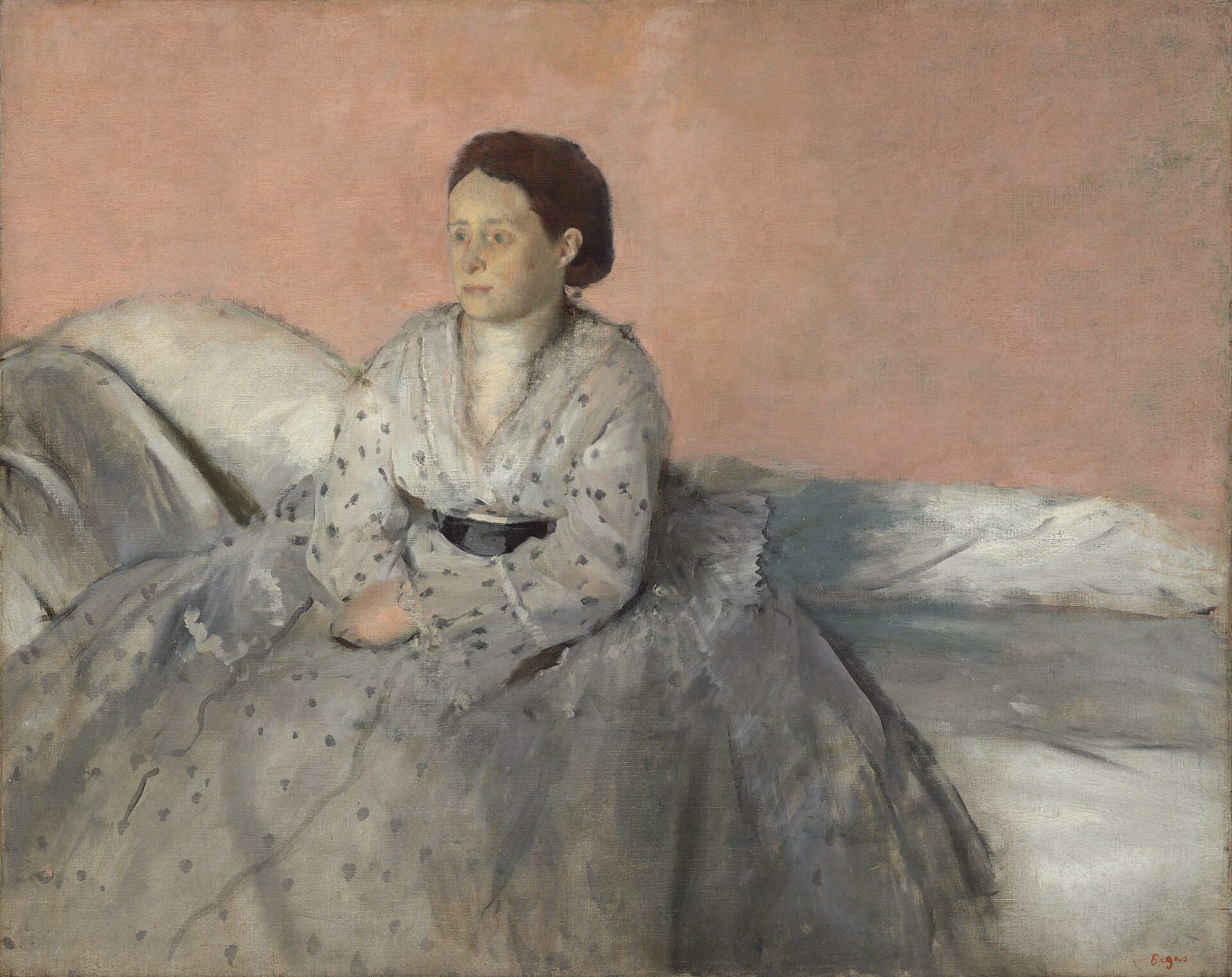
Madame René De Gas is a portrait of a woman who was going blind, painted by a man who had just learned that his own sight was failing. She sits at the centre of a pale couch and looks towards us, her head turned a little to her right, the chestnut hair combed back over the ears; the face is pale and quiet, and the gaze does not quite settle on the viewer. She wears a loose white dress strewn with small dark floral marks, wide sleeves and white lace at the throat and wrists, closed at the waist by a dark band, and the skirt spreads across the whole lower half of the canvas in a soft grey. Behind her is a smooth pink wall, undivided. Grey and pink carry the whole picture and there is almost no other colour. The original is 92 x 72.9 cm, painted in 1872/1873, and it hangs in the National Gallery of Art in Washington under accession 1963.10.124. The mark at the lower right is not a signature but the atelier stamp. We make it by hand, in seven sizes from 50 x 40 to 150 x 110 cm or to your own measurement, and before dispatch you receive a photograph of the finished work for approval.
| Title: | Madame René De Gas |
| Other titles: | Renée Degas [Estelle] (the catalogue’s title), Portrait d’une jeune femme en robe de mousseline blanche |
| Painter: | Edgar Degas (1834–1917) |
| Year: | 1872/1873 (atelier stamp at the lower right, not a signature) |
| Size of the original: | 92 cm x 72.9 cm |
| Technique of the original: | oil on canvas |
| Painting style: | impressionism |
| Where the original hangs: | National Gallery of Art, Washington (accession 1963.10.124), Chester Dale Collection; catalogue Schulman MS 1946, Lemoisne I-313 |
| Our version: | hand-painted oil on linen, 7 sizes from 50 x 40 cm to 150 x 110 cm, custom size on request |
Madame René De Gas – Edgar Degas
Who is the woman?
The museum names her: Estelle Musson Balfour de Gas, the artist’s first cousin and his sister-in-law, married to his brother René. The picture was painted during Degas’s visit to New Orleans in 1872-1873, where his mother’s family lived. The catalogue lists the work under her own first name — Renée Degas [Estelle] — and under a description of her dress, Portrait d’une jeune femme en robe de mousseline blanche. She sits at the centre of a pale couch, her head turned a little to her right, and looks towards us without quite meeting us.
What is on the canvas?
Almost nothing but a woman and a wall. The chestnut hair is combed back over the ears. The dress is loose white muslin strewn with small dark floral marks, with wide sleeves and white lace at the throat and wrists, closed at the waist by a dark band; the skirt spreads across the whole lower half of the canvas in a soft grey. One hand rests in her lap. Behind her a smooth pink wall runs unbroken from edge to edge — no window, no picture, no doorway. At the left the bolster and back of the couch rise; at the right its surface runs off the edge. Grey and pink carry everything, and there is almost no other colour in the picture at all.
Why is she painted this way?
Because she was losing her sight, and so was he. The museum states it plainly: the discovery in 1871 that his own vision was deteriorating made Degas alert to Estelle’s near-blindness when he visited the following year. It also says what he did about it. Posture, gesture and accessories were his usual way of characterising a sitter, and here those details were deliberately omitted. The soft focus, the subdued and nearly monochromatic colour and her unfocused gaze, in the museum’s own reading, parallel her limited sight and show the painter’s respect and his understanding of her situation. So the emptiness a first look might read as unfinished is the subject: this is what it is to be painted by someone who has understood how you see.
What does the scene mean?
That a portrait can be about attention rather than appearance. As a canvas painting it is quiet to the point of severity — one figure, one wall, two colours — and it rewards being lived with rather than glanced at. Because grey and pink are soft and warm, it makes calm wall art for a bedroom, a hallway or a reading corner, where its restraint is an advantage rather than a lack. Among Degas’s portraits it is the tenderest, and among his works of the 1870s it is the one furthest from the theatre and the racecourse. Our reproduction is built around the two things that make it work: the softness of the edges and the exact pink of that wall.
From the studio sale to Chester Dale
Degas kept this portrait; it was still his when he died. It went into the Degas atelier sale at the Galerie Georges Petit in Paris on 6-8 May 1918 as number 97, where it was bought by the dealer Jacques Seligmann (1858-1923) for his own private collection. At the Seligmann sale at the American Art Galleries in New York on 27 January 1921 it was number 51, and was bought by M. Knoedler & Co. of London, New York and Paris. Knoedler sold it in 1921 to Henry D. Hughes of Philadelphia; it was later on consignment with the Marie Sterner Galleries, and on 10 November 1928 sold to Chester Dale (1882-1962) of New York. Dale left it to the National Gallery of Art, which received it as a bequest in 1963 and still credits it to the Chester Dale Collection. The catalogue describes that last step as a gift rather than a bequest; we follow the museum.
The motif among Degas’s works
Three works we sell stand close to this one. Portrait in a New Orleans Cotton Office comes from the same visit of 1872-1873 and shows the other side of that stay: the family business instead of the family. Edmondo and Thérèse Morbilli is a portrait of his sister Thérèse and her husband, and it hangs in the same museum under the very next accession number, from the same Chester Dale collection. The Bellelli Family is the earliest and largest of his family portraits. The original is in the National Gallery of Art, Washington, which records it as Madame René de Gas, 1872/1873, oil painted on canvas, overall 72.9 x 92 cm, accession 1963.10.124, and the Schulman catalogue lists it as MS 1946, Lemoisne I-313, with the Vente Degas stamp at the lower right.
How is our hand-painted version made?
With a brush and oil paint, in the same technique as the original, as an oil on canvas. The hardest part is the softness. Every edge in this picture — the line of the shoulder, the hair against the wall, the hem of the sleeve — is slightly out of focus, and that has to be painted rather than smudged: the form is drawn correctly first and then softened, because an edge that was never firm reads as a mistake. The second hard part is the pink wall, a single unbroken field across the top half; it must stay even without going dead, which means many thin passes rather than one thick one. The third is the face, where the gaze must stay unfocused without becoming vacant — the difference is a few millimetres at the eyelid. No two versions are quite alike; each hand-painted copy is its own. For this motif we have no photographs of our finished canvases yet, because we have not painted it before, so none are shown here and none are described. A photograph of your own canvas comes to you before dispatch.
Which size for which wall?
If you are undecided: 100 x 80 cm. The original is 92 cm wide and 72.9 cm high, a ratio of 1.26, and 100 x 80 cm gives 1.25 — the closest of the seven and a difference nobody sees on a wall. It is also nearest the original in scale: 8 cm wider and 7 cm taller, so the head reads at close to life size. 50 x 40 cm matches the same ratio in a small format, for a narrow wall or a shelf. 70 x 50, 80 x 60 and 90 x 60 cm suit a chest of drawers or a desk, though 90 x 60 cm at 1.50 departs furthest from the original and crops tighter above the head. At 120 x 90 and 150 x 110 cm a large painting of this kind wants distance and a wall of its own; at 150 cm the figure is well beyond life size. Measure your chosen size on the wall first with a paper cut-out. None is held in stock: every piece is made to order.
Custom size, frame and stretcher
If none of the seven fits, we paint to your measurement and keep the ratio of 1.26 and the height of that pink wall above her head, since the space above the figure is what makes the picture quiet; that is our work made to order. Every piece ships stretched on a wooden stretcher, ready to hang. For the frame use our 3D application: it shows every moulding we carry — gold, silver, black, white and natural wood — and serves the choice of frame and nothing else. How it behaves on your own wall is shown by our separate service, placement in the room.
Delivery and guarantee
Every piece is made to order in our workshop in Slovenia; allow 15-45 days depending on the size, at the largest sizes usually at the upper end. It travels stretched and protected for transport, framed if you chose a frame, to sixteen countries in the European Union, without customs. Before dispatch you receive a photograph of the finished work for approval, and our returns arrangement applies to every order. The whole range is in the Edgar Degas gallery, and his life is described in our article on Edgar Degas.
Frequently asked questions
Who is the sitter?
Estelle Musson Balfour de Gas, the painter’s first cousin and sister-in-law, married to his brother René. The museum names her.
Is the painting signed?
No. The museum records the mark at the lower right as an atelier stamp reading Degas — applied at the studio sale after his death — and the catalogue records the same. It is not a signature, and we do not call it one.
Is it true that she was going blind?
Yes, and the museum says so: it describes Estelle’s near-blindness and connects it to the picture’s soft focus, its nearly monochromatic colour and her unfocused gaze. It also notes that Degas had discovered the deterioration of his own vision the year before.
When was it painted?
1872/1873, during Degas’s visit to New Orleans. That is the museum’s dating; the Schulman catalogue gives circa 1872, and we follow the institution that owns the picture.
Why is there so little in the picture?
Because the detail was left out on purpose. The museum notes that Degas normally used posture, gesture and accessories to characterise a sitter, and that here such details were deliberately omitted — which is itself part of the portrait.
How big is the original?
92 cm wide and 72.9 cm high. With its frame the museum gives 119.7 x 100.3 cm, so allow for that if you order a framed version at full size.
Who was Chester Dale?
The New York collector who bought the painting in 1928 and left it to the National Gallery of Art; the museum received it in 1963 and still credits it to the Chester Dale Collection.
Which of your sizes matches the original?
100 x 80 cm, on both counts: the ratio is 1.25 against the original’s 1.26, and the size is within a few centimetres of the canvas Degas painted.
Which size should I avoid if I want the original proportion?
90 x 60 cm. At 1.50 it is the furthest of the seven from the original’s 1.26, and the scene sits noticeably tighter above the head.
Is this a print?
No. The work is made by hand in oil on linen; the brushstrokes are visible and can be felt, though on this motif they are deliberately soft rather than sharp.
Is it suitable as a gift?
Yes, particularly for someone who likes portraits that are calm rather than showy, and it comes with a story worth telling. Since every piece is made to order, allow for the making time; if you would rather leave the choice to the recipient, there is our gift voucher.
- Motif: Estelle Musson de Gas, the painter’s sister-in-law, seated against a plain pink wall
- Original: Edgar Degas, 1872/1873, oil painting, 92 x 72.9 cm, National Gallery of Art, Washington (1963.10.124)
- Our version: hand-painted in oil, seven sizes from 50 x 40 to 150 x 110 cm; 100 x 80 cm matches both the ratio and nearly the scale
- Worth knowing: the sitter was nearly blind, and Degas had discovered his own failing eyesight the year before