






Description
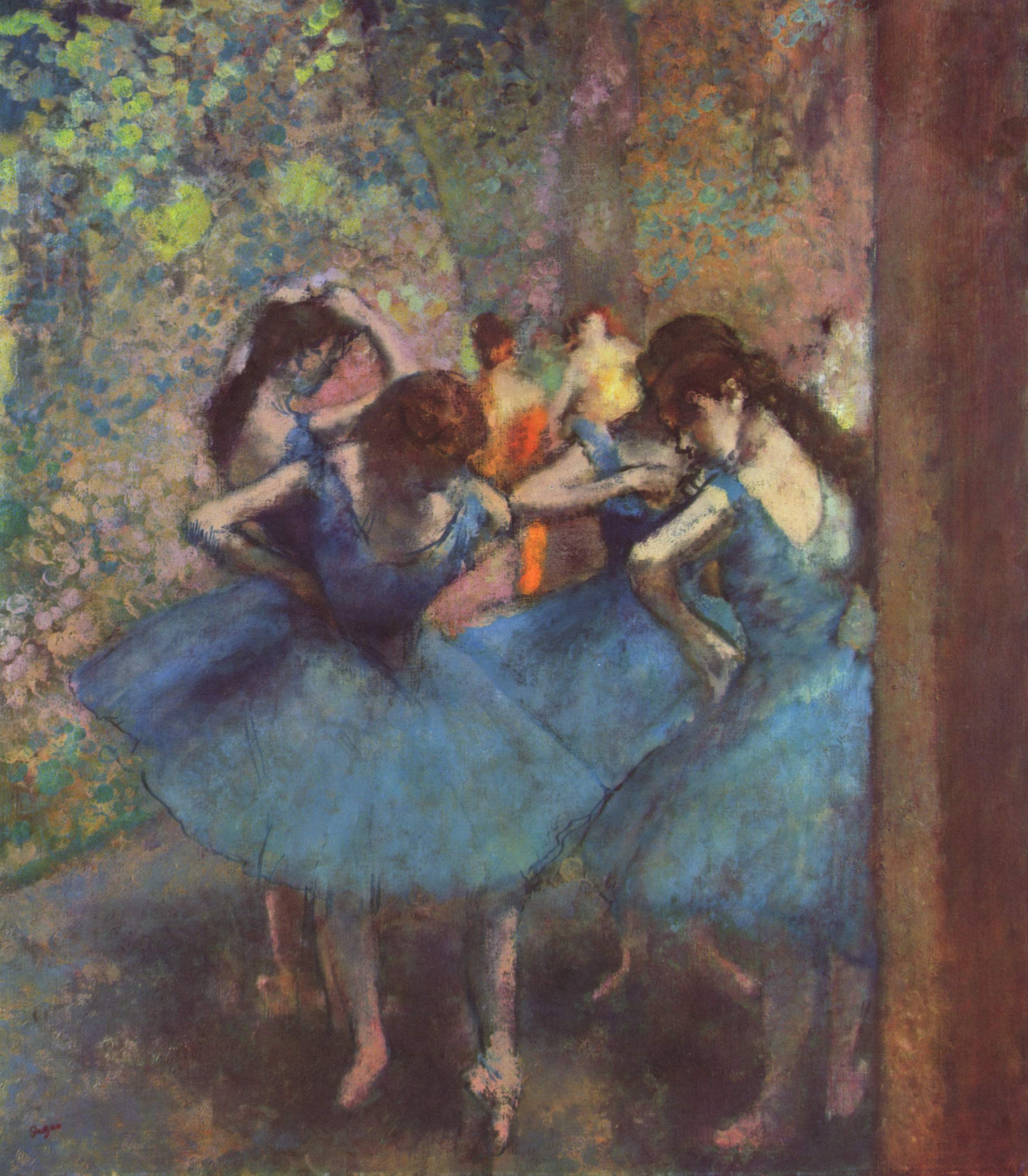
Blue Dancers shows a group of dancers in blue skirts standing close together just before going on. One raises both arms to her hair, another adjusts a strap, a third leans forward; the faces are barely indicated and the bodies overlap until they read as a single movement. The skirts are painted in dense blue and greenish layers that dissolve into light towards the edges, and among them an orange sash on a figure at the back is the only warm colour in the scene. The background is not a room but an agitated plane of green and yellow dots, a painted stage flat of foliage; at the right a dark brown vertical pillar closes the canvas. The original measures 75.3 x 85.3 cm, was made about 1890, and is held by the Musée d’Orsay in Paris under inventory number RF 1951 10. Ours is painted by hand in eight sizes from 60 x 70 to 150 x 170 cm or to your own measurement, and you receive a photograph of the finished work for approval before it ships.
| Title: | Blue Dancers |
| Other titles: | Danseuses bleues |
| Painter: | Edgar Degas (1834–1917) |
| Year: | about 1890 (signed lower left: Degas) |
| Size of the original: | 75.3 cm x 85.3 cm |
| Technique of the original: | oil on canvas |
| Style: | Impressionism |
| Where it hangs: | Musée d’Orsay, Paris (inv. RF 1951 10; Schulman catalogue MS 1227, Lemoisne III-1014) |
| Our version: | hand-painted oil on linen canvas, 8 sizes from 60 x 70 cm to 150 x 170 cm, custom size on request |
Blue Dancers – Edgar Degas
Who is in the scene?
Four dancers, none of them named. The museum record names nobody, so neither do we. They stand close together in blue ballet skirts and blue bodices with bare shoulders. One raises both arms to her hair and adjusts something there; another has a hand on a shoulder strap and looks down; a third leans forward so that her back curves and her face disappears; a fourth is only partly visible between the others. The faces are barely indicated, without eyes or mouths, and that is the point: these are not portraits but bodies getting ready. Arms, shoulders and knees overlap until the group reads as one figure with many limbs. The moment is just before going on, not on stage; nobody is dancing.
What is on the canvas?
Blue, taking up almost everything. The skirts are laid on in dense blue and greenish layers, nearly opaque at the centre and dissolving into light towards the edges, so that the hem of a skirt is not a line but a transition. Among them an orange sash on a figure at the back is the only warm colour in the picture and the point where the eye settles. The background is not a room but an agitated plane of green and yellow dots standing for a painted stage flat of foliage; there is no floor and no ceiling anywhere, so the group floats in colour rather than in a space. At the right a dark brown vertical pillar closes the canvas and gives it an edge. The signature is at the lower left.
Why does this picture matter?
Because the painter looks where the audience cannot. Ballet in the Paris of that period was a luxury watched from the auditorium; Degas painted it from the side and from behind, at the moments when dancers are not beautiful but busy. The second reason is the colour. Instead of separating the bodies, the blue binds them into one plane, so the scene reads less as a group of individuals than as a single organism about to move. The third is the background. By painting a stage flat instead of a room, the painter admits that the whole thing is theatre, and yet the moment itself is entirely off-stage. This is late Degas, and the colour in it is already nearly independent of the subject.
What does the picture mean?
That most of the work is invisible. Impressionism in Degas means close observation of people at work rather than light in the open air, and the work here is ballet. As a canvas painting it operates first of all as colour: the blue is extensive enough to change the mood of the room it hangs in. That makes it generous wall art for a living room or a bedroom, especially against warm wood or a white wall where the blue is given room. Anyone looking for a large painting of the ballet will not get a performance here but the minute before one. Our reproduction is built to keep that blue doing the work.
How did the canvas reach the Orsay?
By a route that can be read in full. According to the Schulman catalogue the work stayed in Degas’s studio and was sold in 1918 at the first sale of his estate, the Vente Degas, as number 72. It was then with Danthon in Paris, and from there it passed to Dr and Mme Albert Charpentier. In 1951 they gave it to the state: the museum record enters it as a gift of Dr and Mme Albert Charpentier, 1951. It belonged first to the Musée du Louvre, was in the Musée du Jeu de Paume between 1951 and 1986, and has been in the Musée d’Orsay since 1986. Exactly where it was between 1918 and 1951 the catalogue gives only as a list of owners without dates, and we do not fill that in.
Three different works with the same title
At least three works by Degas are called Blue Dancers and they are easily confused. Ours is the one painted in oil, 75.3 x 85.3 cm, held by the Musée d’Orsay under inventory number RF 1951 10; in the Schulman catalogue it is entered as MS 1227, dated circa 1886 and signed lower left. Beside it there are two pastels: one in the Pushkin Museum in Moscow, square, 67 x 67 cm, from 1897, and one in the Arkansas Art Center in Little Rock, 53 x 50 cm, circa 1899, catalogued as MS 253. Ours is the only one of the three painted in oil. Among the works by Degas we offer, the closest to this canvas are Four Dancers, again a group in the moment before going on, Dancers in Pink, the same scene in another colour, and Two Dancers.
How is our hand-painted version made?
With a brush and oil paint, in the same technique as the original, so ours is oil on canvas too. The hardest thing is the blue. It is not one colour but several layers of blue, green and grey laid over one another, dense and opaque at the centre and opening up towards the edges; painted from a single mixture the skirts flatten into paper. The second hard part is the faces, which have to stay unfinished. There is a temptation every time to give them eyes, and every time it would destroy the scene, because the bodies would turn into portraits. The third is the orange sash: small, but it carries the whole balance of colour, so we paint it last and tune it against however strong the blue around it has become. Every copy is made afresh and no two are quite alike; every hand-painted copy is its own. We have no photographs of our own finished canvases for this subject yet, because we have not painted it before, so none is shown here and none is described. You receive a photograph of your own canvas before it ships.
Which size for which wall?
If you are unsure: 80 x 90 cm. Here is something that rarely happens on this shelf: our 75 x 85 cm is very nearly identical to the original. The original measures 75.3 x 85.3 cm, so the two differ by three millimetres on each side; if you want the canvas at exactly the size it hangs in Paris, that is the one to choose. In proportion 75 x 85 and 150 x 170 cm are equally close, both 1.133 against the original’s 1.133. 60 x 70 cm is the only size smaller than the original and suits a narrow wall. 80 x 90 and 90 x 100 cm are the right choice above a chest of drawers or a bed, where the blue is given some room. 100 x 110 and 110 x 130 cm want a quiet wall with no other pictures beside them. At 120 x 140 and 150 x 170 cm the blue becomes the lighting of the room rather than a motif on the wall. Measure your chosen size on the wall first with a paper cut-out. None is held in stock: each piece is painted to order.
Custom size, stretcher bar and frame
If none of the eight sizes suits, or if you want exactly the proportion of the original, we paint to your measurement and keep the height, so that some of the stage flat stays above their heads and the dark pillar at the right is not cropped away; that is our work made to order. Every piece is sent stretched on a wooden stretcher bar, ready to hang. For the frame use our 3D application: on this subject it shows every moulding we carry — gold, silver, black, white and natural wood — and it is for choosing a frame and nothing else. How the work sits on your own wall is shown by our separate service, placement in the room.
Delivery and guarantee
Each piece is painted to order in our workshop in Slovenia; allow 15-45 days depending on the size, at the largest sizes usually at the upper end. It travels stretched and protected for transport, framed if you chose a frame, to sixteen countries in the European Union, without customs. Before dispatch you receive a photograph of the finished work for approval, and our returns arrangement applies to every order. The full range is in the Edgar Degas gallery, and his life is described in our article about Edgar Degas.
Frequently asked questions
Which painting is this?
Degas’s oil Blue Dancers, 75.3 x 85.3 cm. It is held by the Musée d’Orsay in Paris under inventory number RF 1951 10.
Is this the one in Moscow?
No. The Moscow work of the same title is a pastel, square, 67 x 67 cm, from 1897, in the Pushkin Museum. Ours is the oil painting, and it is in Paris. A third work of the same title, also a pastel, is in Little Rock, Arkansas.
When was it painted?
The museum states: about 1890. We keep the approximation. The Schulman catalogue gives circa 1886 for the same canvas; where the sources differ we follow the museum that holds it.
How big is the original?
75.3 cm wide and 85.3 cm high. With its frame the museum gives 94 x 102 cm. Our 75 x 85 cm matches the original to within three millimetres.
Is the canvas signed?
Yes. The Schulman catalogue records the signature at the lower left: Degas.
Why do the dancers have no faces?
Because they are barely indicated, without eyes or mouths. That is an observation from the picture, not a reading from the record; the museum says nothing about it. The effect is that the scene shows not individuals but a movement.
What is in the background?
An agitated plane of green and yellow dots standing for a painted stage flat of foliage. There is no room, no floor and no ceiling; at the right the scene is closed by a dark brown vertical pillar.
Where can it be seen?
At the Musée d’Orsay in Paris. Whether it is on display at any given moment or in storage, the record does not say.
Can I have a size that is not listed?
Yes. The eight sizes are our usual choice, but we also paint to your measurement. If you want exactly the size of the original, that is our 75 x 85 cm.
Is this a print?
No. The work is made by hand in oil on linen; the brush strokes are visible and can be felt, particularly in the dense layers of the skirts.
Is it suitable as a gift?
Yes, particularly for someone who likes ballet or strong blues. Because each piece is painted to order, allow for the making time; if you would rather leave the choice to them, there is our gift voucher.
- Subject: four dancers in blue skirts pressed close together in the minute before going on, faces barely indicated
- Original: Edgar Degas, oil painting on canvas, 75.3 x 85.3 cm, Musée d’Orsay, Paris (RF 1951 10)
- Ours: painted by hand in oil, eight sizes from 60 x 70 to 150 x 170 cm
- Worth knowing: our 75 x 85 cm matches the original to within three millimetres on each side