







































Description
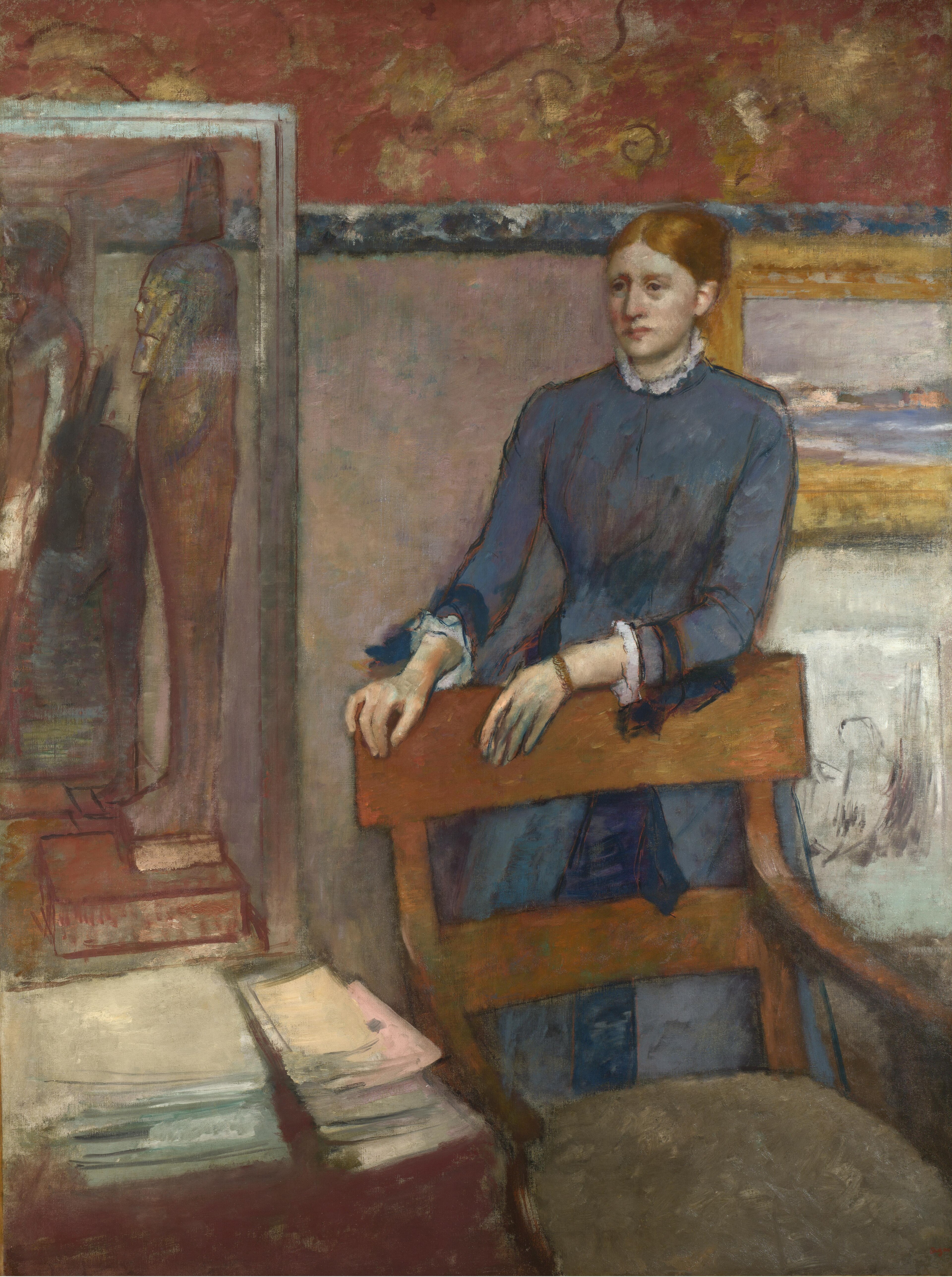
Hélène Rouart in her Father’s Study shows a young woman standing behind her father’s empty chair, both hands resting on its back. Her dress is grey-blue, the collar and cuffs are white lace, and her gaze slips past us to the left. To her left stands a glass case holding three Egyptian statues, above her hangs a Chinese wall hanging, and at the right are framed drawings and a picture in a yellow frame; below, a pile of papers and folders lies on the table. The study is painted as a collection, and the woman stands inside it without support. The sitter was twenty-three and married, but Degas painted out her wedding ring. The original measures 121 x 162.5 cm, was made about 1886, and is held by the National Gallery in London under number NG6469. Ours is painted by hand in nine sizes from 40 x 60 to 110 x 150 cm or to your own measurement, and you receive a photograph of the finished work for approval before it ships.
| Title: | Hélène Rouart in her Father’s Study |
| Other titles: | Hélène Rouart dans le bureau de son père |
| Painter: | Edgar Degas (1834–1917) |
| Year: | about 1886 |
| Size of the original: | 121 cm x 162.5 cm |
| Technique of the original: | oil on canvas |
| Style: | Impressionism |
| Where it hangs: | National Gallery, London (inv. NG6469; Schulman catalogue MS 814) |
| Our version: | hand-painted oil on linen canvas, 9 sizes from 40 x 60 cm to 110 x 150 cm, custom size on request |
Hélène Rouart in her Father’s Study – Edgar Degas
Who is in the picture?
This time we know. The museum record names her: Hélène Rouart, daughter of Henri Rouart. She was twenty-three when the picture was painted, and married. She stands upright behind a wooden chair, both hands resting on its back; the chair is her father’s and it is empty. Her dress is grey-blue and plainly cut, the collar and both cuffs are white lace, and a gold bracelet catches the light at her wrist. Her hair is reddish, pinned up. Her gaze slips past us to the left, so that she looks neither at us nor at anything in the room; the face is calm and slightly absent. The museum record also states something the canvas does not show: although she was married, Degas painted out her wedding ring, perhaps to keep her a daughter rather than a wife.
What is on the canvas?
Her father’s collection, arranged around her. At the left stands a glass case holding, by the museum’s account, three Egyptian statues; an upright figure on a reddish base is clearly visible. Above it hangs a Chinese wall hanging, so the upper wall is dark and patterned while the lower part is a quiet grey, with a bluish band running between them. At the right hang framed drawings and a picture in a yellow frame. Below, at the edge of the table, lies a pile of papers and folders. The room is made entirely of things somebody gathered, and that is exactly why the empty chair stands out. The paint is laid on densely, and in places, by the museum’s account, Degas worked pastel directly onto the canvas, so some passages are drier and more powdery than others.
Why does this portrait matter?
Because it does not put the sitter at the centre of her own portrait. She stands to one side of her own picture, among objects belonging to somebody else, holding a chair that somebody else does not sit in. The second reason is the empty chair itself: using an empty seat for an absent person was not unusual, but here the chair is also a family object, since the museum records that it came from Madame Rouart’s father, the cabinet maker Jacob-Desmalter. The third reason is a decision that was never carried out. Degas first intended a double portrait of Hélène with her mother, possibly to match the earlier picture of father and daughter, and abandoned it; once he had settled the final arrangement he set it down with almost no alteration.
What does the portrait mean?
That a person is partly defined by what they did not choose. Impressionism in Degas means close observation of people in their own rooms rather than effects of light, and here the room is very nearly a second sitter. As a canvas painting it is one of those portraits that rewards a longer look, because it changes as you read the objects. The colours are restrained — grey, blue-grey, dark red and a little gold — so it makes calm wall art for a living room, a study or a hallway. Anyone looking for a large painting with a story will find a whole room here that talks about an absent man, and a woman who is not quite at home in it. This is a reproduction of that canvas, painted by hand.
How did the canvas reach London?
By a route the museum publishes in full. In 1918 it was bought at the first Degas Studio sale at the Galerie Georges Petit in Paris, held 6–8 May, as lot 110, by Paul Rosenberg (1881–1959); the museum records the purchase as made jointly, for 27,500 francs, by Rosenberg and Co. of Paris and the Galerie Georges Bernheim of Paris, and it puts a question mark against that second name itself, which we keep. The purchase is dated 7 May 1918. On 27 May 1924 René Gimpel (1881–1945) bought it for 70,000 francs from the Galerie Bernheim-Jeune in Paris. It passed by descent to Peter Gimpel (1915–2005), who sold it to the National Gallery in April 1981. In its own summary line the museum records this simply as Bought, 1981.
The motif among the painter’s works
Degas never painted portraits to commission; he took his sitters from family and friends, and the Rouarts were both. He had painted Hélène before, as a nine-year-old on her father’s knee; that earlier picture is entered in the Schulman catalogue as MS 832, Henri Rouart and his daughter Hélène, and it is in a private collection. Among the works by Degas we offer, the closest to this canvas are The Collector of Prints, again a man surrounded by his own collection, Hilaire de Gas, a family portrait of an old man in an armchair, and Edmondo and Thérèse Morbilli, a double portrait of a married couple from the painter’s own family. This canvas is held by the National Gallery in London under inventory number NG6469.
How is our hand-painted version made?
With a brush and oil paint, in the same technique as the original, so ours is oil on canvas too. The hardest part is the dress. The grey-blue mass takes the middle of the canvas and has to stay one colour while still showing the weight of the cloth and every fold, so we build it from several cool greys with blue, never from a single mixture. The second hard part is the lace at the collar and cuffs: it has to be painted as light and not as pattern, or it becomes ornament and pulls the eye. The third is the glass case at the left, which must read as glass and contents at once; we keep the statues soft, as they are in the original, because sharpening them makes them intrusive. The empty chair is painted last, since whether the scene works depends on its weight. Every copy is made afresh and no two are quite alike; every hand-painted copy is its own. We have no photographs of our own finished canvases for this subject yet, because we have not painted it before, so none is shown here and none is described. You receive a photograph of your own canvas before it ships.
Which size for which wall?
If you are unsure: 70 x 90 cm. The original is large at 121 x 162.5 cm, and our biggest size, 110 x 150 cm, comes closer to it than on most works on this shelf — only a little short on both sides. In proportion the nearest is 97 x 130 cm: 1.340 against the original’s 1.343. 40 x 60 and 50 x 60 cm are small; at those sizes the case at the left and the papers below are lost, though the figure survives. 50 x 70, 60 x 80 and 70 x 90 cm are the right choice above a chest of drawers, in a hall or on a stair wall. 80 x 110, 90 x 120 and 97 x 130 cm need a calm, wider wall; at those sizes the expression and the pattern of the Chinese hanging both read. At 110 x 150 cm the figure stands at very nearly life size, and that is where the empty chair works hardest. Measure your chosen size on the wall first with a paper cut-out. None is held in stock: each piece is painted to order.
Custom size, stretcher bar and frame
If none of the nine sizes suits, or if you want exactly the proportion of the original, we paint to your measurement and keep the height of the scene, so the Chinese hanging stays above her head and the papers on the table are not cropped away below; that is our work made to order. Every piece is sent stretched on a wooden stretcher bar, ready to hang. For the frame use our 3D application: on this subject it shows every moulding we carry — gold, silver, black, white and natural wood — and it is for choosing a frame and nothing else. How the work sits on your own wall is shown by our separate service, placement in the room.
Delivery and guarantee
Each piece is painted to order in our workshop in Slovenia; allow 15-45 days depending on the size, at the largest sizes usually at the upper end. It travels stretched and protected for transport, framed if you chose a frame, to sixteen countries in the European Union, without customs. Before dispatch you receive a photograph of the finished work for approval, and our returns arrangement applies to every order. The full range is in the Edgar Degas gallery, and his life is described in our article about Edgar Degas.
Frequently asked questions
Which painting is this?
Degas’s oil Hélène Rouart in her Father’s Study, 121 x 162.5 cm. It is held by the National Gallery in London under inventory number NG6469.
Who was Henri Rouart?
By the museum’s account an engineer and amateur landscape painter who exhibited with the Impressionists. He and Degas had been at school together, and their lifelong friendship began when Degas served under his command during the Siege of Paris in 1871. He owned a substantial collection of contemporary French painting, including work by Degas.
When was it painted?
The museum states: about 1886. We keep the approximation, because the record keeps it.
How big is the original?
121 cm wide and 162.5 cm high, so taller than a person. Our largest size, 110 x 150 cm, is the closest to it in scale, and 97 x 130 cm the closest in proportion.
Why is she not wearing a wedding ring?
Because Degas painted it out. The museum records that Hélène was married when the picture was made, and suggests the ring was removed to stress her role as a daughter rather than a wife. The suggestion is the museum’s, not ours.
What is in the case behind her?
By the museum’s account, three Egyptian statues in a glass case, with a Chinese wall hanging above. Both were part of her father’s collection.
Whose chair is she holding?
Her father’s, and it is empty. The museum adds that the chair came from Madame Rouart’s father, the cabinet maker Jacob-Desmalter.
Where can it be seen?
At the National Gallery in London. At the time of reading the record lists it in Room 41; whether it still hangs there can change.
Is the original an oil or a pastel?
An oil, painted on canvas, with one interesting detail: the museum records that Degas reworked some passages and applied pastel directly onto the canvas while doing so.
Is this a print?
No. The work is made by hand in oil; the brush strokes are visible and can be felt, particularly in the dress and the lace.
Is it suitable as a gift?
Yes, particularly for someone who likes portraits and quiet, darker colours. Because each piece is painted to order, allow for the making time; if you would rather leave the choice to them, there is our gift voucher.
- Subject: Hélène Rouart standing behind her father’s empty chair, surrounded by his collection
- Original: Edgar Degas, oil painting on canvas, 121 x 162.5 cm, National Gallery, London (NG6469)
- Ours: painted by hand in oil, nine sizes from 40 x 60 to 110 x 150 cm
- Worth knowing: she was married, but Degas painted out the wedding ring — by the museum, to keep her a daughter