




Description
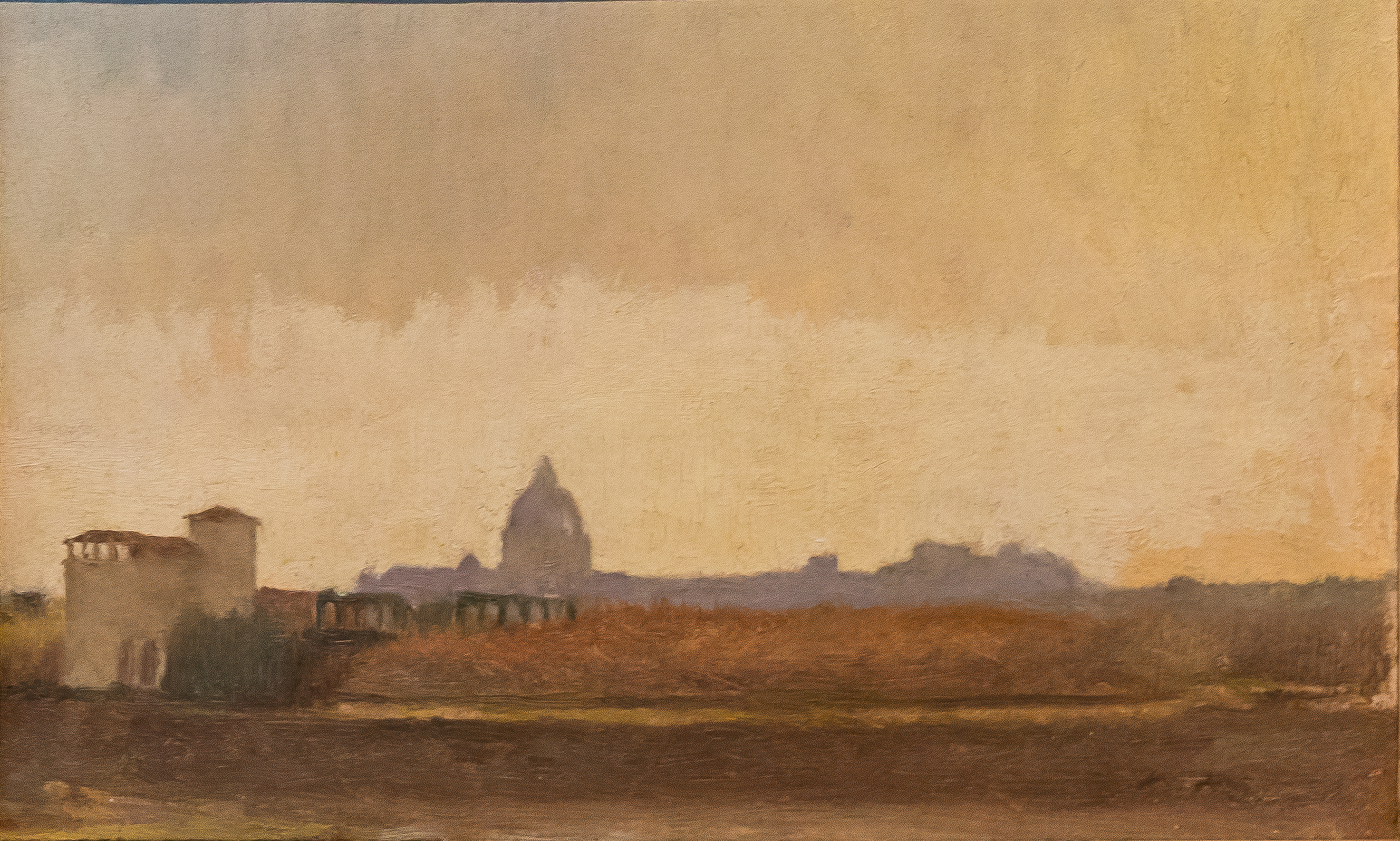
View of Rome from the Banks of the Tiber is a small scene in which nearly two thirds of the surface is sky. It is golden and honey-coloured, without a single sharp cloud; below it the outline of the city stretches away in a soft violet grey, and out of it rises a dome, barely legible. A pale block of buildings with a small tower stands at the left, and beside it a low row of arches recalling an aqueduct. Between the city and us lies a band of rust-brown vegetation, laid on so quickly that the separate strokes remain visible, and a dark brown band of riverbank closes the picture at the bottom. The original is small, 26 x 18.1 cm, and it was made in 1857/58, when Degas was twenty-three. It is not painted on canvas but on paper laid down on canvas — that is the technique given by the museum that holds it, the Museum Langmatt in Baden, Switzerland. We make it by hand, in six sizes from 80 x 60 to 140 x 100 cm or to your own measurement, and before dispatch you receive a photograph of the finished work for approval.
| Title: | View of Rome from the Banks of the Tiber |
| Other titles: | Blick auf Rom vom Tiberufer aus (the museum’s title), Pogled na Rim z bregov Tibere |
| Painter: | Edgar Degas (1834–1917) |
| Year: | 1857/58 |
| Size of the original: | 26 cm x 18.1 cm |
| Technique of the original: | oil on paper, laid down on canvas |
| Painting style: | impressionism |
| Where the original hangs: | Museum Langmatt, Baden, Switzerland (Stiftung Langmatt Sidney und Jenny Brown); the museum publishes no inventory number for this work |
| Our version: | hand-painted oil on linen, 6 sizes from 80 x 60 cm to 140 x 100 cm, custom size on request |
View of Rome from the Banks of the Tiber – Edgar Degas
What is in the scene?
Sky first, and only then a city. Nearly two thirds of the surface is a golden, honey-coloured sky without a single sharp cloud, so that the upper part of the picture is in effect empty. Below it the outline of Rome stretches away in a soft violet grey, and out of it rises a dome — by its position and shape the dome of St Peter’s, which we read from the picture and from the title, since the museum record says nothing about it. A pale block of buildings with a small tower stands at the left, and beside it a low row of arches recalling an aqueduct. Between the city and the viewer lies a band of rust-brown vegetation, and a dark brown band of riverbank closes the picture at the bottom. There are no people. The scene is nearly monochrome: everything is sand, ochre and violet.
When and where was it made?
In Rome, in 1857/58. The date is not our estimate but the record of the museum that owns the work, and it is more precise than the commonly quoted “the 1850s”. Degas was twenty-three at the time — he was born in 1834 — so this is the very beginning, a long way before the ballet and racecourse scenes he is known for today. What others wrote about him in those years we leave out on purpose: you will often read that he was in Italy on a scholarship, but the museum record does not say so and we do not repeat the claim. What is certain is the date, the place named in the title, and the age that follows from them.
Why paper rather than canvas?
Because the original is an oil on paper. The Museum Langmatt gives the technique as oil on paper laid down on canvas, and that is not a cataloguer’s detail but the explanation of how the picture looks. Paper was convenient for working outdoors: a small sheet the painter carries with him and covers with a thin layer of colour. That is exactly why the separate strokes in the band of vegetation are still visible, why the ground and the grain show through in places, and why the whole reads more like a note about light than a finished view. Our version admits the difference honestly: we paint on canvas, because canvas is what stretches, hangs and lasts, and the look of a paper support is reached by keeping the paint thin, not by changing the support.
What does the scene mean?
That a city can be nothing but light. A canvas painting of this kind does not inventory buildings, it records an hour of the day; Rome is identifiable here by a single dome and everything else is colour. Because the tones are warm and quiet — sand, ochre, violet — it makes unobtrusive wall art for a living room, a bedroom or a hallway, the sort chosen to settle a room rather than to command it. Among Degas’s works it is an exception: almost everything else of his that we sell is people indoors. Our reproduction is built around keeping the sky the main event and not an empty space above a city.
The motif among Degas’s works
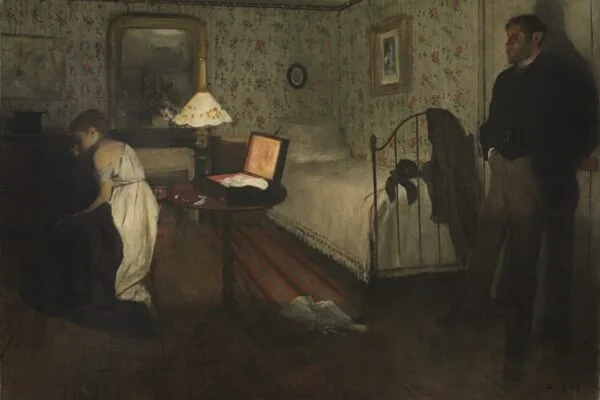
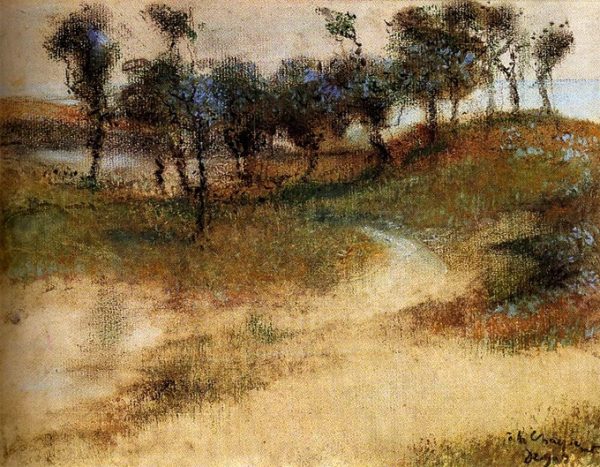
Landscapes are rare in Degas, and for that reason rare on our shelf too. Closest to this one are View of Saint-Valéry-sur-Somme and Peasant Girls Bathing in the Sea at Dusk, both scenes with a wide sky. Worth singling out is The Bellelli Family: it was begun during the same Italian stay, but indoors and full of people, so the two works come from one period and are each other’s opposite. The original is held by the Museum Langmatt, which records it as Blick auf Rom vom Tiberufer aus, 1857/58, oil on paper on canvas, 18.1 x 26 cm. The collection was assembled between 1900 and 1933 by Sidney and Jenny Brown, most of it bought between 1908 and 1919, when Impressionism was still contemporary art.
How is our hand-painted version made?
With a brush and oil paint, as an oil on canvas. The hardest part is the sky. Two thirds of the surface here carries almost no drawing, only a passage from gold into honey and on into a greyish tone, and it is in exactly such a passage that every mistake shows; we build it in thin layers until the transition is continuous. The second hard part is the dome, which has to stay barely legible: painted too firmly, the scene turns into a postcard of Rome, which the original is not. The third is the band of vegetation, where the separate strokes must remain visible — it is the only part of the picture with pronounced texture, and its roughness is deliberate. Every version is made afresh and no two are quite alike; each hand-painted copy is therefore its own. For this motif we have no photographs of our finished canvases yet, because we have not painted it before, so none are shown here and none are described. A photograph of your own canvas comes to you before dispatch.
Which size for which wall?
If you are undecided: 100 x 70 cm. The ratio of the original is 1.44, and 100 x 70 cm gives 1.43, which is the closest of the six and a difference nobody sees on a wall. The other thing has to be said plainly as well: the original is barely 26 cm wide, so it is smaller than every size we offer, and even the smallest version is about three times wider than it, the largest more than five times. For this motif that is not a fault, since an open scene with a great deal of sky takes enlargement well, but it is a difference worth knowing in advance. 80 x 60 and 90 x 65 cm suit a smaller cabinet or a narrow room. 100 x 70 and 110 x 80 cm are the right choice above a bed or a sofa, the first because of the ratio. At 120 x 90 and 140 x 100 cm a large painting of this kind wants a wall with nothing else on it and some distance to stand back; that is where the sky works hardest. Measure your chosen size on the wall first with a paper cut-out. None is held in stock: every piece is made to order.
Custom size, frame and stretcher
If none of the six sizes fits, we paint to your measurement, keeping the ratio of 1.44 and the share of sky, so that the city does not drift into the middle of the picture; that is our work made to order. Every piece ships stretched on a wooden stretcher, ready to hang. For the frame use our 3D application: on this motif it shows every moulding we carry — gold, silver, black, white and natural wood — and it serves the choice of frame and nothing else. How the work behaves on your own wall is shown by our separate service, placement in the room.
Delivery and guarantee
Every piece is made to order in our workshop in Slovenia; allow 15-45 days depending on the size, at the largest sizes usually at the upper end. It travels stretched and protected for transport, framed if you chose a frame, to sixteen countries in the European Union, without customs. Before dispatch you receive a photograph of the finished work for approval, and our returns arrangement applies to every order. The whole range is in the Edgar Degas gallery, and his life is described in our article on Edgar Degas.
Frequently asked questions
What work is this?
An early Roman view by Degas, recorded by the museum as Blick auf Rom vom Tiberufer aus. It measures 26 x 18.1 cm and is held by the Museum Langmatt in Baden, Switzerland.
When was it painted?
In 1857/58. That is the date given by the museum that owns it, and it is tighter than the frequently quoted “the 1850s”.
How big is the original?
Very small: 26 cm wide and 18.1 cm high, narrower than a sheet of A4 and a good deal shorter. Every size we offer is larger than the original.
Is the original on canvas?
No. The museum gives oil on paper, laid down on canvas. That explains the thin paint and the visible strokes; our version is painted directly on linen.
Which building is on the horizon?
A dome, barely separable from the outline of the city; by its position and by the title it is the dome of St Peter’s. We read that from the picture — the museum record does not name the building.
Where is the original today?
In the Museum Langmatt in Baden, Switzerland. The museum is run by the Stiftung Langmatt Sidney und Jenny Brown, and the Browns assembled the collection between 1900 and 1933.
Why do you give no inventory number?
Because the museum does not publish one for this work in its own public record. We would rather give nothing than give a number we cannot check against the source.
Was Degas in Italy on a scholarship?
We do not claim that. You will meet the statement often, but the museum record does not support it, so it is absent here. What is certain is that the work was made in 1857/58, when he was twenty-three.
Which of your sizes matches the original?
By ratio 100 x 70 cm, which gives 1.43 against the original’s 1.44. By size none, because the original is smaller than every size we offer.
Is this a print?
No. The work is made by hand in oil on linen; the brushstrokes are visible and can be felt, on this motif most of all in the band of vegetation below the city.
Is it suitable as a gift?
Yes, particularly for someone who loves Rome or quiet scenes with a wide sky. Since every piece is made to order, allow for the making time; if you would rather leave the choice to the recipient, there is our gift voucher.
- Motif: Rome seen from the banks of the Tiber, nearly two thirds sky, the dome barely legible
- Original: Edgar Degas, 1857/58, oil on paper on canvas, 26 x 18.1 cm, Museum Langmatt, Baden
- Our version: hand-painted in oil, six sizes from 80 x 60 to 140 x 100 cm; 100 x 70 cm is closest to the original’s ratio
- Worth knowing: this is one of Degas’s few landscapes, and he made it at twenty-three