







































Description
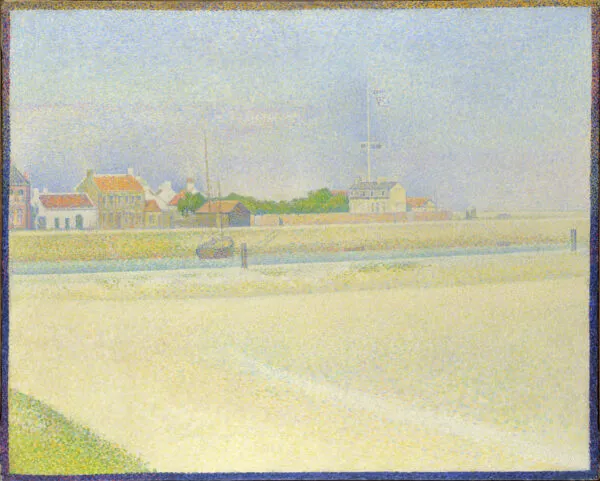
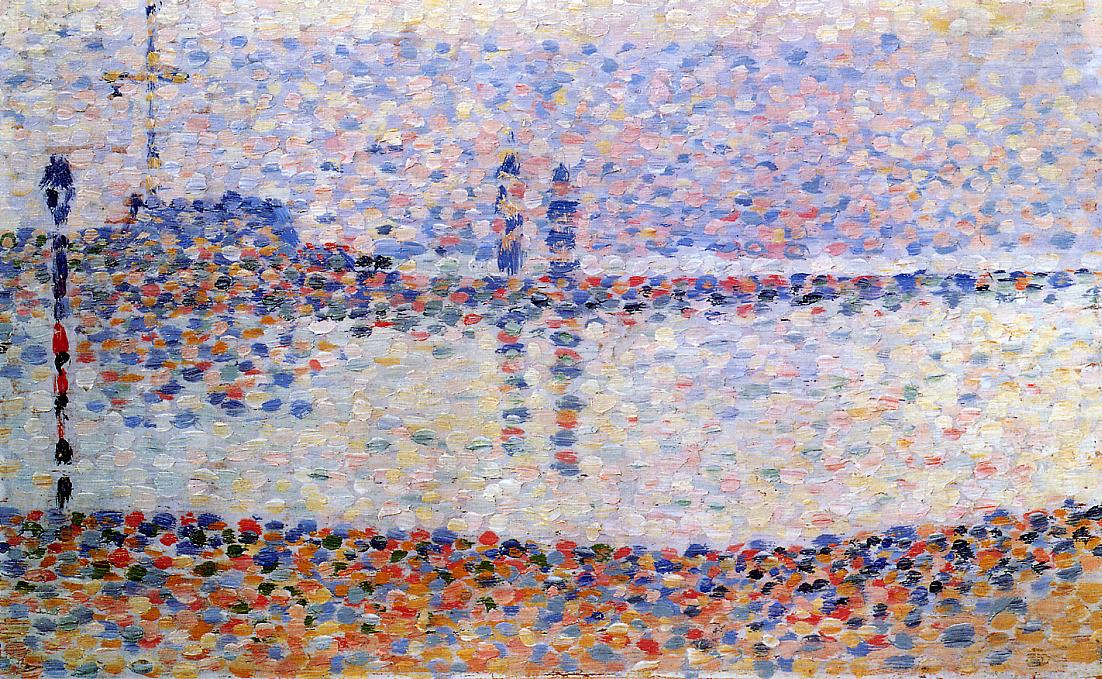
The Channel at Gravelines (Saint-Tropez) is a small oil painting on wood by Georges Seurat from 1890: we look across a channel to the far bank past a tall striped post, two upright posts on the other side are mirrored in the water, and everything is built from tiny dots of colour. The original, 25 x 16 cm, belongs to the French state; the Musée national d’art moderne (Centre Pompidou) lists it as AM 3818 P and has deposited it at the Musée de l’Annonciade in Saint-Tropez. We paint it as a canvas painting, by hand in oils, in five sizes or to your own measurements, and you approve a photograph of the finished work before it is dispatched.
| Title: | The Channel at Gravelines (Saint-Tropez) |
| Other titles: | »Chenal de Gravelines«; »Gravelines«, attributed title »Chenal de Gravelines, étude« |
| Painter: | Georges Seurat (1859–1891) |
| Year painted: | 1890 |
| Original size: | 25 cm x 16 cm |
| Original technique: | Oil on wood |
| Painting style: | Small dots of pure colour placed side by side |
| Located at: | Musée de l’Annonciade, Saint-Tropez, on deposit from the Musée national d’art moderne (inv. no. AM 3818 P) |
| Our reproduction: | hand-painted oil on canvas, 5 sizes from 25 x 16 cm to 80 x 50 cm, custom size on request |
The Channel at Gravelines (Saint-Tropez) – Georges Seurat
What does the painting show?
A channel and its far bank, with no people. Along the bottom edge runs a band of densely scattered dots that reads as the near bank. Above it opens a wide, bright stretch of water. On the left stands a tall, thin post with a dark top that looks like a lamp or a marker; its lower part is striped, alternately red and dark, and reaches almost to the bottom edge. On the far bank, a little above the middle, lies a low strip of land; at its left end is a darker mass, perhaps a building or a jetty, with a tall mast and crossbar above it. In the centre stand two upright posts, like small lighthouses or markers, and their reflections stretch down across the water. The upper half belongs to a pale sky.
What is on the panel?
A horizontal wooden panel, 25 cm wide and 16 cm high. The whole surface is covered with small round and elongated dots of pure colour lying side by side without blending. This pointillism is dense and visible to the naked eye: in the sky and the water the dots are light, in soft pastel tones, while in the band of the near bank they are darker and stronger. The horizon is a straight line a little above the middle, so the painting divides into three bands: sky, water and near bank. The posts and the mast are the only vertical forms. On so small a panel the dots are large in relation to the whole, so the scene is sensed more than drawn. The photograph in this listing shows the subject and the composition; it cannot promise the exact tones of the original.
Why does this painting matter?
Because it shows how the French painter Georges Seurat builds a scene out of dots alone, even on a small panel. The Musée national d’art moderne lists it under the attributed title »Chenal de Gravelines, étude«, that is, as a study, and that is its appeal: you watch the channel, the posts and the light assemble from single points of colour. Its history adds to it: the museum record says it passed from the painter’s studio to Paul Signac. For a buyer it is a bright, airy waterside scene in a small format, its method visible at first glance.
What does the painting mean?
Stillness by the water. There are no people and no boats, only the channel, the bank, the posts and light broken into thousands of dots. The straight horizon and the upright posts give the scene a firm order, while the dots set it in motion, so that water and sky almost vibrate. The reflections of the posts tie the upper and lower halves together. At home it feels bright and calm; its pastel tones go well with white walls, pale wood and blue or grey fabrics.
What happened to the original?
The two museum records trace the panel’s path without dates. According to the entry in the French POP database it went from the painter’s studio to Paul Signac, then to Ginette Signac and then to Georges Grammont. The record of the Musée national d’art moderne also lists it as formerly owned by Paul Signac and Ginette Signac. Grammont left it as a bequest; today it belongs to the French state and is entered in the collection of the Musée national d’art moderne under number AM 3818 P. It is on deposit at the Musée de l’Annonciade in Saint-Tropez under deposit number D 1955.1.51. When the panel passed from one owner to the next, the records do not say. All details are taken from the museum records.
What place does it have among Seurat’s works?
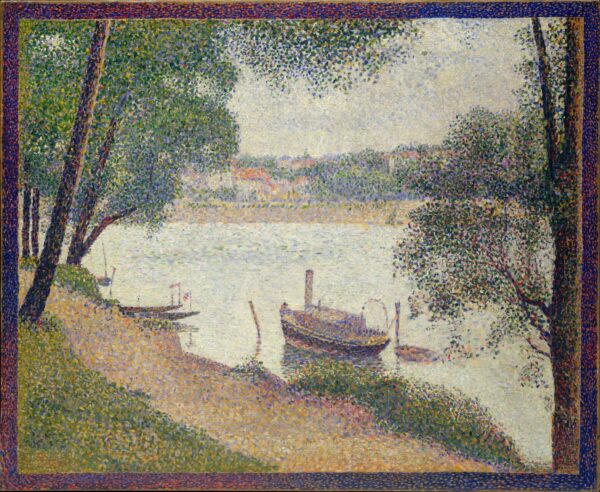
Several Seurat works we offer have Gravelines in the title. The Channel of Gravelines, Petit Fort-Philippe is in the museum collection in Indianapolis (the museum’s collection record), The Channel of Gravelines, Grand Fort-Philippe is held by The National Gallery in London, and Study for The Channel of Gravelines, Petit Fort-Philippe is in the Nelson-Atkins museum in Kansas City. Beside them, this is the small 1890 panel the Centre Pompidou lists as a study. The addition Saint-Tropez in our title says where the original is and sets it apart from our other Gravelines paintings.
How is our hand-painted version made?
With a brush and oil paint, never by machine. Our painter works from an image of the original and builds the painting dot by dot, as Seurat built it. Here a pointillist technique is essential: the dots must stay pure and separate, light in the sky and water, darker and stronger in the lower band, or the scene would lose its light. The posts and their reflections get particular care: they must remain distinct among the dots. Because everything is done by hand, no two canvases are ever quite the same, and each hand-painted copy is unique. We have no photographs of our own of a finished canvas of this subject yet; when we paint it for the first time, we will photograph it and publish the photographs here.
Which size for which wall?
If you are not sure which to choose, take 60 x 40 cm. Our 25 x 16 cm size is identical to the original: the original measures 25 x 16 cm and so does ours, with no difference at all. The format is horizontal, with proportions close to 8 : 5, so it sits well on a shelf, above a narrow chest of drawers or in a group of smaller works. For a painting that fills a wall alone, go larger: 50 x 30 and 60 x 40 cm suit a hallway or bedroom, while 70 x 45 and 80 x 50 cm hold their own above a desk, a chest of drawers or a bed. In the larger sizes the dots grow and the surface comes even more alive. Every oil painting reproduction of this subject is made to order.
Custom size, stretcher bar and frame
If none of the five sizes fits your wall, we paint to your measurements, up to 80 x 50 cm, and keep the proportions of the original, so the horizon and the posts stay where they belong; that is our custom size painting service. You can order the painting in three forms: as a rolled canvas without a stretcher, stretched on a wooden stretcher bar and ready to hang, or framed; you choose the form when you order. You pick a frame in our 3D app, which shows gold, silver, black, white and wooden profiles on this subject; the app serves only to choose the frame. To see the painting on your own wall, use our separate room-visualisation service.
Delivery and guarantee
We paint every canvas to order in our studio in Slovenia, so expect 15 to 45 days depending on the size. It travels in the form you chose when ordering — rolled, stretched or framed — protected for transport, within Slovenia and across the EU with no customs duty. Before dispatch you receive a photograph of the finished work to approve, and our returns policy covers every order. All of Seurat’s subjects are in the Georges Seurat gallery, and our article about Georges Seurat tells you when a fine art reproduction of a famous painting is really good.
Frequently asked questions
Where is the original?
In the Musée de l’Annonciade in Saint-Tropez, where it is on deposit under number D 1955.1.51. It belongs to the French state and is in the collection of the Musée national d’art moderne (Centre Pompidou) under number AM 3818 P; it came there through the bequest of Georges Grammont.
Why is Saint-Tropez in the title?
Because the original is on deposit in Saint-Tropez. The addition distinguishes it from the other Seurat views of the Gravelines channel we offer.
Is »Chenal de Gravelines« the same work?
Yes. That is what the French POP database calls it; the Musée national d’art moderne lists it as »Gravelines«, with the attributed title »Chenal de Gravelines, étude«.
Is this a print?
No. It is hand-painted oil on canvas; the dots and brushstrokes are visible and can be felt.
Which size should I choose?
25 x 16 cm, which matches the original; for a larger wall, 60 x 40 cm. The detailed guide is above.
Can I have a size that is not on the list?
Yes. We paint to measure and keep the side ratio of the original.
Is this neo-impressionism?
Neither museum record assigns the painting to a movement, so we do not either. What you can see is a surface built from small dots of pure colour.
What are the posts in the painting?
The records do not explain them. In the painting they look like markers or lighthouses beside the channel; the left one is striped red and dark in its lower part.
Is the original for sale?
No. The panel belongs to the French state and is not for sale. We can paint its subject for you by hand instead.
How high should I hang it?
With its centre at eye level, about 145–150 cm from the floor; hang the smaller sizes lower, closer to where you sit.
Is it a good gift?
Yes, especially for someone who loves water and light. If you would rather leave the choice to the recipient, there is our gift voucher.
- Subject: the channel at Gravelines with posts on the bank and their reflections, all in tiny dots – 1890
- Original: 25 x 16 cm, oil paint on wood, Musée de l’Annonciade, Saint-Tropez, on deposit from the Musée national d’art moderne (inv. no. AM 3818 P)
- Ours: hand-painted, five sizes from 25 x 16 to 80 x 50 cm, as a rolled canvas, stretched or framed — your choice
- Worth knowing: from Seurat’s studio the panel passed to Paul Signac, then to Ginette Signac and to Georges Grammont