










Description
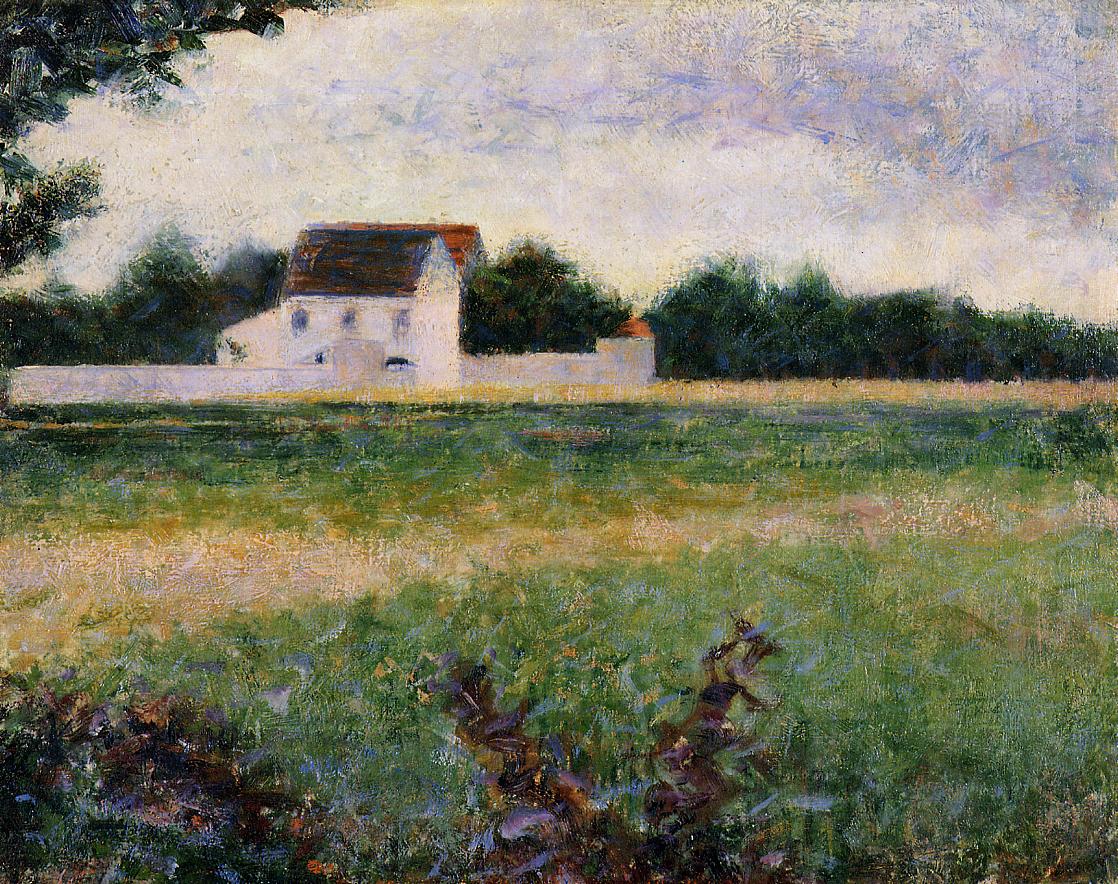
Landscape in the Île-de-France is a Seurat painting that the museum dates to 1881–1882: beyond a broad field in bands of green and yellow stands a white house with a brick-red roof, a long white wall before it and a dark line of trees behind. The original, oil paint on canvas, 40.7 x 32.5 cm, belongs to the Musée d’Orsay under inventory number RF 1948 13 and is kept at the Museum of Fine Arts in Bordeaux. We make it as a fine art reproduction, hand-painted in oils on canvas, in five sizes or to measure, and you approve a photograph of the finished work before dispatch.
| Title: | Landscape in the Île-de-France |
| Other titles: | »Paysage d’Ile de France« |
| Painter: | Georges Seurat (1859–1891) |
| Year painted: | 1881–1882 |
| Original size: | 40.7 cm x 32.5 cm |
| Original technique: | Oil on canvas |
| Painting style: | Early work – short, criss-crossing strokes |
| Located at: | Musée d’Orsay collection, on deposit at the Museum of Fine Arts, Bordeaux (inv. no. RF 1948 13) |
| Our reproduction: | hand-painted in oils on canvas, 5 sizes from 46 x 38 cm to 80 x 65 cm, custom sizes on request |
Landscape in the Île-de-France – Georges Seurat
What does the painting show?
Quiet countryside with nobody in it. Just left of centre stands a white house with a tall brick-red roof and a few small windows, with a lower, reddish-roofed building to its right. A long, low white wall runs from the left edge to just past the middle, separating the field from the house. Behind them a dark green band of trees and bushes closes off the horizon on the right. Most of the canvas is the field: a wide plain in bands of green, yellow and ochre. Dark, brownish-violet plants grow in the foreground, and at the top left a tree branch reaches into the scene. The museum record describes it only with keywords: landscape, field, vegetation, tree, house, enclosure.
What is on the canvas?
A horizontal canvas, 40.7 cm wide and 32.5 cm high. The sky fills the upper third in light, creamy white strokes with patches of lilac and sky blue among them. The field is built from short, criss-crossing, mostly horizontal strokes; yellow and pink touches are woven into the green, so the plain is a lively weave of colour rather than a flat surface. The white house and the wall are among the brightest spots and draw the eye, small as they are. The dark plants in the foreground are painted with looser brown and violet strokes. There are no dots on this canvas. According to the museum record, the lower right carries the signature Seurat and, in the same place, a red stamp M, which the record explains with the words »pour Moline«.
Why does this painting matter?
Because the art world has taken it seriously for more than a century. The museum record lists 32 exhibitions between 1900 and 2016: it was shown in 1900 at La Revue blanche in Paris, in 1908–1909 at the Seurat retrospective at the Bernheim-Jeune gallery, in 1958 at the Art Institute of Chicago, and in 1991 at the Seurat exhibition at the Grand Palais in Paris and in 1991–1992 at the Metropolitan Museum in New York, both times as number 80. The French painter (1859–1891) painted a perfectly ordinary piece of countryside here. Pointillism plays no part; instead, small criss-crossing strokes build up the light on the field. This is the quiet, reserved side of the artist.
What does the painting mean?
The title tells us only where we are: in the Île-de-France. The museum does not name the place, nor the house. Nothing happens; there are no people, no animals, no path by which anyone might arrive. What remains is the light over the field, a white wall catching the sun and the dark green line of trees. That stillness is the point: the painter looked at something most people would walk past and made a balanced picture of it. At home it feels calm and bright, and its greens and yellows sit well with wood, linen and other natural materials.
What happened to the original?
The museum record gives the painting’s history in this order. First it was in the collection of Madeleine Knoblock; in 1908 in that of Alexandre Natanson; then in those of Georges Lecomte and Eugène Blot. For Madeleine Knoblock, Georges Lecomte and Eugène Blot the record gives no dates. Until 1948 it was in the collection of Albert Marquet, who in 1948 bequeathed it to the French national museums, subject to a usufruct in favour of Mrs Albert Marquet; from 1948 to 1960 it was in her collection. It was then assigned to the Louvre and kept at the Museum of Fine Arts in Bordeaux from 1961 to 1992; it was then assigned to the Musée d’Orsay, where it stayed from 1992 to 1995. In 1995 it was placed on deposit at the Museum of Fine Arts in Bordeaux. According to the museum, it is not currently on display in a gallery.
What place does this painting have among Seurat’s works?
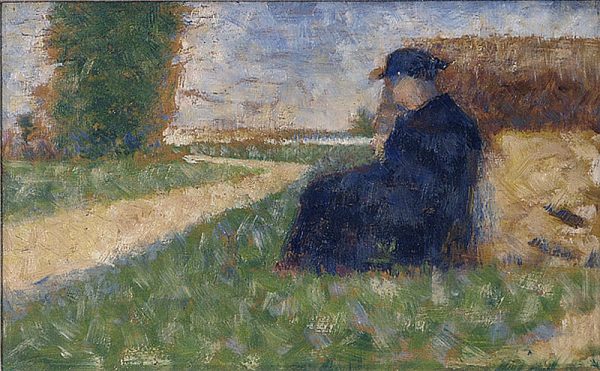
It belongs with Seurat’s early canvases of the countryside and the city’s edge. From the same years we also offer The Suburbs (La Banlieue), which our site dates to about 1882, Farm Women at Work from 1882–1883 and Peasant Woman Seated in the Grass (Paysanne assise dans l’herbe) from 1883. Both peasant paintings are held by the Solomon R. Guggenheim Museum in New York. Our landscape shares a white house behind an empty field with The Suburbs, and grass and earth with the two peasant paintings, though here there is no figure. Anyone looking for neo-impressionism in Seurat will find something else here: a landscape built from short, criss-crossing strokes.
How is our hand-painted version made?
With a brush and oil paint, never with a printer. Our painter works from a photograph of the original and keeps what makes this early work special: the short, criss-crossing strokes on the field, the bright white house and wall, and the dark band of trees behind. A pointillist technique would be wrong here, since the original has no dots, and the result would be a different work. Because it is all done by hand, no two canvases are ever identical, and every hand-painted copy is one of a kind. We do not yet have our own photographs of a finished canvas of this subject; when we paint it for the first time, we will photograph it and publish the photographs here.
Which size suits which wall?
If you are not sure which to choose, take 60 x 50 cm. Our smallest size, 46 x 38 cm, is the closest to the original: against the original’s 40.7 x 32.5 cm it is 5.3 cm wider and 5.5 cm taller, and we offer nothing smaller than the original. The horizontal format fits above a chest of drawers or a desk, or in a study. 46 x 38 and 50 x 40 cm suit smaller walls and hallways; 60 x 50 and 70 x 60 cm fill the wall above a sofa or bed on their own; 80 x 65 cm is our largest size for this subject, as the photograph of the original we paint from allows nothing larger. Every canvas painting of this subject is made to order.
Custom size, stretcher bar and frame
If none of the five sizes suits your wall, we paint to your measurements, up to 80 x 65 cm, and keep the original’s proportions, so the house, wall and field stay in balance; that is our custom size painting service. You can order the painting in three forms: as a rolled canvas without a stretcher, stretched on a wooden stretcher bar and ready to hang, or framed; you choose the form when you order. You choose the frame in our 3D app, which shows gold, silver, black, white and wooden profiles on this subject; the app is for the frame only. To see the painting on your own wall, there is our separate room-visualisation service.
Delivery and guarantee
Every canvas is painted in our Slovenian studio, so allow 15 to 45 days depending on size. We send it in the form you chose when ordering — rolled, stretched or framed — protected for transport, within Slovenia and across the EU without customs duty. Before dispatch you approve a photograph of the finished work, and our returns policy covers every order. All of Seurat’s subjects are in the Georges Seurat gallery, and our article about Georges Seurat explains when a reproduction of a famous painting is genuinely good.
Frequently asked questions
Where is the original?
It belongs to the Musée d’Orsay (inventory number RF 1948 13) and has been on deposit at the Museum of Fine Arts in Bordeaux since 1995. According to the museum, it is not currently on display in a gallery.
Are there people in the painting?
No. There are only the house, the wall, the trees, the field and the foreground plants.
Is »Paysage d’Ile de France« the same work?
Yes. That is the title under which the museum lists the work; Landscape in the Île-de-France is our English title for the same canvas.
Is this a print?
No. Our painting is painted by hand, in oil on canvas; you can see and feel the brushstrokes.
Which size should I choose?
For most walls, 60 x 50 cm; for the size closest to the original, 46 x 38 cm. The detailed guide is above.
Can I have a size that is not on the list?
Yes. We paint to measure, up to 80 x 65 cm, and keep the side ratio of the original.
Why is there no single year?
Because the museum does not give one: its record dates the painting to between 1881 and 1882, so we write 1881–1882 as well.
What is at the lower right?
According to the museum record, there is the signature Seurat and a red stamp M, which the record explains with »pour Moline«.
How big is the original with its frame?
The museum gives 58.7 x 50.2 cm for the original with its frame; the canvas alone measures 40.7 x 32.5 cm.
Is the original for sale?
No. The canvas is in a public collection and is not for sale, but you can hang our hand-painted version of it in your own home.
Is it suitable as a gift?
Yes, especially for a lover of the countryside and peaceful landscapes. If you would rather leave the choice to the person receiving it, there is our gift voucher.
- Subject: a white house with a brick-red roof and a long white wall beyond a broad field – 1881–1882
- Original: 40.7 x 32.5 cm, oil paint on canvas, Musée d’Orsay collection, on deposit at the Museum of Fine Arts, Bordeaux (inv. no. RF 1948 13)
- Ours: hand-painted oil painting reproduction, five sizes from 46 x 38 to 80 x 65 cm, as a rolled canvas, stretched on a stretcher bar or framed — your choice
- Worth knowing: until 1948 the painting was in the collection of Albert Marquet, who bequeathed it to the French national museums