


Description
| Title: | Exotic Landscape |
| Other titles: | Paysage exotique (French title) |
| Painter: | Henri Rousseau |
| Year painted: | 1910 |
| Original size: | 130.2 cm x 162.6 cm (height x width) |
| Original technique: | oil on canvas |
| Painting style: | naive art (primitivism) |
| Held at: | Norton Simon Museum, Pasadena, USA (inv. F.1971.3.P) |
| Our reproduction: | hand-painted oil on canvas, ten sizes or a size made to order |
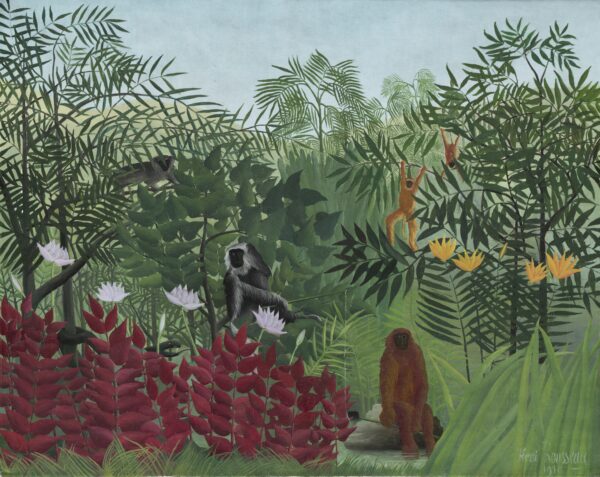
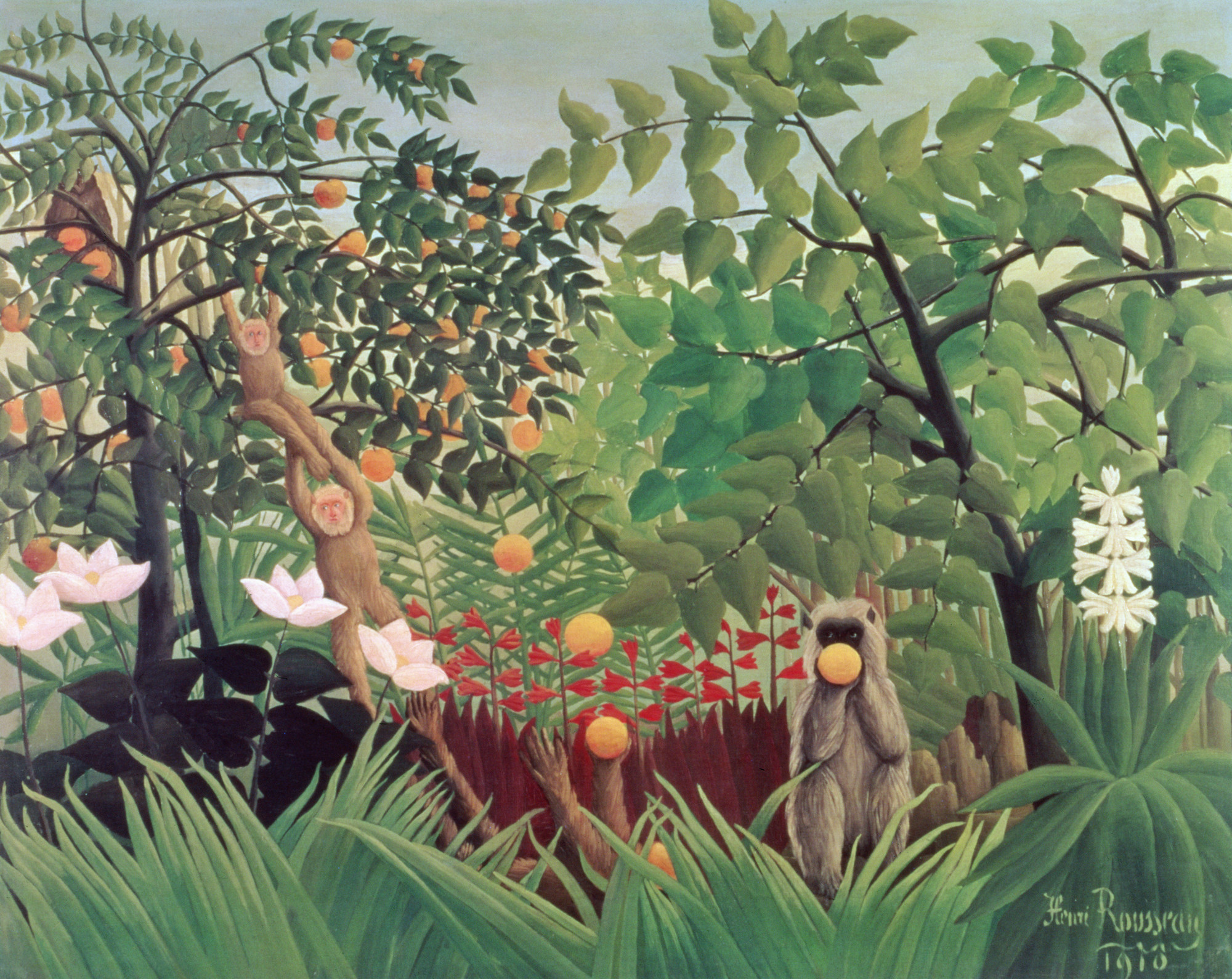
Exotic Landscape is a painting by Henri Rousseau, oil on canvas, signed and dated 1910 by the painter at the lower right. The original measures 130.2 cm high and 162.6 cm wide and is held by the Norton Simon Museum in Pasadena under accession number F.1971.3.P. What you see: monkeys with orange and yellow fruit in a bright, sunlit forest, a tree laden with oranges, white, red and pink flowers, and tall grass in the foreground.
Exotic Landscape
What is on the canvas?
This is a daylight scene: the sky is a pale greenish blue and the foliage is lit throughout. At the upper left stands a tree full of round orange fruit. From it two light brown monkeys hang in a chain: the upper one holds a branch, the lower one hangs from its arm. In the grass below, a third monkey is almost hidden; only its raised arms show above the grass, holding up an orange fruit. Right of centre a large grey monkey sits upright, pressing a yellow fruit to its mouth. Large white and pink flowers open at the left, red spiky flowers in the middle, and a white flower spike rises on the right. In front, tall green grass closes everything off. The signature Henri Rousseau and the year 1910 are at the lower right.
Did Rousseau ever see a jungle?
According to the museum’s text, most likely not. Rousseau called his jungle landscapes “my Mexican pictures” and claimed they were inspired by his military service in Mexico, but in all likelihood he never left France. His scenes packed with exotic plants and animals were built on a careful study of picture books and of the animals at the Paris zoo. The museum adds that it was frankly naive, richly imagined dreamscapes like this one, a scene of almost human monkeys at play, that won him the affection of avant-garde artists and writers, including Pablo Picasso and Guillaume Apollinaire. Another monkey painting we offer from the same year, 1910, is Tropical Forest with Monkeys.
Who owned the painting before the museum?
The museum publishes the chain of owners, and we give it as written. In 1910 the painting was with Ambroise Vollard in Paris. By 1922 it belonged to Tetzen-Lund in Copenhagen; it then passed through Paul Rosenberg in Paris and the Chester H. Johnson Galleries in Chicago to Mrs. Robert F. McCormick, of Chicago and Washington, who owned it by 1933. It was sold at Sotheby’s in New York on 21 October 1971, as lot 90, to the Norton Simon Foundation. The places are where the owners and firms were based, as the record gives them, not a route the canvas is known to have taken; the only event in the chain of ownership that the record ties to a place is the 1971 sale. Monkeys with fruit also appear in Monkeys and Parrot in the Virgin Forest.
How large is the original, and what does that mean on a wall?
The original is 130.2 cm high and 162.6 cm wide, larger than every size we offer. Ten sizes are available: 66 x 55, 75 x 58, 79 x 64, 90 x 72, 97 x 74, 100 x 81, 110 x 86, 115 x 91, 125 x 98 and 135 x 105 cm. The largest, 135 x 105 cm, is 27.6 cm narrower and 25.2 cm lower than the original, so none of our sizes is its true size; 90 x 72 cm keeps its proportion exactly. A bright daytime scene like this works well in a living room or a dining room, and at the larger sizes the monkeys’ faces and the chain they hang in come into their own. Custom sizes are ordered through the made-to-order painting page. A denser, darker jungle is The Equatorial Jungle.
How is a hand-painted reproduction made?
Every canvas painting is made by hand in oils when you order it, in the size you choose. From a high-resolution image of the original, the painter sets down the oranges, the leaves and the monkeys’ fur layer by layer, so that each fruit stays round and each leaf stays clearly apart from the next. No two hand-painted canvases are exactly alike; that difference is the trace of the hand, and a print erases it. The canvas is stretched on a wooden frame and ready to hang. The jungle with which Rousseau began this kind of painting is Tiger in a Tropical Storm, and the whole collection is in the Henri Rousseau gallery.
Frequently asked questions
Where is the original kept?
At the Norton Simon Museum in Pasadena, California, accession number F.1971.3.P, owned by the Norton Simon Foundation. Whether it is on view is best checked with the museum.
What are the monkeys doing?
The museum describes the scene as almost human monkeys at play. On the canvas two hang in a chain, a third lifts a fruit out of the grass, and a fourth, grey one raises a fruit to its mouth.
When was it painted?
In 1910: Rousseau signed and dated it at the lower right, and the museum gives the same year.
Is this a print?
No. It is painted by hand in oils, and the layers of paint can be seen and felt.
Is the painting suitable as a gift?
Yes. A bright, cheerful scene of monkeys and fruit with no hunt in it suits a child’s room too. If you would rather the recipient chose, there is a gift voucher.
- Subject: monkeys with orange and yellow fruit in a bright, sunlit forest, a tree laden with oranges, and white, red and pink flowers.
- Original: oil on canvas, 130.2 x 162.6 cm (height x width), Norton Simon Museum, Pasadena, inv. F.1971.3.P; 1910.
- Our version: hand-painted oil, ten sizes from 66 x 55 to 135 x 105 cm, or a size made to order.
- Of note: according to the museum, the painting was shown at the Art Institute of Chicago in 1933 and in 1942.