
















Description
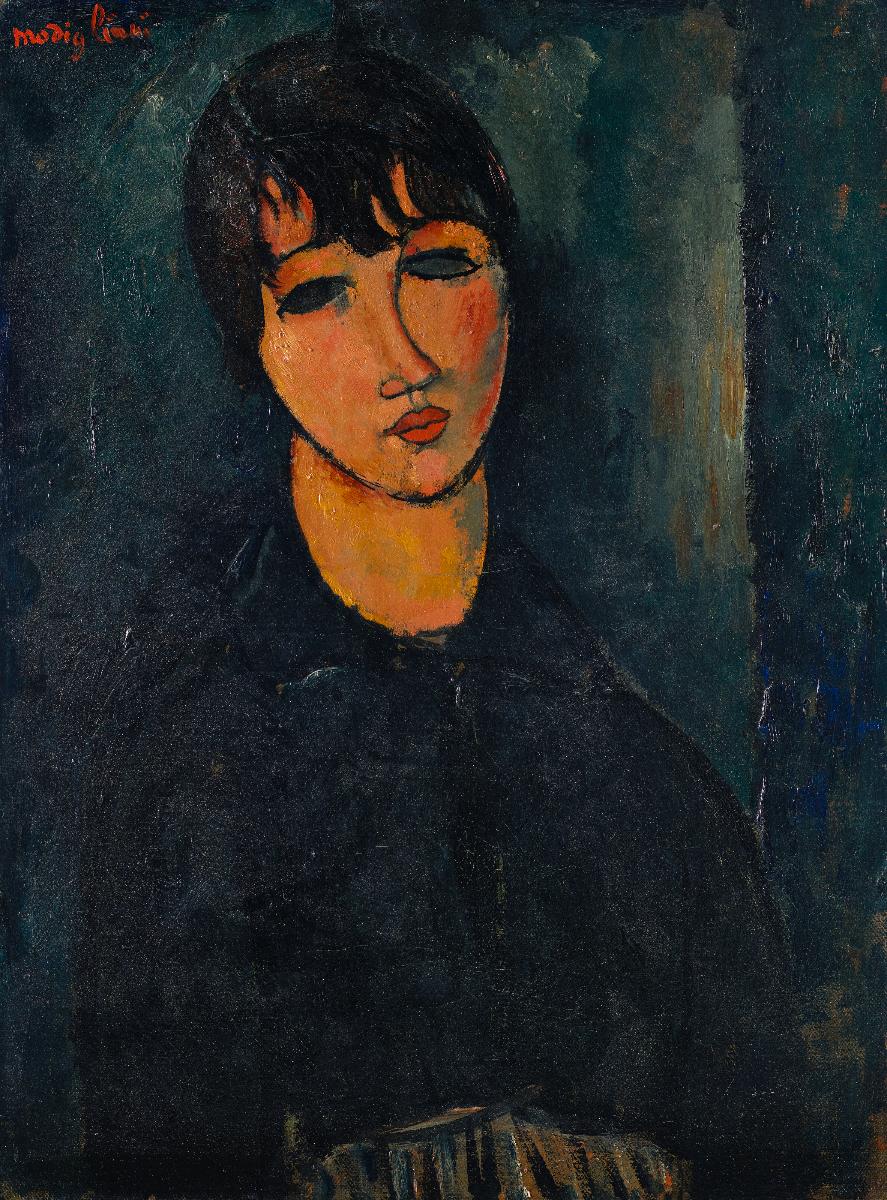
The Servant Girl is a canvas of 1916 held by the Kunsthaus Zürich under inventory number 1851, a gift of the Ulrico Hoepli Foundation since 1927. The sitter is shown to the chest, with no prop and no room around her, against a dark green wall, and the whole picture is carried by the face. With us it is made as a hand-painted copy, oil on canvas, to order, in eight sizes or in a size you give us; before dispatch we send you a photograph of the finished canvas.
| Title: | The Servant Girl |
| Other titles: | La Petite Servante · Das Dienstmädchen · La servetta · The Waitress (all listed by the museum or by Wikidata) |
| Painter: | Amedeo Modigliani (1884–1920) |
| Year of creation: | 1916 (signed modigliani at the upper left, in red) |
| Original size (width × height): | 54 × 73 cm |
| Original technique: | oil on canvas |
| Painting style: | expressionism, École de Paris |
| Located: | Kunsthaus Zürich (inv. 1851, gift of the Ulrico Hoepli Foundation, 1927) |
| Our reproduction: | hand-painted copy, oil on canvas, eight sizes or a custom size |
The Servant Girl – Amedeo Modigliani
What is on the canvas?
The young woman is shown frontally and fills almost the whole surface. Dark hair is cut in a short bob with a blunt fringe low on the forehead. The lids are heavy and darkly outlined and the eyes are nearly closed — she is not asleep, she is looking down. The nose is long, the mouth small and orange-red. The throat is a saturated orange-ochre and is the warmest plane on the canvas; below it a dark blue-black high-necked garment begins and almost merges with the ground. The ground is dark green, worked with visible strokes and a little lighter towards the left. There is no furniture, no window and no object: the painter has removed everything that would have told us where she is.
What does the museum know about this canvas?
More than it knows about most. The record states that the picture is signed at the upper left in red — an unusual choice, since Modigliani normally signs in a dark colour. It also records what is written on the back of the canvas: Modigliani. 3 Joseph Bara. Paris. That is the address of the painter’s Paris studio at the time, so the canvas carries its own place of birth on its reverse. The work is entered in both of the major catalogues of Modigliani’s output, as Ceroni 124 and as Patani 127. The museum states that the digitisation of its inventory is still in progress and publishes no ownership history for this work — so we give none either. Where the record is silent we are silent. The work also has its own Wikidata entry.
The title names a job, not a person
Besides the French title the museum and the catalogues list the picture as La servetta, Das Dienstmädchen, The Servant-girl and, on Wikidata, as The Waitress. Every one of those names an occupation. None of them names her. No record we can reach gives the sitter a name, and we do not supply one — the safest thing that can be said about this face is that somebody who worked for a living sat for it in Paris in 1916. That was the year Modigliani was painting the people immediately around him, and the circle he did it in is the one we now call the École de Paris.
The motif among the painter’s works
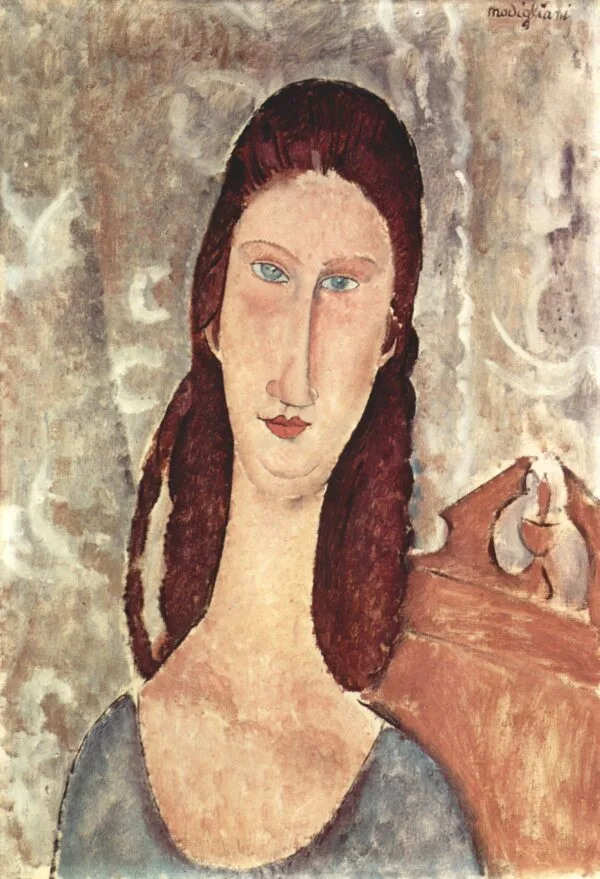
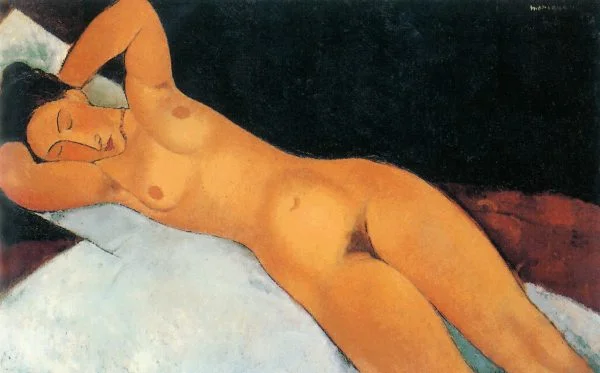
The shelf carries other faces from these same Paris years, and they read better together than any one of them does alone: L’Enfant gras of 1915 and The Boy, both of them sitters with as little setting as this one. For the same treatment given to a face the painter knew well, there is Portrait of Moïse Kisling. The whole selection is in the Amedeo Modigliani gallery, and we have written a longer article about the painter.
How is our hand-painted version made?
A painter paints it, with a brush, in oil on canvas, to your order. Every canvas painting takes some weeks, and each copy comes out slightly its own; that is the consequence of a person working rather than a machine. On this motif the difficulty is the dark. The garment and the ground are both dark and they must stay two different darks, or the figure sinks into the wall and the picture loses its only edge. The orange-ochre of the throat is the warm note that holds the whole canvas together, and it has to be kept exactly as warm as it is — a little too far and she looks sunburnt, a little too little and the picture goes cold. Before dispatch you receive a photograph of the finished canvas and approve it. It is never a print.
Which size for which wall?
For this motif we suggest 50 × 70 cm. It is a quiet, self-contained picture that rewards being looked at closely, so it does well at eye level in a room people sit in rather than pass through. Of the sizes we offer, 60 × 80 cm follows the proportions of the original most closely. Because the canvas is dark, it holds a room with warm light — a dining room, a wall beside bookshelves, a corner where a pale picture would carry no weight — and at 80 × 110 cm it will take a larger wall without thinning out. A post-impressionist painting in a size that is not on the list is no trouble: we make it to order.
Frequently asked questions
Where is the original?
In the Kunsthaus Zürich, inventory number 1851, given by the Ulrico Hoepli Foundation in 1927.
Who is the young woman?
No record we can reach names her. The title describes what she did for a living, not who she was.
Is La Petite Servante the same work?
Yes. That is the French title, and Das Dienstmädchen, La servetta and The Waitress are the same canvas under other languages.
How closely does it follow the original’s proportions?
The original measures 54 × 73 cm. The closest of our sizes is 60 x 80 cm, which departs from the original’s proportions by 1.39%.
- Subject: a young woman to the chest, dark bobbed hair, eyes almost closed and looking down, an orange-ochre throat against a dark green ground
- Original: 54 × 73 cm, oil on canvas, 1916, Kunsthaus Zürich, inv. 1851
- Ours: hand-painted oil on canvas, eight sizes or a custom size, with a photograph to approve before dispatch
- Worth knowing: the back of the canvas carries the painter’s own studio address as the record gives it, 3 Joseph Bara, Paris — but nobody recorded the sitter’s name
The eyes on this canvas are painted without pupils. We counted all 76 Modigliani works on this shelf: 53 are like that, 17 are not – work by work.