







































Description
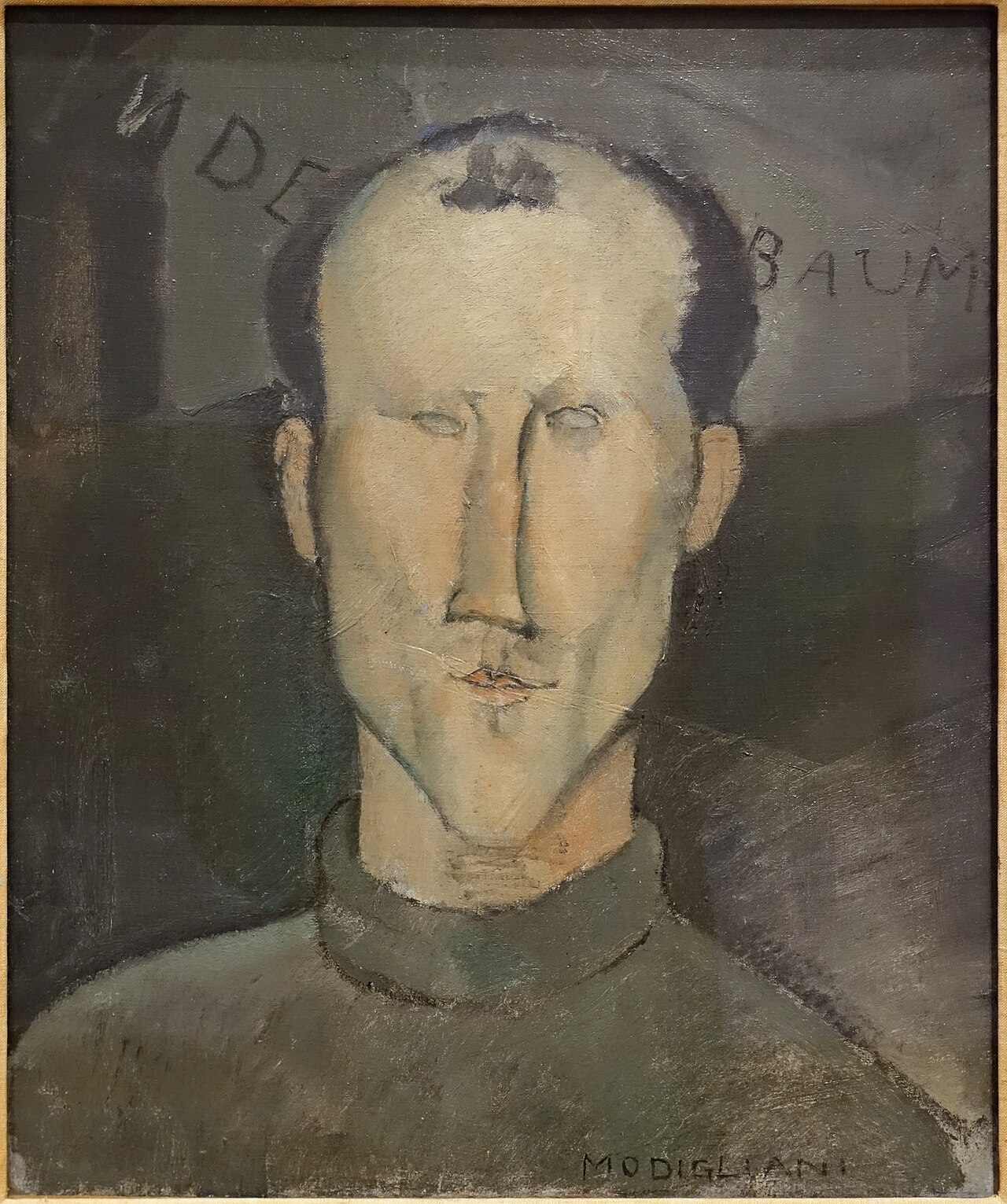
Léon Indenbaum is a portrait of 1916 in the Henry and Rose Pearlman Collection, number L.1988.62.19, on long-term loan to the Princeton University Art Museum. The sitter — a sculptor and a friend of the painter — is shown frontally in greys and greens with no setting at all, and his surname is painted in large letters across the top of the canvas. With us it is made as a hand-painted copy, oil on canvas, to order, in eight sizes or in a size you give us; before dispatch we send you a photograph of the finished canvas.
| Title: | Léon Indenbaum |
| Other titles: | Portrait of Léon Indenbaum (the longer form used in catalogues) |
| Painter: | Amedeo Modigliani (1884–1920) |
| Year of creation: | 1916 (signed lower right MODIGLIANI; the sitter’s name inscribed across the top) |
| Original size (width × height): | 45.7 × 54.6 cm |
| Original technique: | oil on canvas |
| Painting style: | expressionism, École de Paris |
| Located: | The Henry and Rose Pearlman Collection, on long-term loan to the Princeton University Art Museum (inv. L.1988.62.19) |
| Our reproduction: | hand-painted copy, oil on canvas, eight sizes or a custom size |
Léon Indenbaum – Amedeo Modigliani
What is on the canvas?
The man is shown to the chest, frontally, and fills almost the whole surface. The forehead is high, pale and domed, the hair receding at both temples with a dark tuft standing at the centre of the hairline. The face is long and narrow, the eyes heavy-lidded almonds with no iris, the nose long and straight, the mouth small and pink, the ears prominent. The neck is long and runs into a grey-green high-necked garment. The ground is grey-green and divided: a darker band at the left, a lighter field at the right. Across the top, in large letters, runs the sitter’s surname, cut into two halves by the head itself. The signature stands at the lower right, in capitals.
Why is the name painted across the top?
Because the picture was a present, and the collection’s record explains how it came about. Modigliani asked to paint the sculptor’s portrait and wanted to know whether he had painting materials at his apartment. He then worked diligently through three sittings and, when Indenbaum offered to pay, insisted that the portrait was a gift. The inscribed name appears on other portraits of Modigliani’s friends who were artists and dealers, and the collection reads the group as a series meant to repay material help and friendship. So the letters across the top are not a label added later by a museum: they are part of the painting, and they say who this is and that he mattered to the painter. The two men had studios at various times between 1911 and 1919 in the Cité Falguière, a cul-de-sac off the Rue Falguière — and Indenbaum, the record notes, would be nearly forgotten today were it not for the portraits of him by his friends.
The record of the original, and how the canvas travelled
The original is oil on canvas. The collection measures it 54.6 cm high and 45.7 cm wide, so on our page, where width comes first, it reads 45.7 × 54.6 cm. The number L.1988.62.19 begins with an L because it is a loan: the work belongs to the Henry and Rose Pearlman Foundation and is housed at Princeton. The ownership chain is named the whole way and it starts with the sitter, which is rare: acquired from the artist by Léon Indenbaum in Paris in 1916, then sold to Georges Chéron around the same year; sold at auction at the Hôtel Drouot on 1 July 1937 as lot 151; then Victor Raykis at the Galerie Zak in Paris, sold to Henry Pearlman by 1949, and to the Foundation after 1974. One deviation we state plainly: the Princeton museum’s own pages refuse our requests, so we link the Pearlman Collection’s record instead of theirs and take nothing from a page we could not read. The work also has its own Wikidata entry.
The motif among the painter’s works
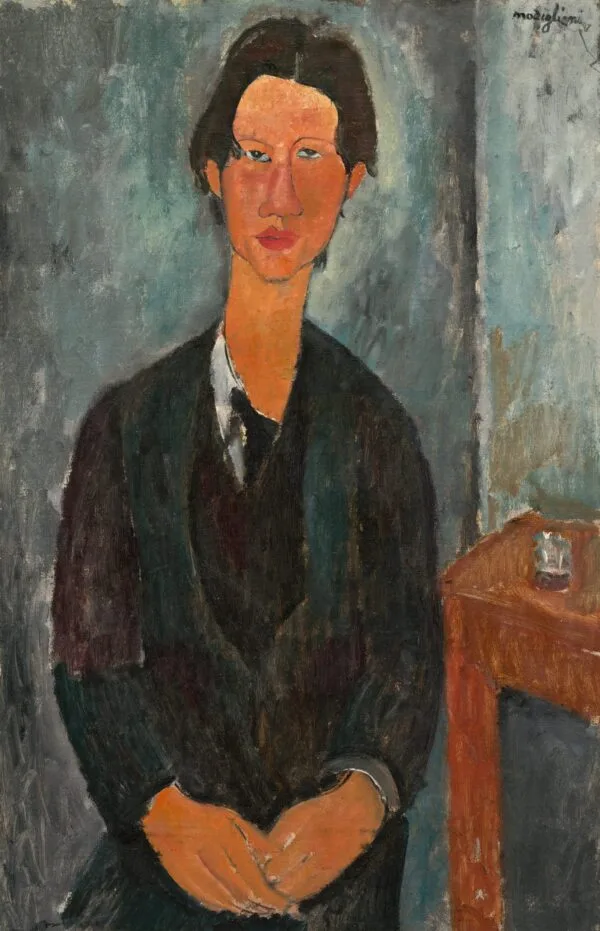
The neighbouring number in the same collection is Jean Cocteau, L.1988.62.18 — the two hang in the catalogue side by side, and both are on this shelf. Painted the same year, and just as stripped of any setting, is The Servant Girl; and for another friend from the same Montparnasse circle there is Portrait of Moïse Kisling. Put together they show what Modigliani did over and over in those years: a face, no room, and a name — when there was one to give. The whole selection is in the Amedeo Modigliani gallery, and we have written a longer article about the painter.
How is our hand-painted version made?
A painter paints it, with a brush, in oil on canvas, to your order. Every canvas painting takes some weeks, and each copy comes out slightly its own; that is the consequence of a person working rather than a machine. On this motif the difficulty is that almost everything is one family of colour. The face, the garment and the ground are all in the grey-green range, and they have to stay three separate things without any of them being pushed into a brighter key than the original allows. The lettering across the top has to be painted, not drawn or stencilled, and it has to keep the slight unevenness it has — mechanically perfect letters would look printed and would give the whole picture away. There is one thing our copy cannot show you: an x-ray taken in 2011 found an unrelated design underneath this portrait, possibly a still life. It is invisible on the surface, and so it is invisible on ours. Before dispatch you receive a photograph of the finished canvas and approve it. It is never a print.
Which size for which wall?
For this motif we suggest 90 × 110 cm. The picture is nearly square and quiet, with no strong colour in it, so it works where a painting should not raise its voice: a study, an office, a library, an entrance hall. The grey-green scale sits well with wood and with earth-coloured walls, and loses some of its calm on a very dark one. Of the sizes we offer, 137 × 164 cm follows the proportions of the original most closely, and 60 × 70 cm is enough where the wall is small and the picture will be looked at from close up. A post-impressionist painting in a size that is not on the list is no trouble: we make it to order.
Frequently asked questions
Where is the original?
In the Henry and Rose Pearlman Collection, number L.1988.62.19, on long-term loan to the Princeton University Art Museum.
Who was Léon Indenbaum?
A sculptor, born in Vilnius and schooled in Ukrainian art schools, who came to Paris in 1911 and probably met Modigliani in the circles of Montparnasse, the group we now call the École de Paris. The word probably is the collection’s and we keep it. The collection’s page gives two different years for his death, so we print none.
What does the writing across the top say?
The sitter’s surname, painted into the picture by Modigliani himself and cut in two by the head.
Is it suitable as a gift?
Yes — and appropriately so, since the original was one. If you would rather not pick the size there is a gift voucher the recipient redeems themselves.
How closely does it follow the original’s proportions?
The original measures 45.7 × 54.6 cm. The closest of our sizes is 137 x 164 cm, which departs from the original’s proportions by 0.19%.
- Subject: a man to the chest, frontal, high domed forehead, eyes without an iris, his surname in large letters across the top
- Original: 45.7 × 54.6 cm, oil on canvas, 1916, Henry and Rose Pearlman Collection, inv. L.1988.62.19
- Ours: hand-painted oil on canvas, eight sizes or a custom size, with a photograph to approve before dispatch
- Worth knowing: Modigliani painted it in three sittings and refused to be paid — and an x-ray in 2011 found another, unrelated picture underneath it
The eyes on this canvas are painted without pupils. We counted all 76 Modigliani works on this shelf: 53 are like that, 17 are not – work by work.