



Description
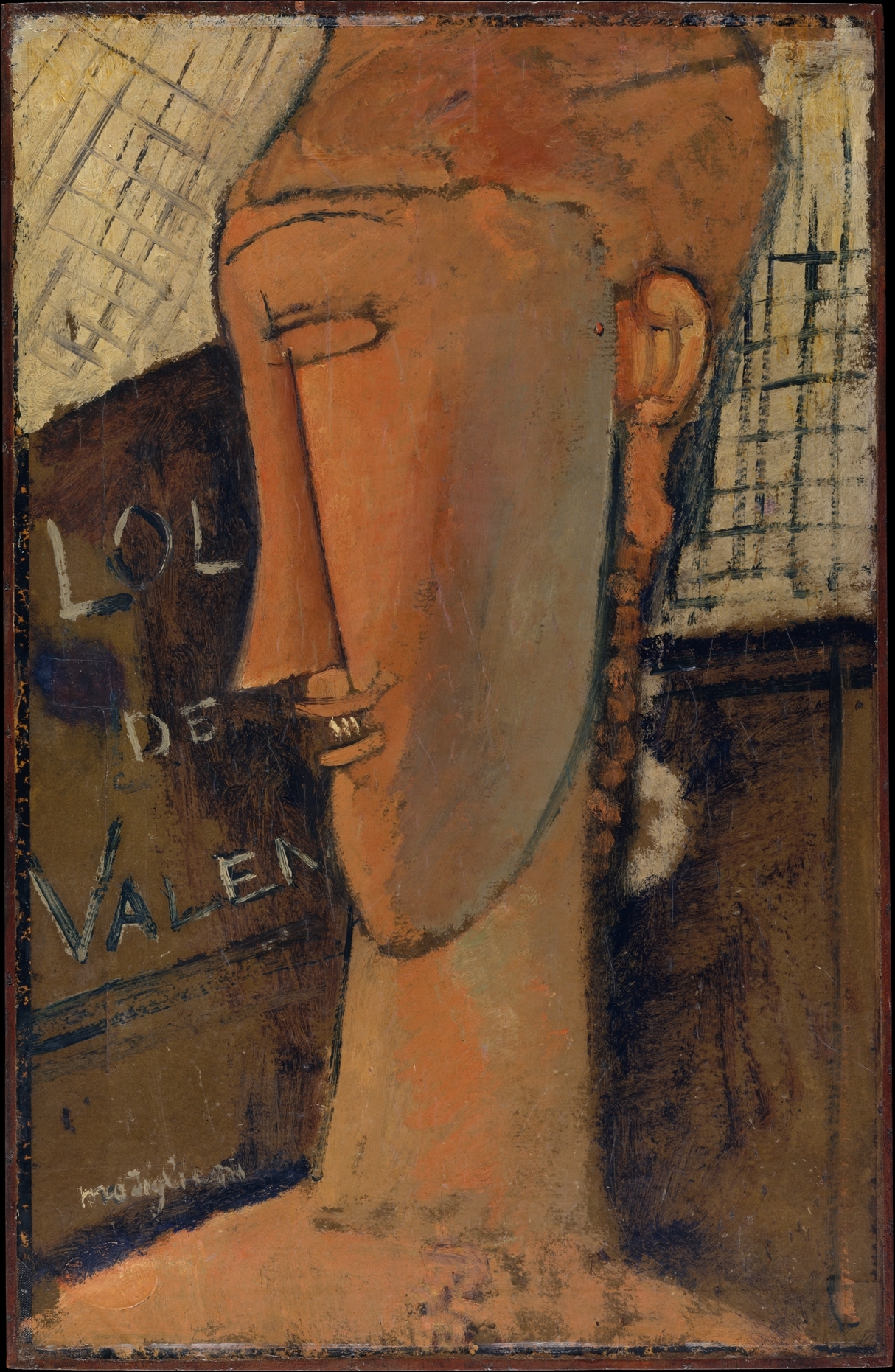
Lola de Valence is a head of 1915 in the Metropolitan Museum of Art, under the number 67.187.84. A long ochre face is drawn in a few lines against a dark olive ground, and the sitter’s name is painted into that ground in large pale letters, broken and cut off by the head itself. With us it is made as a hand-painted copy, oil on canvas, to order, in eight sizes or in a size you give us; before dispatch we send you a photograph of the finished canvas.
| Title: | Lola de Valence |
| Other titles: | the museum gives this one title, and the picture carries it in paint as LOL DE VALEN |
| Painter: | Amedeo Modigliani (1884–1920) |
| Year of creation: | 1915 — a flat year, on the museum’s record and on Wikidata alike |
| Original size (width × height): | 33.7 × 52.1 cm — the museum’s figures; older catalogues gave 33 × 51 cm |
| Original technique: | oil on paper, mounted on a wood panel — the museum’s own wording, not oil on canvas |
| Painting style: | expressionism, École de Paris |
| Located: | The Metropolitan Museum of Art, New York (inv. 67.187.84, bequest of Miss Adelaide Milton de Groot, 1967) |
| Our reproduction: | hand-painted copy, oil on canvas, eight sizes or a custom size |
Lola de Valence – Amedeo Modigliani
What is on the picture?
A head and a long neck fill nearly the whole height. The face is a long ochre-orange oval and it is drawn rather than modelled: the eyes are two horizontal slits under a single dark bar, without pupils; one continuous line runs from the brow down the length of the nose; the mouth is a small dark shape with a few crossing strokes. On the right the ear is a spiral, and below it a plait falls as a chain of ochre knobs. The hair over the crown is a flat dark cap. The ground is divided into three: a pale hatched panel at the upper left, a second pale panel with a grid at the upper right, and beneath them a dark olive-brown field that fills the lower half. Into that field, at the left, the name is painted in large pale letters — LOL, DE, VALEN, on three lines, each one running out of room where the head cuts across it. The signature stands at the lower left. The four corners are damaged, and the catalogue file notes holes there, which is what happens to a sheet of paper that has been pinned up.
Why does the picture carry its own title in paint?
Because Modigliani wrote it there, and it is part of the picture rather than a label on it. The letters are not neatly placed: they begin at the left edge and are interrupted by the head, so the name arrives as LOL DE VALEN and stops. Wikidata records the inscription in exactly that truncated form, which is a small check that we and the database are looking at the same object. Lola de Valence is a Spanish dancer’s name that had been a picture title before, and we leave the association there without building on it, because the museum’s record does not explain it and we would only be guessing at what he meant by it. What the lettering does do is fix the date in style: in 1915 Modigliani was still working like the sculptor he had been, cutting a face down to a few lines and treating the ground as a flat surface to be inscribed. The sculpture years are on this shelf too, in Caryatid; for what the same head became two years later, see Lolotte.
The record of the original: paper, not canvas
This is the one thing on this page a buyer should read twice. The museum’s medium field says oil on paper, mounted on a wood panel. It is not a painting on canvas, and we would rather say so than let the word canvas slide past. Older catalogues recorded it as oil on canvas and gave the size as 33 × 51 cm; the museum, which has the object, gives 33.7 × 52.1 cm and paper on wood, and where the institution and an old catalogue disagree we follow the institution. The photograph supports the museum’s figures: the published image is 407 by 624 pixels, a shape of 0.652, within 0.9 per cent of 33.7 × 52.1. The museum marks its own photograph as public domain. Its object page rate-limits automated readers, so the link above is registered against its public API record, which answers with this work’s artist, title, accession, date and medium. The work also has its own Wikidata entry. The whole selection is in the Amedeo Modigliani gallery, and we have written a longer article about the painter.
Where has the picture been?
The museum states the end of the chain itself: a bequest from Miss Adelaide Milton de Groot in 1967. The catalogue file fills in what came before, and one name on it is familiar here — a Guillaume collection in Paris in 1929. The file gives only the surname, so we will not insist it is the dealer Paul Guillaume, whose portrait hangs on this same shelf as Paul Guillaume; we say what is written and leave the identification open. After that the file lists G. le Niveau in 1938, then the Valentine Gallery in New York in 1940, with a stock number and a sale to Miss de Groot for 980 dollars in January of that year, then her own collection until 1967, with the picture already on loan to the museum from 1952. It is an unusually detailed chain for this shelf, and its last link is the one the museum confirms in its own words. The names in it are the ordinary trade of the École de Paris: a Paris collection, a French dealer, a New York gallery, an American collector.
How is our hand-painted version made?
A painter paints it, with a brush, in oil on canvas, to your order. Every canvas painting takes some weeks, and each copy comes out slightly its own; that is the consequence of a person working rather than a machine. Since the original is on paper and ours is on canvas, the difference has to be handled rather than ignored: the paper gives the original a dry, slightly absorbed surface, so the copy is kept thin and matt rather than glossy, and the ground is laid flat so the letters can sit on it. The lettering is the hard part. It has to look painted by hand and slightly uneven, the way it is, and it must keep its exact interruption where the head crosses it — corrected into a full LOLA DE VALENCE, it would be a different picture. The face is a drawing more than a modelling, so the contour line has to go down in one stroke and be left alone. Before dispatch you receive a photograph of the finished canvas and approve it. It is never a print.
Which size for which wall?
For this motif we suggest 60 × 92 cm. Two of our sizes are close on proportion and we measured both: 90 × 140 cm is nearest at 0.6 per cent from the original’s shape, and 60 × 92 cm follows at 0.8 per cent — a difference small enough that we would choose between them on the wall rather than on the arithmetic. The next one after those is 70 × 110 cm at 1.6 per cent. The original is small, a third of a metre across, and the design is severe: one head, three panels of ground, four words. That severity holds a large format better than most portraits do, so 90 × 140 cm works on a main wall; at 60 × 92 cm it stays a picture you stand in front of. The ochre and dark olive suit a warm or neutral wall and fight a cold blue one. A post-impressionist painting in a size that is not on the list is no trouble: we make it to order.
Frequently asked questions
Where is the original?
In the Metropolitan Museum of Art, New York, accession number 67.187.84, bequeathed by Miss Adelaide Milton de Groot in 1967.
Is the original on canvas?
No. The museum records it as oil on paper, mounted on a wood panel. Older catalogues called it oil on canvas; we follow the museum, which holds the object.
What does the writing on it say?
LOL, DE, VALEN — the sitter’s name painted into the ground and cut off by the head. We reproduce it exactly as it stands, unfinished.
How closely does it follow the original’s proportions?
The original measures 33.7 × 52.1 cm. The closest of our sizes is 90 x 140 cm, which departs from the original’s proportions by 0.61%. The catalogues do not agree on the size and give 33.7 × 52.1 cm; 33 × 51 cm; the comparison above starts from the first of them.
- Subject: a long ochre head drawn in a few lines, a plait falling on the right, and the name LOL DE VALEN painted into a dark olive ground
- Original: 33.7 × 52.1 cm, oil on paper mounted on a wood panel, 1915, Metropolitan Museum of Art, inv. 67.187.84
- Ours: hand-painted oil on canvas, eight sizes or a custom size, with a photograph to approve before dispatch
- Worth knowing: the original is not a canvas but a sheet of paper on a panel, and older catalogues had both the medium and the size wrong
The eyes on this canvas are painted without pupils. We counted all 76 Modigliani works on this shelf: 53 are like that, 17 are not – work by work.