



Description
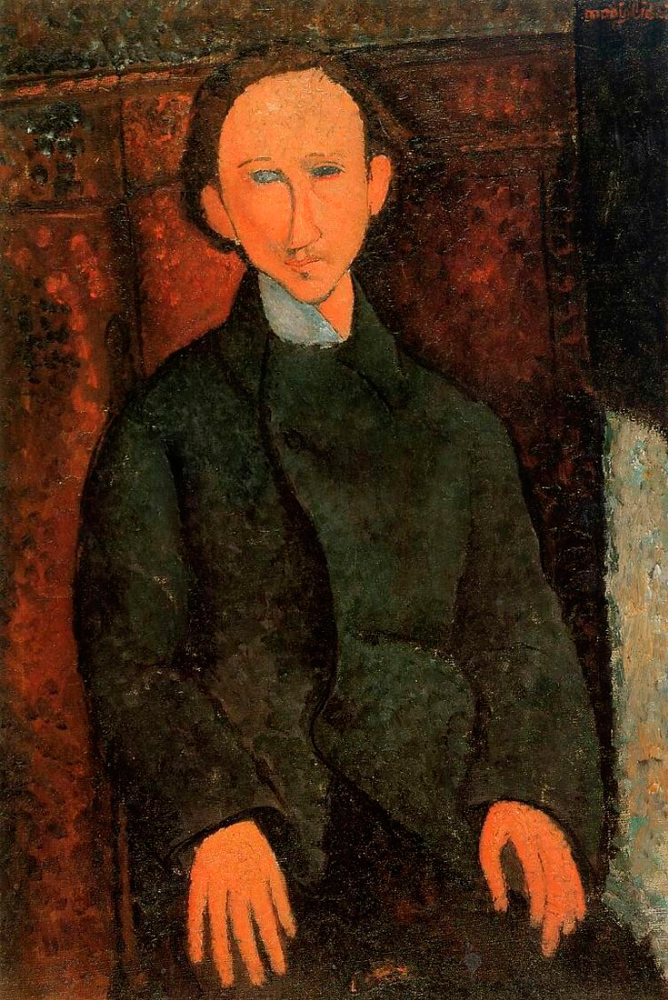
The Painter Krémègne is a portrait of 1916, held by the Kunstmuseum Bern under the number G 81.036. A man sits in a patterned chair, frontal and slightly turned, in a green-black overcoat, with both hands laid open on his knees. With us it is made as a hand-painted copy, oil on canvas, to order, in eight sizes or in a size you give us; before dispatch we send you a photograph of the finished canvas.
| Title: | The Painter Krémègne |
| Other titles: | Le Peintre Krémègne · Pinchus Krémègne, the forms used by the records |
| Painter: | Amedeo Modigliani (1884–1920) |
| Year of creation: | 1916 — all three records we could read agree on the year |
| Original size (width × height): | 55.5 × 82 cm — two records agree on this; Wikidata gives 55 × 81 cm |
| Original technique: | oil on canvas |
| Painting style: | expressionism, École de Paris |
| Located: | Kunstmuseum Bern (inv. G 81.036, recorded as the legacy of Georges F. Keller, 1981) |
| Our reproduction: | hand-painted copy, oil on canvas, eight sizes or a custom size |
The Painter Krémègne – Amedeo Modigliani
What is on the canvas?
The sitter is shown to the thighs, frontal and turned a little to his right, in a chair whose patterned red-brown back spreads out behind him. The forehead is high and domed in a warm orange-pink, the hair thin over the crown, receding at the temples and dark at the sides. The face is long and narrow; the eyes are pale blue-grey almonds under heavy lids, with the pupils barely marked; the nose is long and straight, a small dark moustache sits over a small mouth. He wears a green-black buttoned overcoat with a broad collar, and a pale blue-white shirt collar shows at the throat. Both hands rest open on the knees, palms down and the fingers spread, painted in the same orange-pink as the face — three light planes in a dark picture, and the most unusual thing in it. At the upper right the ground turns to a dark brown-black panel; down the right edge runs a strip of flecked blue-grey light. The signature stands at the upper right, in red, and the catalogue file records it in exactly that place and colour.
Why is a painter painting a painter?
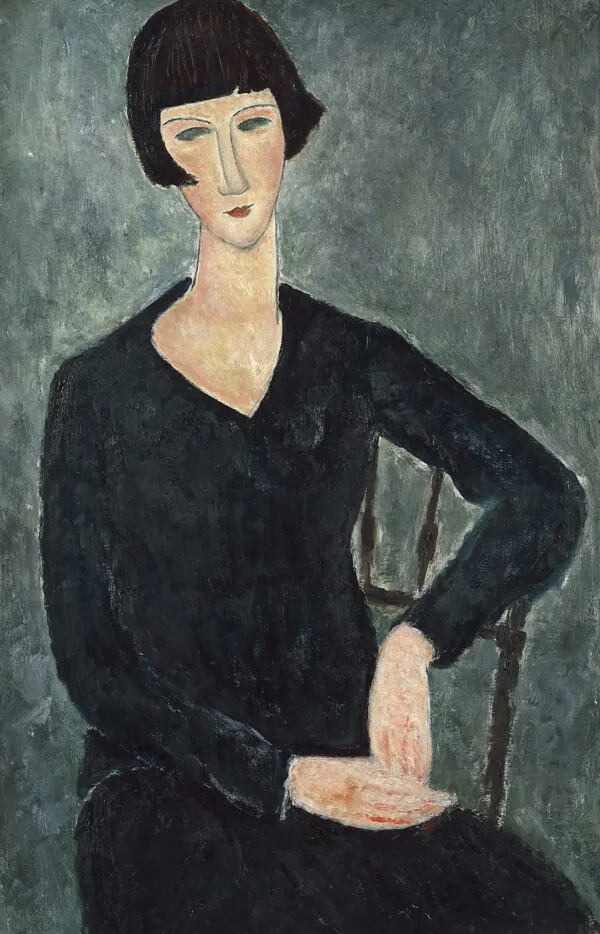
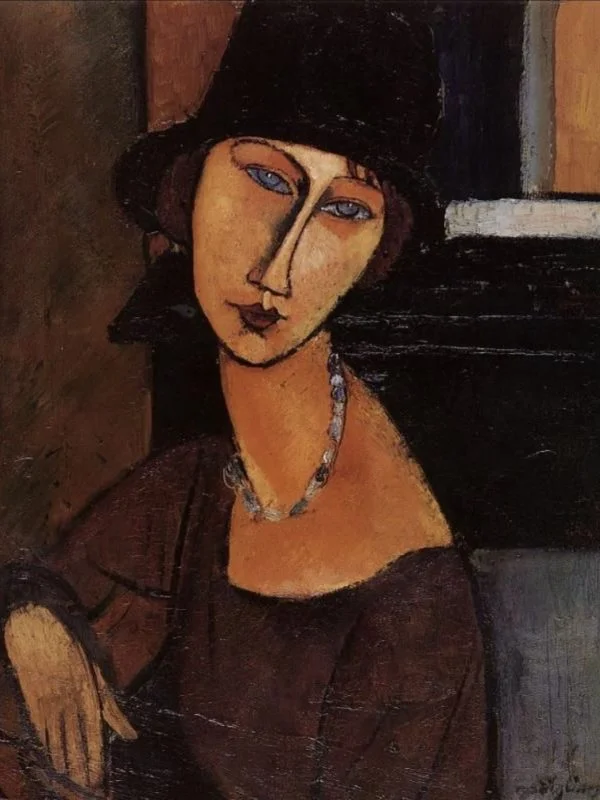
Because the sitter was one. Pinchus Krémègne was a Litvak sculptor and painter of the same Montparnasse circle, and Modigliani painted a good many of his own colleagues: the shelf also carries Portrait of Chaïm Soutine, Portrait of Moïse Kisling and Léon Indenbaum. That is the École de Paris seen from inside — foreign artists in Paris painting each other because they were who was there. What is worth looking at is how this one is painted: not as a mask with sealed eyes, which is the common Modigliani formula, but with a gaze you can meet, and with hands that are not folded away in the lap but laid open on the knees. It is the posture of a man sitting and waiting, and it makes the portrait more particular than most. For the same year in a wholly different key see Woman with Earrings.
The record of the original, and the two sizes that do not agree
The museum’s own catalogue could not be read from here: its collection site returned us no entry for this work, and the provenance document the museum itself references answers 401 — and answers 401 to a made-up filename as well, so that door tells us nothing either way. What we could read are two records that are not the museum. The Bildindex record kept by the Bildarchiv Foto Marburg gives 1916, oil on canvas, 82 × 55.5 cm, Kunstmuseum Bern; a published Modigliani catalogue file gives 1916, oil on canvas, 82 × 55.5 cm, inventory G 81.036. They agree with each other. The work’s Wikidata entry gives 81 × 55 cm, which is a centimetre and a half smaller in both directions. We print the pair that two independent records share, and we print the third figure too rather than hiding the disagreement. As a weak third check, the shape of the published photograph is 0.668, which is nearer the 82 × 55.5 pair than the other — nearer, but not proof. We give width first, so on our page it reads 55.5 × 82 cm. The whole selection is in the Amedeo Modigliani gallery, and we have written a longer article about the painter.
Where has the picture been?
The catalogue file sets out a chain and marks its own research as unfinished, and we carry it in that spirit. It runs: the Paris dealer Libaude — the man Wikidata lists under his pen name, Louis Lormel — then the Mareuse collection in Paris, which the file itself flags with a question mark, then the Keller collection in Bern, and then the Kunstmuseum Bern, as the legacy of Georges F. Keller in 1981. The inventory number G 81.036 is consistent with that year. We do not say the chain is complete, because the file that supplies it does not say so, and because the museum’s own provenance report is the document we could not open. What we can say is which names are recorded, in what order, and which link is already marked doubtful by the source that supplies it.
How is our hand-painted version made?
A painter paints it, with a brush, in oil on canvas, to your order. Every canvas painting takes some weeks, and each copy comes out slightly its own; that is the consequence of a person working rather than a machine. This motif is a dark one with three light passages in it — the face and the two hands — and the whole thing stands or falls on their being the same colour. Painted a shade apart, the hands stop belonging to the man and start looking like objects on his knees. The coat is green-black and must keep its green, not collapse into flat black, because it takes up most of the surface. The chair back behind him is patterned red-brown and has to stay a background: worked up too brightly it competes with the face. Before dispatch you receive a photograph of the finished canvas and approve it. It is never a print.
Which size for which wall?
For this motif we suggest 60 × 90 cm. There is no single closest size and we will not invent one: four of our eight sizes share the same 2:3 shape, and all four sit 1.5 per cent from the original’s proportions — 40 × 60, 60 × 90, 80 × 120 and 100 × 150 cm are equally close. The next nearest is 90 × 130 cm at 2.3 per cent. That ranking survives the disagreement over the original’s measurements: taking Wikidata’s 55 × 81 cm instead, the same four still come first. The picture is dark and it reads from a distance, so it wants a light wall and room to be seen from across it; at 80 × 120 cm it becomes the main picture of a room. Close to, on a narrow wall, 60 × 90 cm gives the hands about the size they have in the original. A post-impressionist painting in a size that is not on the list is no trouble: we make it to order.
Frequently asked questions
Where is the original?
In the Kunstmuseum Bern, inventory number G 81.036, recorded as the legacy of Georges F. Keller in 1981.
Who was Krémègne?
Pinchus Krémègne, a Litvak sculptor and painter working in Montparnasse. Modigliani painted him as a colleague, not as a client.
How large is the original?
Two records agree on 55.5 × 82 cm; Wikidata gives 55 × 81 cm. We print the first and name the second, because the museum’s own sheet was not reachable to settle it.
How closely does it follow the original’s proportions?
The original measures 55.5 × 82 cm. The closest of our sizes is 60 x 90 cm, which departs from the original’s proportions by 1.5%. The catalogues do not agree on the size and give 55.5 × 82 cm; 55 × 81 cm; the comparison above starts from the first of them.
- Subject: a seated man to the thighs, green-black overcoat, both hands open on the knees, a patterned red-brown chair back behind him
- Original: 55.5 × 82 cm, oil on canvas, 1916, Kunstmuseum Bern, inv. G 81.036
- Ours: hand-painted oil on canvas, eight sizes or a custom size, with a photograph to approve before dispatch
- Worth knowing: the museum’s own record could not be read from here; two other records agree on the size and a third differs by a centimetre and a half, and we print all of it
The eyes on this canvas are painted without pupils. We counted all 76 Modigliani works on this shelf: 53 are like that, 17 are not – work by work.