



Description
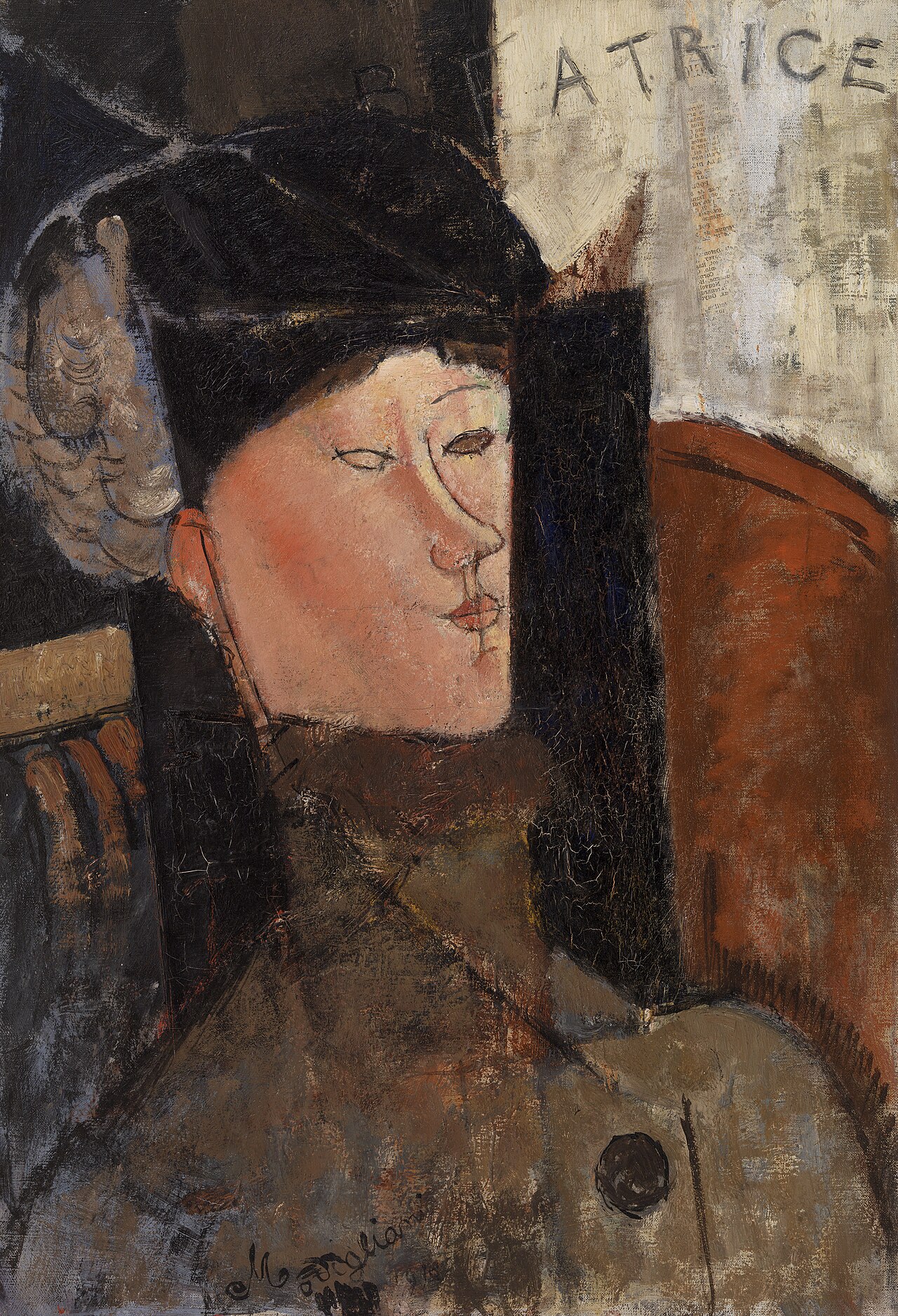
Beatrice (Portrait of Béatrice Hastings) is a canvas of 1916 in the Barnes Foundation, Philadelphia, under the number BF361. The sitter is seen close to under a black hat, her eyes almost shut, and her name runs across the top of the picture in painted capitals. With us it is made as a hand-painted copy, oil on canvas, to order, in eight sizes or in a size you give us; before dispatch we send you a photograph of the finished canvas.
| Title: | Beatrice (Portrait of Béatrice Hastings) |
| Other titles: | Beatrice (Portrait de Béatrice Hastings), the museum’s own form; the catalogues also list Au théâtre |
| Painter: | Amedeo Modigliani (1884–1920) |
| Year of creation: | 1916 — the museum’s year, and the painter dated the canvas himself |
| Original size (width × height): | 38.2 × 55 cm — the museum’s overall figures; an older catalogue gave 33 × 55 cm |
| Original technique: | oil on canvas with newsprint — the museum’s own wording, not oil alone |
| Painting style: | expressionism, École de Paris |
| Located: | Barnes Foundation, Philadelphia (inv. BF361, bought by Albert C. Barnes in 1925) |
| Our reproduction: | hand-painted copy, oil on canvas, eight sizes or a custom size |
Beatrice (Portrait of Béatrice Hastings) – Amedeo Modigliani
What is on the canvas?
The head and shoulders fill the picture, the head turned to her left and tilted, the eyes almost shut — one shows a dark iris under a heavy lid, the other is reduced to the lid’s line. A large black hat sits low over the brow, and a pale grey plume curls out of it at the left. The face is pink and ochre, broad at the cheek and narrowing to a small red-brown mouth; the nose is one unbroken line from the brow. Down the right side of the face runs a hard black slab of shadow — not modelled but cut, a flat block laid against the cheek. She wears a heavy olive-brown coat with a wide collar crossing at the front and one large dark button at the lower right. The ground is built from panels: a striped grey-brown one at the left, a rust-orange field at the right, and above them a pale panel that carries the printed texture of newspaper. Across the top, in large painted capitals, runs her name — the hat cuts into it, so what reads clearly is ATRICE. The signature is at the lower centre, and the catalogue file records it as Modigliani with the year beneath.
Why is there newspaper in the picture?
Because there was a piece of it stuck to the surface. The museum’s own record says so: at one time a strip of newspaper was pasted to the canvas, and traces of the newsprint ink remain visible in the background, just below her name. That is why the medium field reads oil on canvas with newsprint rather than oil on canvas, and it is why the pale panel at the upper right looks like printed matter under the paint — we can see it in the photograph, and the museum’s note explains what we are seeing. The museum reads the picture as an experiment with cubism, the sitter translated into sharp blocky forms; that is its description and we hand it on as its description, with the note that the museum’s own record marks this text as not yet curatorially approved. The strip is gone; the ink stayed. For the same trick of writing a name into a picture, see Lola de Valence, where the head cuts the lettering off in the same way.
The record of the original, and who the sitter was
The original is oil on canvas with newsprint, and the museum gives its overall size as 55 cm high and 38.2 cm wide; we give width first, so on our page it reads 38.2 × 55 cm. An older catalogue recorded 33 cm across rather than 38.2, and the modern catalogue file agrees with the museum, so we follow the museum. The number is BF361 and the year is 1916, which the painter also wrote on the canvas himself. Béatrice Hastings was a British poet and journalist who came to Paris in 1914 and wrote from Montparnasse under a pen name; she and Modigliani were together, stormily, for about two years, and he painted her more than once. The other portrait is on this shelf as Portrait of Beatrice Hastings. The work also has its own Wikidata entry. The whole selection is in the Amedeo Modigliani gallery, and we have written a longer article about the painter.
Where has the picture been?
This is the shortest and firmest provenance on the shelf so far, because the museum publishes it in one line of its own: purchased by Albert C. Barnes from Paul Guillaume, Paris, in January 1925. Two names, one date, and the institution itself standing behind them. Paul Guillaume was the Paris dealer who handled a great deal of Modigliani, and he is on this shelf too, painted by him, as Paul Guillaume. Nothing is published about the nine years between the painting and that sale, and we do not fill them in. It is worth saying how unusual this is: most of the works on this shelf come with a chain of collectors that some catalogue has marked as unfinished, and this one comes with a receipt. Guillaume was the dealer the École de Paris ran through, which is why his name keeps appearing on this shelf.
How is our hand-painted version made?
A painter paints it, with a brush, in oil on canvas, to your order. Every canvas painting takes some weeks, and each copy comes out slightly its own; that is the consequence of a person working rather than a machine. Two things decide whether this one comes off. The first is the black slab beside the face: it has to stay a flat shape with a hard edge, because the moment it is softened into shadow the picture stops being the experiment it is and becomes an ordinary portrait. The second is the lettering, which must be painted with the same brush as the rest and must keep its interruption where the hat crosses it. The pale panel behind is painted as a worked, printed-looking surface rather than a clean wall, since that is what the original carries. We do not paste newspaper onto the copy; it is painted throughout, and we say so rather than implying a collage. Before dispatch you receive a photograph of the finished canvas and approve it. It is never a print.
Which size for which wall?
For this motif we suggest 70 × 100 cm. On proportions we measured the ladder: 90 × 130 cm is nearest at 0.3 per cent from the original’s shape, and 70 × 100 cm follows at 0.8 per cent, with 120 × 170 cm third at 1.6 per cent. The picture is built out of flat panels of colour, so it reads from a distance better than a modelled portrait does and it takes enlargement well; at 90 × 130 cm it holds a main wall without becoming a poster. The palette is olive, rust and black, which wants a light wall — on a dark one the coat and the hat close up and only the face is left. A post-impressionist painting in a size that is not on the list is no trouble: we make it to order.
Frequently asked questions
Where is the original?
In the Barnes Foundation, Philadelphia, inventory number BF361, bought by Albert C. Barnes from Paul Guillaume in January 1925.
Is there really newspaper on the original?
There was. The museum records that a strip of newspaper was once pasted to the surface and that traces of its ink remain in the background. Our copy is painted, not pasted.
Who was Béatrice Hastings?
A British poet and journalist who came to Paris in 1914. She and Modigliani were together for about two years, and he painted her more than once.
How closely does it follow the original’s proportions?
The original measures 38.2 × 55 cm. The closest of our sizes is 90 x 130 cm, which departs from the original’s proportions by 0.32%. The catalogues do not agree on the size and give 38.2 × 55 cm; 33 × 55 cm; the comparison above starts from the first of them.
- Subject: a woman under a black hat, eyes almost shut, a hard black block beside the face, her name in capitals across the top
- Original: 38.2 × 55 cm, oil on canvas with newsprint, 1916, Barnes Foundation, inv. BF361
- Ours: hand-painted oil on canvas, eight sizes or a custom size, with a photograph to approve before dispatch
- Worth knowing: a strip of newspaper was once pasted to the original and its ink still shows; the museum bought the picture from Paul Guillaume in January 1925 and says so in one line
The eyes on this canvas are painted without pupils. We counted all 76 Modigliani works on this shelf: 53 are like that, 17 are not – work by work.