


Description
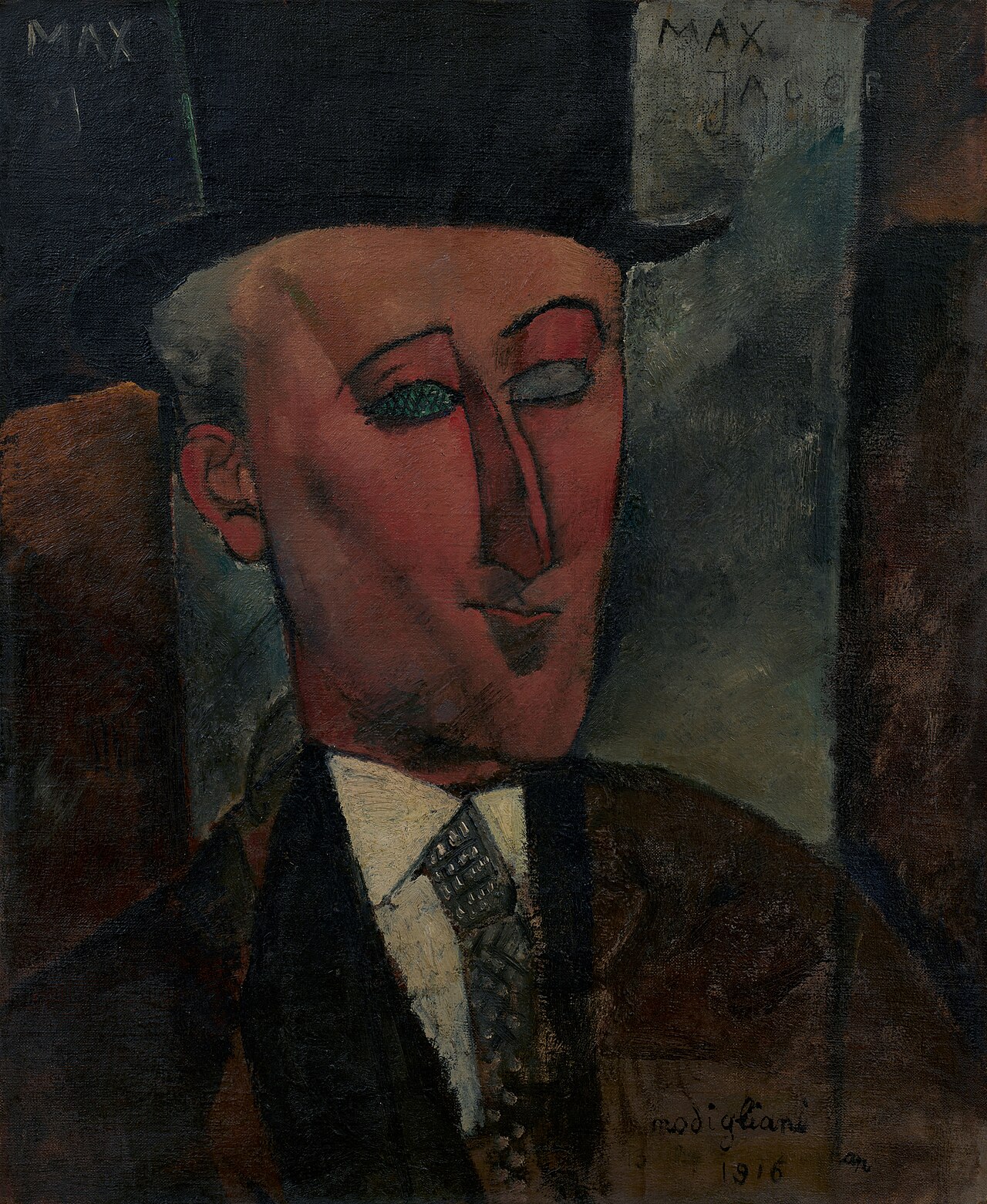
Portrait of Max Jacob is a canvas of 1916 in the Kunstsammlung Nordrhein-Westfalen in Düsseldorf, under the number 1036. A man in a black bowler hat is seen close to, one eye open and green and the other closed, with his name written twice into the background. With us it is made as a hand-painted copy, oil on canvas, to order, in eight sizes or in a size you give us; before dispatch we send you a photograph of the finished canvas.
| Title: | Portrait of Max Jacob |
| Other titles: | Portrait de Max Jacob, the museum’s own French form; the catalogue number is Restellini RP 116 |
| Painter: | Amedeo Modigliani (1884–1920) |
| Year of creation: | 1916 — the museum’s year, and the painter wrote it on the canvas beside his name |
| Original size (width × height): | 63.8 × 76.7 cm, the painting; the museum also gives the frame, 83.4 × 95.5 × 8.5 cm |
| Original technique: | oil on canvas |
| Painting style: | expressionism, École de Paris |
| Located: | Kunstsammlung Nordrhein-Westfalen, Düsseldorf (inv. 1036, acquired 1965) |
| Our reproduction: | hand-painted copy, oil on canvas, eight sizes or a custom size |
Portrait of Max Jacob – Amedeo Modigliani
What is on the canvas?
The head and shoulders fill the canvas, seen close to, the head turned a little to our right. The face is a broad brick-pink mask bounded by heavy dark contours, its planes cut rather than modelled; the nose is long and made of two joined planes, the mouth small and dark, the brows heavy. The two eyes are not a pair: the one on our left is a green almond with a dark lid line and is open, while the other is a closed lid, a pale grey-mauve crescent with no pupil at all. He wears a black bowler hat, its brim running across the top of the head, and a dark jacket over a white shirt with a patterned tie of dark cloth marked with pale squares. Behind him the ground is built in panels: black at the upper left, a pale grey panel at the upper right, brown-red down both edges and a grey-green field behind the head. Pale letters are scratched into two of those panels, and the signature and the year stand together at the lower right.
Why is the name written twice?
Because Modigliani wrote it twice, and the museum’s inscription line records all three marks: at the lower right, modigliani with the year; at the upper left, MAX J; and at the upper right, MAX JACOB on two lines. On the photograph the upper-left letters read MAX clearly with a further letter beneath them, and the upper-right block gives the name in full. So one corner starts the name and stops, and the other completes it — the same habit of writing into the picture that runs through this shelf, but here it happens twice on one canvas. Lola de Valence has the title painted into the ground and cut short by the head; this one cuts itself short and then corrects itself in the opposite corner. The sitter was the poet Max Jacob, a close friend of the painter, and the shelf carries another portrait of him under the same title, Portrait of Max Jacob.
The record of the original
The original is oil on canvas. The museum gives the painting as 76.7 × 63.8 × 2 cm — the depth is the stretcher — and the frame separately as 95.5 × 83.4 × 8.5 cm; we print the painting, width first, so on our page it reads 63.8 × 76.7 cm. The inventory number is 1036, the catalogue raisonné number is Restellini RP 116, and the acquisition year is 1965. The credit line is worth quoting because it is unusual: the museum bought the picture in 1965 with a donation from Westdeutscher Rundfunk, the regional broadcaster. The image is marked as being in the public domain, and the work is on display in the museum’s K20 building. The work also has its own Wikidata entry. The whole selection is in the Amedeo Modigliani gallery, and we have written a longer article about the painter.
Where has the picture been?
The museum publishes a chain with dates and its own hedges, and then explains it in prose — including how little is known. It begins with the painter himself, from 1916 until at the latest 1920; then, possibly, Joseph Altounian, with no date; then the Galerie Paul Guillaume in Paris before 1923, the dealer who turns up again and again on this shelf and who is painted on it in Paul Guillaume. From at the latest April 1923 the picture belonged to Paul Poiret, and his collection was auctioned at the Hôtel Drouot on 18 November 1925, where André Lefèvre bought it; it stayed with Lefèvre for forty years until his collection was sold in turn, at the Palais Galliera on 25 November 1965. The museum bought it there — and then, it says, a long dispute over the export licence meant the picture did not reach Düsseldorf until 1972. That is why its own chain ends with the double date 1965/1972. A couturier, a collector, two auction houses and a broadcaster’s donation: the École de Paris reached its museums by whatever route happened to be open.
How is our hand-painted version made?
A painter paints it, with a brush, in oil on canvas, to your order. Every canvas painting takes some weeks, and each copy comes out slightly its own; that is the consequence of a person working rather than a machine. This is a picture of cut planes, not of modelling, and the copyist has to resist rounding it: the cheek, the nose and the jaw meet along edges, and softening those edges turns a mask back into a face. The two eyes must stay as they are — one open and green, one shut — because the whole expression depends on the asymmetry. The lettering is scratched pale into dark and belongs to the surface, so it is painted with the same brush and not drawn in afterwards. The brick-pink of the face is the strongest colour and everything else, black, brown and grey-green, is held below it. Before dispatch you receive a photograph of the finished canvas and approve it. It is never a print.
Which size for which wall?
For this motif we suggest 75 × 90 cm. This is a near-square picture rather than a tall one, and two of our sizes are equally close on proportion: 75 × 90 cm and 125 × 150 cm both sit 0.18 per cent from the original’s shape, with 141 × 170 cm at 0.29 and 58 × 70 cm at 0.39. Between the two equals, 75 × 90 cm is also nearest the original’s own scale, a canvas about sixty-four centimetres across. The head is large in the frame and it holds a wall on its own; it does not need company and it does not want a busy background near it. The palette is dark with one strong pink, which sits well on white, grey or wood. A post-impressionist painting in a size that is not on the list is no trouble: we make it to order.
Frequently asked questions
Where is the original?
In the Kunstsammlung Nordrhein-Westfalen in Düsseldorf, inventory number 1036, on display in the K20 building.
Why is one eye closed?
Because Modigliani painted it that way: one eye is an open green almond, the other a closed lid without a pupil. We reproduce both exactly as they are.
What is written on it?
The museum records three marks: modigliani with the year at the lower right, MAX J at the upper left, and MAX JACOB at the upper right.
How closely does it follow the original’s proportions?
The original measures 63.8 × 76.7 cm. The closest of our sizes is 75 x 90 cm, which departs from the original’s proportions by 0.18%.
- Subject: a man in a black bowler hat seen close to, one eye open and green and one closed, his name written twice into the background
- Original: 63.8 × 76.7 cm, oil on canvas, 1916, Kunstsammlung Nordrhein-Westfalen, inv. 1036
- Ours: hand-painted oil on canvas, eight sizes or a custom size, with a photograph to approve before dispatch
- Worth knowing: the museum bought the picture in 1965 with a donation from a broadcaster, and an export dispute kept it from arriving until 1972 — which it says itself
The eyes on this canvas are painted without pupils. We counted all 76 Modigliani works on this shelf: 53 are like that, 17 are not – work by work.