Description
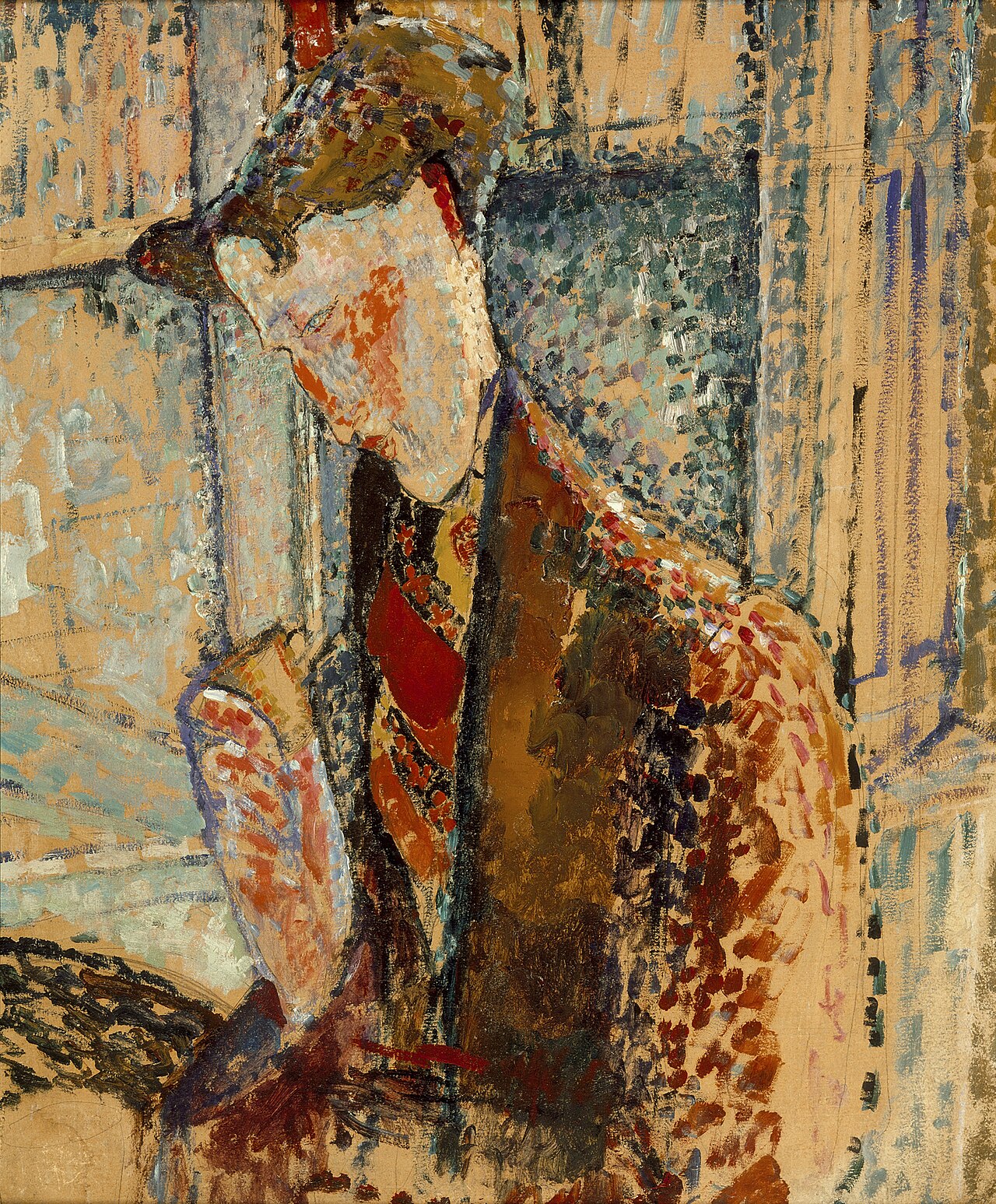
Reverie (Study for the Portrait of Frank Burty Haviland) is a small study, and it is one of the few works on this shelf that Modigliani left unfinished. A figure sits in profile facing left, built out of separate dabs of ochre, blue-grey, red and cream, with the warm support showing through everywhere between them. With us it is made as a hand-painted copy, oil on canvas, to order, in eight sizes or in a size you give us; before dispatch we send you a photograph of the finished canvas.
We print no year, no size and no museum number in the table below. Our own earlier sourcing named a Los Angeles County Museum of Art sheet, accession 27.7.2a, with a date and a measurement of 62.23 × 49.53 cm. Checked against a catalogue set of 258 Modigliani works, twenty-seven of them share that size band and not one carries that accession, and the museum’s own collection site does not answer us. That is an absent match, not contrary evidence: we neither delete those figures nor print them as settled, and the fields stay empty until a record we can read names them.
| Title: | Reverie (Study for the Portrait of Frank Burty Haviland) |
| Painter: | Amedeo Modigliani |
| Original technique: | oil and graphite on card, as the sheet we read records it — see the note above |
| Our reproduction: | hand-painted copy, oil on canvas, eight sizes or a custom size |
Reverie (Study for the Portrait of Frank Burty Haviland) – Amedeo Modigliani
What is on the picture?
A seated figure faces left in profile and fills the height. Nothing in it is blended: the whole surface is made of short separate strokes, laid side by side, with the warm ochre support left visible between them. The head is at the upper left — a pale face flecked with orange and red, a dark eye, a red mouth — under a mass of olive-green and ochre that reads as hair or a cap. The neck is long and pale. Down the centre falls a dark band patterned in red and black. From there the body slopes to the right in ochre, olive and brown, and the right half of the picture dissolves into a shower of red, orange and cream dabs over dark green. Vertical bands of blue-grey and violet stand at the left edge and along the right. At the bottom left is a dark scribbled mass and a red-brown wedge. There is no signature to be seen in the photograph we read.
Why does the title say study?
Because the word is doing work rather than being polite. The picture really is unfinished, and it is unfinished in a way you can read: the support shows through, the strokes stand apart instead of closing into a surface, and the face is indicated rather than built. That is the interest of it. Most Modigliani portraits present a finished skin — an outline, a long neck, a filled colour — and this one shows the stage before the decision, when the sitter is still a field of separate touches. The handling is closer to what his neighbours were doing than to his own later manner: colour set beside colour rather than mixed. For the same painter visibly trying a method that is not his own, see Beatrice (Portrait of Béatrice Hastings), where the experiment is with cubism instead.
The limits of the record
The note above the table is the short version; here is the reasoning. Our source sheet gives a museum, an accession, a date and a measurement, and we would normally print all four. We could not confirm any of them: the accession appears in no catalogued record in the reference set we hold, twenty-seven catalogued works share the stated size band, and the museum’s collection site returns nothing we can read. None of that shows the sheet to be wrong. An absent match is silence, not contradiction, which is why the figures stay in the note rather than being struck out or promoted. What we can say without any of that is what the photograph shows, what the title says, and who the sitter was. The other work on this shelf that carries the same kind of empty fields, for the same kind of reason, is Caryatid.
The circle this comes out of
Frank Burty Haviland was a French painter and photographer, of the American porcelain family, and one of the people around Modigliani in Montparnasse — a friend rather than a client. That is the École de Paris seen from the inside again: foreign artists in Paris painting each other because they were who was to hand. A study of a friend is also why this one could be left unfinished without anybody minding. For a work in which Modigliani reduced a head to a few lines instead of a field of dabs, see Lola de Valence. The whole selection is in the Amedeo Modigliani gallery, and we have written a longer article about the painter. The photograph we describe is published here, and the sitter has his own Wikidata entry.
How is our hand-painted version made?
A painter paints it, with a brush, in oil on canvas, to your order. Every canvas painting takes some weeks, and each copy comes out slightly its own; that is the consequence of a person working rather than a machine. This motif lives entirely on its brushwork, so the copy is made with the stroke left standing: separate touches, dry edges, and gaps where the warm ground comes through. Smoothed out it would become a different and much duller object — the thing worth having here is precisely the unfinish. Two cautions. The ground must be warm and must be allowed to show, so it is laid first and then left alone. And the dabs must vary in size and direction as they do in the original; made even, they turn into a texture and the figure stops emerging from them. The original is on card and ours is on canvas, which we say plainly rather than let anyone expect board. Before dispatch you receive a photograph of the finished canvas and approve it. It is never a print.
Which size for which wall?
For this motif we suggest 80 × 100 cm. Two of our sizes are equally close on proportion and we measured both: 40 × 50 cm and 80 × 100 cm sit 0.5 per cent from the shape of the sheet as our source records it, and the next after them, 70 × 90 cm, is 2.3 per cent off. Between the two equals we would take the larger, because a picture made of separate strokes needs room for those strokes to separate: small, the dabs merge into a haze and the work looks merely blurred; large, they stand apart and the figure assembles itself as you step back. The palette is warm ochre with blue-grey and red, which sits well on white and on wood, and fights a strong colour. A post-impressionist painting in a size that is not on the list is no trouble: we make it to order.
Frequently asked questions
Where is the original?
We do not print a location for it. Our source sheet names an American museum, and we could not confirm that from any record we can read, so it stays in the note above the table rather than in the table.
Who is the sitter?
Frank Burty Haviland, a French painter and photographer who was part of Modigliani’s circle in Montparnasse.
Is the original finished?
No, and that is the point of it. The support shows through and the strokes stand apart; it was left at the stage of a study.
How closely does it follow the original’s proportions?
We have no recorded size for this original, so we cannot compare the proportions. When the measurement is settled we will give it here.
- Subject: a seated figure in profile facing left, made of separate dabs of ochre, blue-grey, red and cream, with the warm support showing through
- Original: a study, oil and graphite on card as our source sheet records it; no year, size or museum number is printed here
- Ours: hand-painted oil on canvas, eight sizes or a custom size, with a photograph to approve before dispatch
- Worth knowing: the accession our source names appears in no catalogued record we hold, and an absent match is silence rather than contradiction — so nothing is deleted and nothing is promoted
The eyes on this canvas are painted without pupils. We counted all 76 Modigliani works on this shelf: 53 are like that, 17 are not – work by work.