




Description
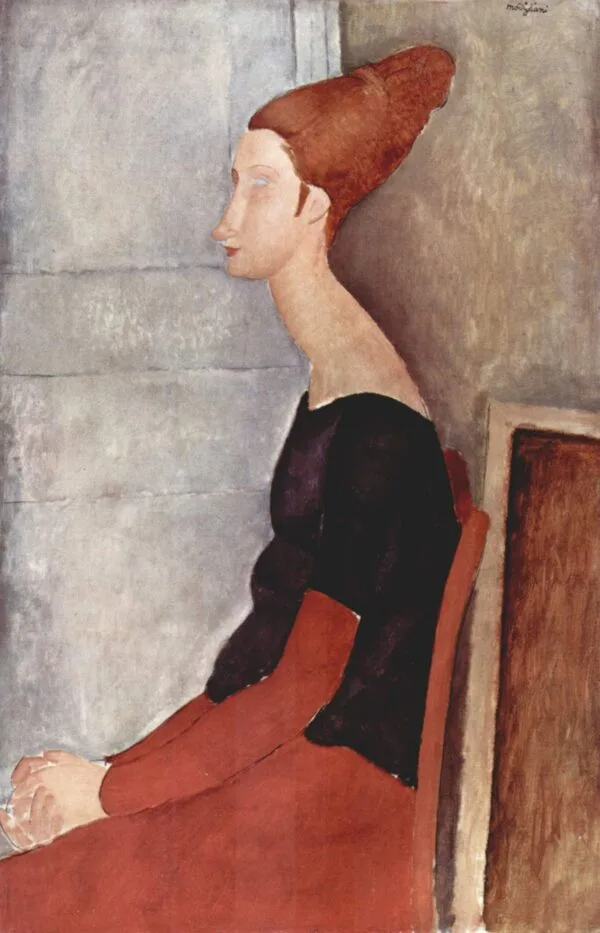
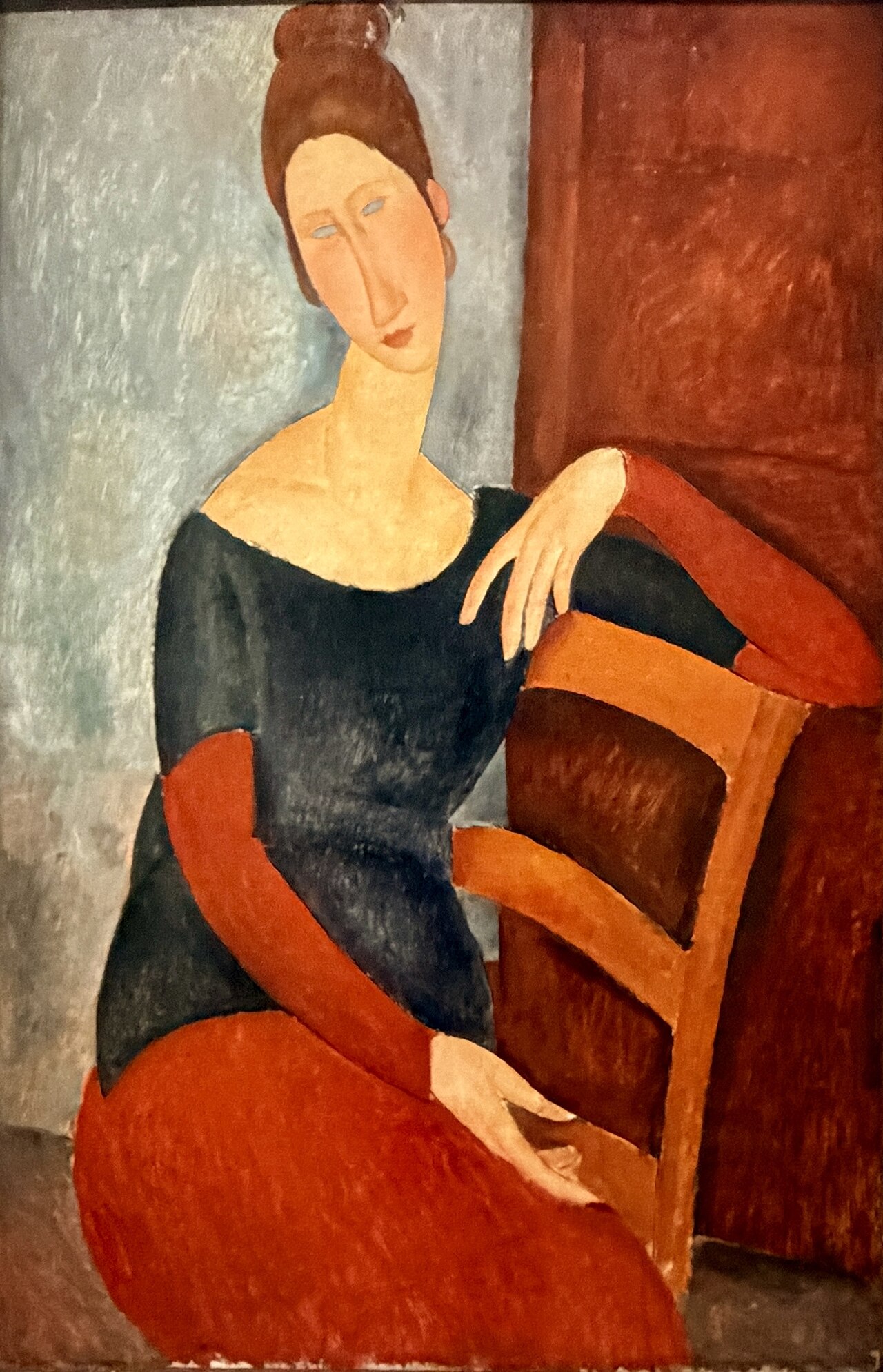
Jeanne Seated with the Arm Resting on the Back of the Chair is a canvas of 1918 in the Norton Simon Museum in Pasadena, under the number M.1975.13.2.P. Jeanne Hébuterne sits turned to one side, one forearm along the back of a plain wooden chair, in a dark blue bodice and a brick-red skirt. With us it is made as a hand-painted copy, oil on canvas, to order, in eight sizes or in a size you give us; before dispatch we send you a photograph of the finished canvas.
| Title: | Jeanne Seated with the Arm Resting on the Back of the Chair |
| Other titles: | Jeanne Hébuterne — the museum uses the sitter’s name alone; the long title comes from the catalogues |
| Painter: | Amedeo Modigliani (1884–1920) |
| Year of creation: | 1918 — the museum’s year |
| Original size (width × height): | 65.7 × 101 cm |
| Original technique: | oil on canvas |
| Painting style: | expressionism, École de Paris |
| Located: | Norton Simon Museum, Pasadena (inv. M.1975.13.2.P, Norton Simon Art Foundation) |
| Our reproduction: | hand-painted copy, oil on canvas, eight sizes or a custom size |
Jeanne Seated with the Arm Resting on the Back of the Chair – Amedeo Modigliani
What is on the canvas?
A woman sits in three-quarter view, turned to our right, with one forearm laid along the top rail of a plain wooden chair and the other hand resting lower, near the seat. The neck is very long and the head small and slightly inclined; auburn hair is drawn up into a knot on the crown above a high pale forehead. The face is a long narrow mask in cream and ochre with a small red mouth and a nose drawn in a single line, and the eyes are pale blue-grey almonds with no pupils at all. She wears a dark navy bodice with a wide neckline off the shoulders and long brick-red sleeves; a full brick-red skirt fills the lower third of the canvas. The chair is ochre-orange, a plain ladder-back with two horizontal slats, seen from the side. Behind her the wall is pale blue-grey at the left and a broad brick-red hanging at the right, with a grey band low on the left.
What does the museum see in the pose?
Something quite specific, and it says so on its own page: that she takes the pose of an Italian Renaissance Virgin Annunciate. The museum adds that Modigliani met Jeanne Hébuterne, an aspiring artist, in the summer of 1917, that their daughter was born in November of the following year, and that she may already have been carrying the child when she sat for this picture. It reads the style as owing to Botticelli and the early Italian masters rather than to anything Parisian. We pass all of that on as the museum’s reading, because it is the museum’s, and it is a more careful account than the usual one: the blank eyes and the tilted head that look like mannerism here have a source, and the source is four centuries old. Hébuterne is on this shelf again in Jeanne Hébuterne in a White Chemise.
The record of the original, and two titles
The original is oil on canvas, 101 cm high and 65.7 cm wide; we give width first, so on our page it reads 65.7 × 101 cm. The accession number is M.1975.13.2.P and the credit line is the Norton Simon Art Foundation. One difference is worth naming: the museum titles the work simply Jeanne Hébuterne, while the long descriptive title we sell it under comes from the catalogues. Both name the same canvas and we print both. Unlike most works on this shelf, the museum claims copyright in its own photograph rather than releasing it, so we describe the picture from a published reproduction and say so. Its own site is behind a challenge that answers automated readers with a holding page — the same page for a made-up accession number — so the link above is registered against an archived copy of the museum page, which carries the title, medium, dimensions, credit line, accession and the full provenance. The work also has its own Wikidata entry. The whole selection is in the Amedeo Modigliani gallery, and we have written a longer article about the painter.
Where has the picture been?
Eleven stations, and the museum marks its own uncertainty at the first one with a question mark: Léopold Zborowski in Paris, probably — the seventh chain on this shelf to begin with him. Then the Galerie Bing in Paris by 1925, which also handled Young Woman in a Yellow Dress; then Paul Guillaume before 1929, painted on this shelf as Paul Guillaume; then De Hauke and Co. in New York by 1929 and Lucien Demotte by 1931, both of whom exhibited it. Mr and Mrs Bernard J. Reis held it from 1935 to 1965 and sold it through the Marlborough-Gerson Gallery on 10 December 1965 to Mr and Mrs Norton Simon. It then passed to Lucille Simon in 1970 as part of a divorce settlement, and on 14 August 1975 it went through Paul Rosenberg and Co., stock number 6478, to the Norton Simon Art Foundation. A picture can be catalogued through a marriage ending, and this one is. Bing, Guillaume, De Hauke, Demotte: the dealers of the École de Paris are the first four names in it.
How is our hand-painted version made?
A painter paints it, with a brush, in oil on canvas, to your order. Every canvas painting takes some weeks, and each copy comes out slightly its own; that is the consequence of a person working rather than a machine. Two colours do the work here: a dark navy and a brick red, set against a pale wall. The red must stay earthy rather than bright, because it fills the whole lower third and any lift in it unbalances the picture. The navy has to keep some blue in it and not slide to black. The drawing is the other half: the neck is long, the shoulders slope, and the arm along the chair rail is one continuous line from shoulder to fingers — broken into segments it stops being a gesture and becomes an anatomy problem. The eyes have no pupils and must not be given any. Before dispatch you receive a photograph of the finished canvas and approve it. It is never a print.
Which size for which wall?
For this motif we suggest 90 × 140 cm. On proportion 130 × 200 cm is almost exact, 0.08 per cent from the original’s shape, with 99 × 151 cm at 0.8 and 90 × 140 cm at 1.2; but 130 × 200 cm is a very large picture, and the original is a canvas about two thirds of a metre across. The composition is calm and vertical and it suits the space beside a door or a stair, where it is seen from a step or two away. The palette — dark blue, brick red, pale grey-blue — sits well on white and on warm grey and disappears against terracotta. A post-impressionist painting in a size that is not on the list is no trouble: we make it to order.
Frequently asked questions
Where is the original?
In the Norton Simon Museum, Pasadena, accession number M.1975.13.2.P, held by the Norton Simon Art Foundation.
Who is the sitter?
Jeanne Hébuterne, an artist herself, who met Modigliani in the summer of 1917 and had a daughter by him the following year. The museum names her in its title.
Why do the eyes have no pupils?
Because Modigliani painted them blank. The museum reads the whole pose as borrowed from an Italian Renaissance Annunciation, which is where that stillness comes from.
How closely does it follow the original’s proportions?
The original measures 65.7 × 101 cm. The closest of our sizes is 130 x 200 cm, which departs from the original’s proportions by 0.08%.
- Subject: a seated woman turned to one side, one forearm along a wooden chair back, dark blue bodice and brick-red skirt, blank pale eyes
- Original: 65.7 × 101 cm, oil on canvas, 1918, Norton Simon Museum, inv. M.1975.13.2.P
- Ours: hand-painted oil on canvas, eight sizes or a custom size, with a photograph to approve before dispatch
- Worth knowing: the museum reads the pose as an Italian Renaissance Annunciate, and its published provenance runs through eleven owners including a divorce settlement
The eyes on this canvas are painted without pupils. We counted all 76 Modigliani works on this shelf: 53 are like that, 17 are not – work by work.