






Description
The Water Lilies – Clear Morning with Willows is a hand-painted reproduction of one of the largest wall panels from Monet’s Nymphéas cycle: a band of the Giverny pond twelve and three quarter metres wide, willow branches hanging from the top edge, a trunk towards each side and open water between them, without sky or horizon. The original measures 1275 x 200 cm in three joined oil panels on canvas glued to the wall, and the museum dates it between 1914 and 1926 under inventory number INV 20106 at the musée de l’Orangerie in Paris. We paint it in four sizes or to your own, with a photograph of the finished work for approval before dispatch.
| Title: | The Water Lilies – Clear Morning with Willows |
| Other titles: | Le Matin clair aux saules · Les Nymphéas |
| Painter: | Claude Monet (1840–1926) |
| Year painted: | between 1914 and 1926 (the museum gives a range, not a year) |
| Original size: | 1275 cm x 200 cm |
| Original technique: | Oil on canvas, three joined panels, canvas glued to the wall |
| Painting style: | Impressionism |
| Located at: | musée de l’Orangerie, Paris (inv. INV 20106) |
| Our reproduction: | Hand-painted oil on canvas, four sizes or to measure |
The Water Lilies – Clear Morning with Willows – Claude Monet
What is on the canvas?
The canvas is exceptionally long and low: the width is about six and a half times the height. Only the water is shown, from above and slightly at an angle. Willow branches hang from the top edge along the whole length, thin rows of olive green and grey blue falling like a curtain into the water. Two trunks grow through it. The first stands about a fifth of the length from the left edge, slender and leaning, in brown, violet and grey bands; the second nearer the right edge, thicker and branching. Between them a wide, almost empty sheet of water opens in pale blue and lilac. The lily pads gather in three clusters — lower left beside the first trunk, in a thin line above the middle, and lower right — with single white and pink blossoms laid on as short, thick touches. This canvas painting has no sky and no bank, so the eye has nothing to measure depth against.
Why is the middle of the canvas empty?
The emptiness is what holds the scene together. The trunks stand near the two ends as vertical limits; everything between them is open water. Were there more trees at even spacing, the panel would fall into a row of identical scenes. Because there are two, and they stand far apart, the viewer travels between them, and that journey lasts as long as the work is wide. The branches close the scene at the top, so the gaze cannot lift towards a sky that is not there. What remains is the odd sense of looking straight down into water and at once through something hanging in front of us. An impressionist painting arranged this way reads as calm, not empty.
What is not on this canvas?
No sky, no horizon, no bank, no bridge, no boat and no person. The museum records the work simply as painting and lists oil paint, wood and canvas — nowhere is a person or building named. The absence is a decision, not a shortfall. Once Monet had removed everything that could serve as a measure — house, path, figure, horizon — what remained was a surface on which you cannot judge distance. The willows are the only trace of a world outside the water, and even they appear only as branches and trunks ringed by water.
Details from the museum record
The work is listed at the Orangerie under inventory number INV 20106 and shown in room 03. In the inventory it carries the title “Le Matin clair aux saules”, with “Les Nymphéas” as a further title, and the measurements read height 200 and length 1275 cm; our table puts the width first. The description speaks of three oil panels joined side by side on canvas glued to the wall. We deliberately give no year. Where sources disagree we give the range the institution asserts, not a year nobody asserts.
The work’s journey from the painter to the Orangerie
The museum record names three stations and no more. In 1922 the work passed to the French state as the painter’s donation; the deed of gift is dated 12 April 1922, the decree approving it 14 June. The musée du Luxembourg in Paris is recorded next, and in 1927 it moved to the musée de l’Orangerie, where it remains. What is missing — when the panels left the studio, where they were in between — the record does not say, so neither do we.
The motif among the Monet works we sell
From the same cycle and Paris collection come The Water Lilies – Green Reflections; the museum lists them as INV 20102, measuring 850 x 200 cm in two joined panels, as their museum record shows. Take care with the name: the same collection holds a panel titled “Le Matin aux saules”, without the word clair, which is not the same work. The tree alone is shown by Weeping Willow, the same pond in square format by Water Lilies, and the scene with architecture by The Water Lily Pond (Japanese Bridge).
How is our hand-painted version made?
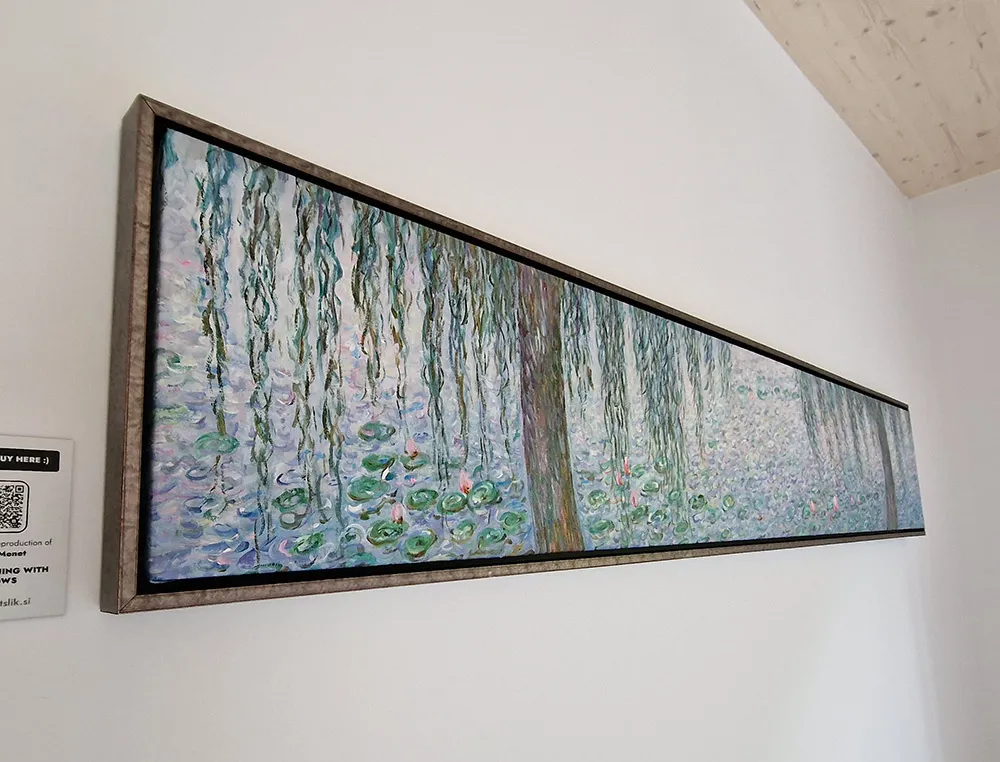
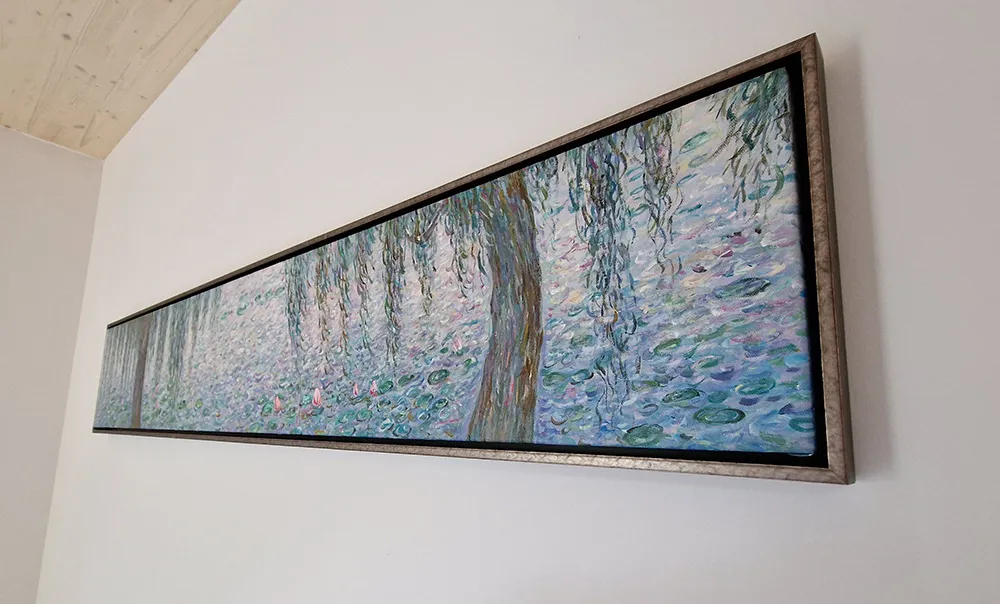
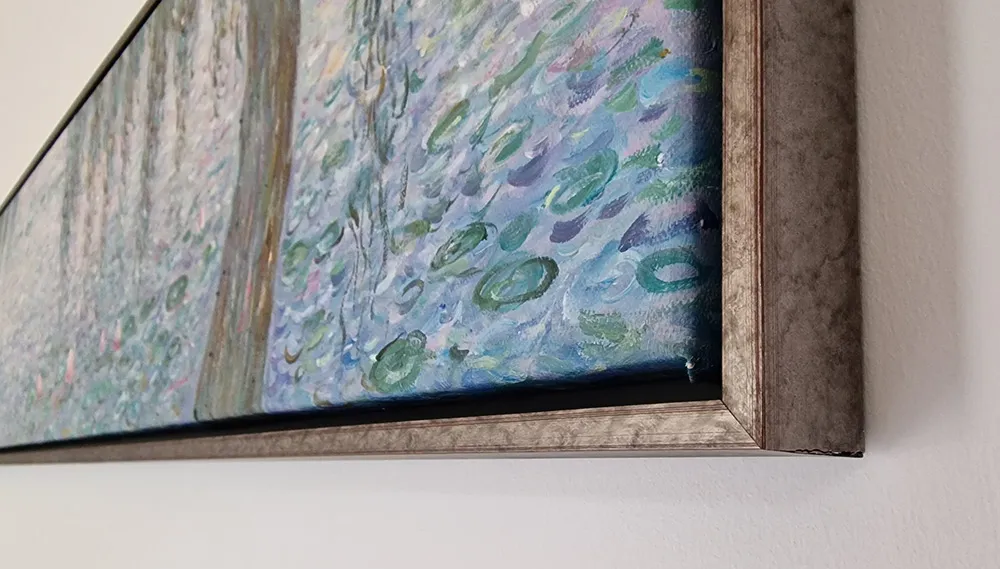
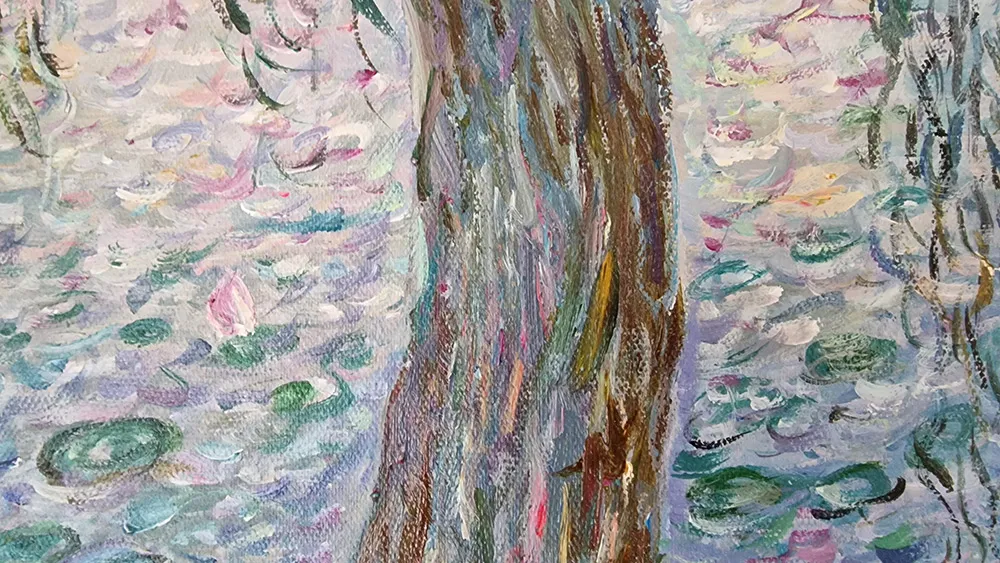
In the first photograph the work hangs on a white wall at an angle from the left, so the canvas recedes and you see how long the band really is; a timber ceiling reaches in at the upper right. In the second photograph the same hang is taken from the opposite side — two standpoints, one work, and only together do they show how such a long format sits on a real wall. In the third photograph a corner is close up: grey-brown floater frame, dark gap, painted edge. In the fourth photograph the surface is shown very close — the weave, the trunk in brown, ochre and violet, pads to the sides, a blossom standing above the ground. All four show what you receive: an oil painting reproduction made with a brush and photographed before dispatch.
Which size for which wall?
The short answer: 250 x 39 cm above a two-seater, 300 x 47 cm above a longer suite, 200 x 31 cm in a hallway. Of the four the smallest is a narrow accent above a chest of drawers, the middle two suit a seating group, the largest a big empty wall. All four keep the proportions of the original, so even the largest stays a band and never becomes an ordinary painting for living room walls. Impressionist wall art of this ratio wants a light background: on a dark wall the pale water loses the light the scene is named for.
How high to hang the painting: the centre a little below the usual 150 cm, about the eye level of a seated person: the scene looks down onto the water and works better hung low.
Custom size, stretcher bar and frame
If none of the four sizes suits your room, we paint it in the measure you set — send width and height and we tell you the price and the date. Work to measure keeps the ratio of the sides, which matters more here than anywhere else: a few centimetres more height and the band of water becomes an ordinary landscape. The hand-painted oil painting is stretched on a wooden bar with the edges painted, so it does not look unfinished without a frame. A narrow grey or dark moulding suits it; a wide frame takes the light from the water.
Delivery and guarantee
Every Monet reproduction we make travels to sixteen countries of the European Union — among them Slovenia, Croatia, Austria, Germany, Italy and Hungary — wrapped in film and firmly packed, in a long crate at the largest sizes. Production takes 15 to 45 days. You receive a photograph of the finished canvas before dispatch: if something is not right, we correct it while the work is in the workshop. Other Monet motifs are in the Claude Monet gallery, and we write about painting on our blog.
If the painting is a gift and you are unsure of the size, there is a gift voucher: the recipient chooses the size and the subject.
Frequently asked questions
Where is the original?
At the Orangerie in Paris, inventory number INV 20106, room 03. Because the canvas is glued to the wall, the museum does not move it like an easel work.
Are there any people in the painting?
No. The museum record lists only painting, oil paint, wood and canvas; no person, building, animal.
What does the painting say in one sentence?
That Monet caught almost thirteen metres of water between two willows and removed everything you could measure it against.
How many Water Lilies panels are there at the Orangerie?
Eight large compositions made up of 22 panels, in two oval rooms. Monet announced the gift to the French State the day after the Armistice of 1918, and the cycle went on show in 1927, months after his death; this composition of three joined panels is one of the eight.
- Subject. A band of the Giverny pond almost thirteen metres wide: willow branches from the top edge, two trunks at the sides, open water between them.
- Original. Oil on canvas, three joined panels, 1275 x 200 cm, 1914-1926, musée de l’Orangerie, inv. INV 20106.
- Ours. Four sizes or made to measure, 200 x 31 to 350 x 55 cm; even the largest is under a third of the original.
- Worth knowing. The museum gives no year but a range, 1914 to 1926, and we give it too. Watch for the almost identical title without the word clair, a different panel.