


Description
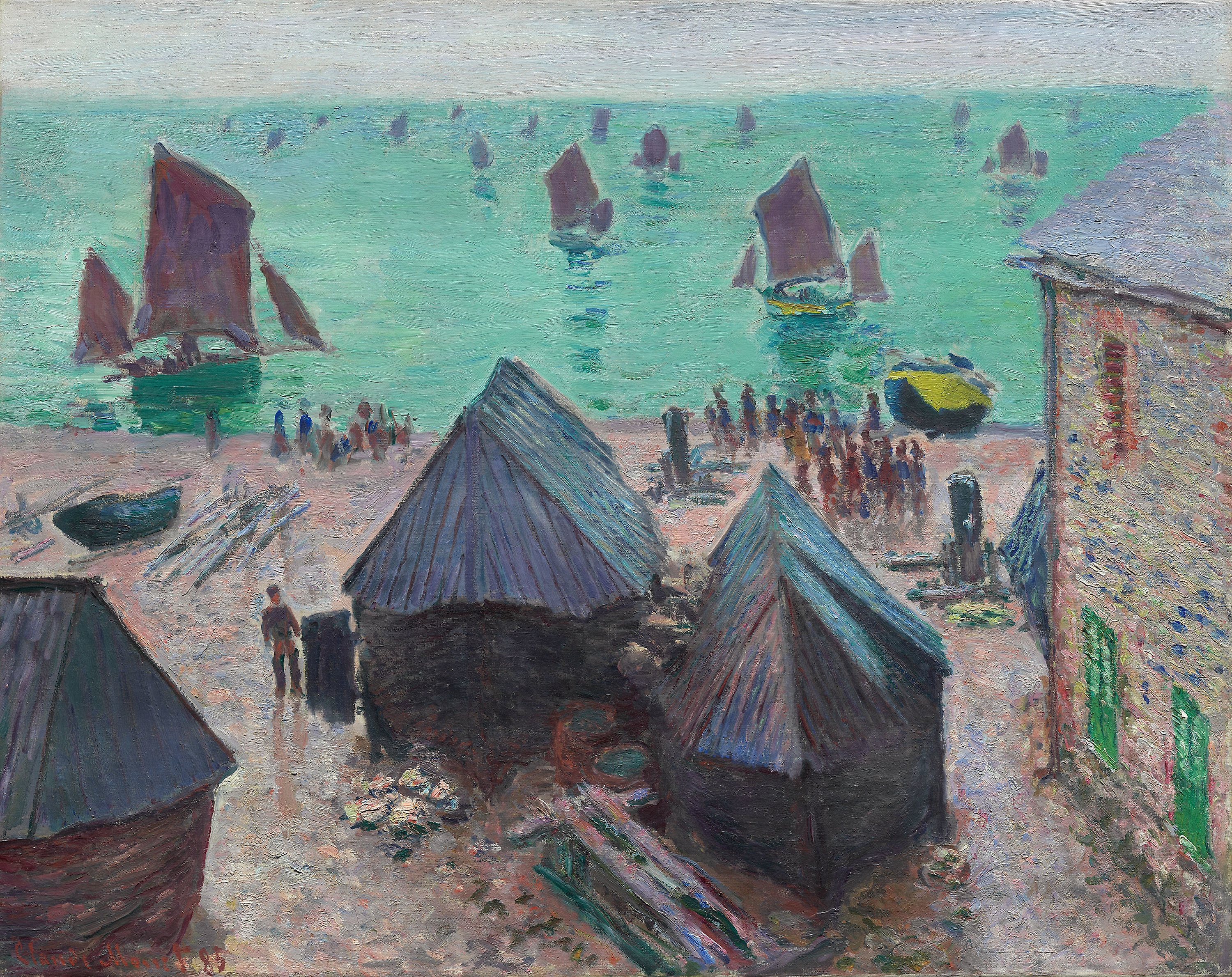
The Departure of the Boats, Étretat is a hand-painted reproduction of Monet’s canvas in the Art Institute of Chicago: a turquoise-green sea fills the upper half with sailing boats under red-brown and violet sails, groups of small figures stand at the water’s edge, three dark, pointed sheds stand on pink shingle in the foreground, and a stone house with green shutters rises on the right. The original measures 93.5 x 73.5 cm, is oil on canvas, is signed »Claude Monet 85« at the lower left, dates from 1885 and carries accession number 1922.428. We paint it in eight sizes or to your own, with a photograph of the finished work sent for approval before dispatch.
| Title: | The Departure of the Boats, Étretat |
| Other titles: | The Departure of the Boats, Étretat (the museum’s title); Le Départ des bateaux, à Étretat (the French title in Wikidata); Caloges d’Etretat (the Durand-Ruel stock book entry of 1892); in the Wildenstein catalogue the work is number 1025 |
| Painter: | Claude Monet (1840–1926) |
| Year painted: | 1885 |
| Original size: | 93.5 cm x 73.5 cm |
| Original technique: | Oil on canvas |
| Painting style: | Impressionism |
| Located at: | Art Institute of Chicago, Chicago (inv. 1922.428) |
| Our reproduction: | Hand-painted oil on canvas, eight sizes or made to measure |
The Departure of the Boats, Étretat – Claude Monet
What is on the canvas?
A view from above onto the beach and the sea. A turquoise-green sea takes up the upper half of the canvas under a narrow strip of pale sky. Sailing boats with red-brown and violet sails move across it: a large one on the left, a few smaller ones in the middle and a whole row of tiny ones towards the horizon, each with a blue and green reflection in the water.
A group of small figures stands at the water’s edge, painted in a few quick strokes, and to its right lies a boat with a yellow and blue hull. On the left a green boat lies on the shingle, three dark, pointed sheds in blue and violet stand in the foreground, and a man stands beside the middle one. A stone house with green shutters closes the right edge. The signature stands at the lower left in orange-red.
When was it painted, and from where?
The museum dates the canvas 1885, with no range, Wikidata gives the same year, and the signature at the lower left carries the year 85. The museum’s record says that Monet, forced indoors by bad autumn weather, painted this canvas from the window of his room at the Hotel Blanquet, together with a second one, Boats on the Beach at Étretat. According to the museum the two share a palette, a subject and a vantage point.
The museum also quotes Monet’s letter of 24 November 1885 to Alice Hoschedé, his companion and later his wife: in the afternoon he had worked in his room, in the rain, on his caloges, and then tried, again through the window, to paint the boats departing. The museum explains caloges as retired fishing boats covered with tarred planks and used for storage.
According to the museum’s record Monet came to Étretat on purpose well after the tourist season, so it is unclear whether he saw the fashionably dressed women on the left or added them as a foil to the local fishermen on the right.
What does the museum record say about the work?
The work is held by the Art Institute of Chicago under accession number 1922.428, in the Potter Palmer Collection. It gives the size height first, 73.5 x 93.5 cm, and 121.7 x 102.3 x 10.8 cm (width first) with the frame; Wikidata gives the same size. The technique is oil on canvas, and in the Wildenstein catalogue of 1979 the work is number 1025.
The record reads »Inscribed lower left: Claude Monet 85«, an inscription at the lower left.
Where has the canvas been?
The museum publishes the whole chain of owners. On 21 December 1892 Monet sold the canvas for 6,000 francs to Durand-Ruel in Paris, which entered it in its stock book for 1891–1901 as number 2548, Caloges d’Etretat. The same day Potter Palmer of Chicago bought it for 6,000 francs, and by descent it passed to his wife, Bertha Honoré Palmer.
From 17 March 1909 to 9 May 1911 she had the canvas on deposit with Durand-Ruel in New York, whose deposit book lists it as number 7535, Caloges d’Etretat, 1885. It then passed by descent to the family the museum calls the Potter Family, and in 1922 it was given to the Art Institute of Chicago. Paul-Louis and Flavie Durand-Ruel of the firm’s archives confirmed the entries in both books to the museum on 5 February 2013.
The same line, Potter Palmer Collection, stands in the museum’s records for four more canvases we sell: Bordighera, 1922.426, On the Banks of the Seine, Bennecourt, 1922.427, Stacks of Wheat (Sunset, Snow Effect), 1922.431, and The Petite Creuse River, 1922.432.
Which Étretat canvas is this?
Monet painted the boats of Étretat more than once, so the title alone does not pick out one canvas. The Art Institute of Chicago also holds this work’s pair, Boats on the Beach at Étretat, also from 1885, oil on canvas, 82.3 x 66 cm, signed Claude Monet at the lower right, accession number 1947.95. Our collection also includes Fishing Boats on the Beach at Étretat, a canvas of 1884 from the Wallraf-Richartz-Museum in Cologne. Ours is 1922.428, 93.5 x 73.5 cm, signed with the year at the lower left; if you are looking for this work in particular, go by that number.
Why does this work matter?
Because, as the museum’s record puts it, it shows Monet building wet surfaces from pastel blues, pinks, purples and greens, and the groups at the water’s edge from quick strokes that tell you something is happening on the beach.
It is also one of two views from the same room, so it is worth reading together with its pair in Chicago: there the boats on the beach are at the centre, here the boats leaving. An impressionist painting of this kind tells no story; it holds one moment on the shore.
How is our hand-painted version made?
Every order is painted individually by an artist, in oil on cotton or linen. That is how every canvas painting leaves us, with no print and no machine step. This oil painting reproduction is demanding in the sea: the turquoise green has to stay light and even and the sails dark, or sea and boats run together.
The second test is the small figures at the water’s edge, which must stay quick strokes rather than drawn people. A Monet reproduction of this kind depends on the sheds in the foreground staying dark and solid while the shingle stays light and pink. Work of this kind will not take a high gloss, so ours is matt. A hand-painted copy is not a facsimile; two canvases of the same size always differ in the brushwork.
Which size for which wall?
There are eight sizes, from 50 x 40 to 150 x 120 cm. By size the closest to the original is 90 x 70 cm, 3.5 cm narrower and 3.5 cm lower, but at 1.2857 slightly more elongated than the original’s 1.2721. By proportion the closest is 70 x 55 cm at 1.2727, followed by 65 x 51 cm at 1.2745.
If you want nearly the size of the original, take 90 x 70; if you want its shape, 70 x 55, and 150 x 120 at 1.2500 for a larger wall. The light green sea and the pink shingle bring daylight into a room, which makes this a good painting for the living room. All sizes are listed with the product in our Claude Monet gallery.
Custom size, stretcher bar and frame
For a size not on the list, made to measure is the only route; send us the width and height and we keep the proportion of the original. The canvas is stretched on a wooden bar. A frame is not included; the museum’s own measures 121.7 x 102.3 cm and is 10.8 cm deep.
Delivery and guarantee
Making it takes two to three weeks, a few days more at the largest sizes. It arrives stretched on its bar in a rigid box, or rolled in a tube, with tracking. If it arrives damaged or differs noticeably from the approved photograph, we replace it or refund. Small differences in the brushwork are expected in handwork; damage is not.
If the painting is a gift and you are unsure of the size, there is a voucher: the recipient chooses the size and the subject.
Frequently asked questions
Where is the original?
In Chicago, at the Art Institute of Chicago, accession number 1922.428.
What year is it from?
1885. The museum, Wikidata and the signature at the lower left all give that year.
What does it show?
Sailing boats leaving across a turquoise-green sea, figures at the water’s edge and three dark sheds on pink shingle.
Where did Monet paint it from?
From the window of his room at the Hotel Blanquet, as the museum records.
- Subject. Sailing boats on a turquoise-green sea, figures at the water’s edge and three dark sheds on pink shingle.
- Original. Oil on canvas, 93.5 x 73.5 cm, 1885; signed at the lower left »Claude Monet 85«; Art Institute of Chicago, inv. 1922.428.
- Ours. Eight sizes; 90 x 70 cm is closest by size, 70 x 55 cm by proportion.
- Worth knowing. By the museum’s record Potter Palmer bought this canvas on 21 December 1892, the same day Monet sold it to Durand-Ruel.