




Description
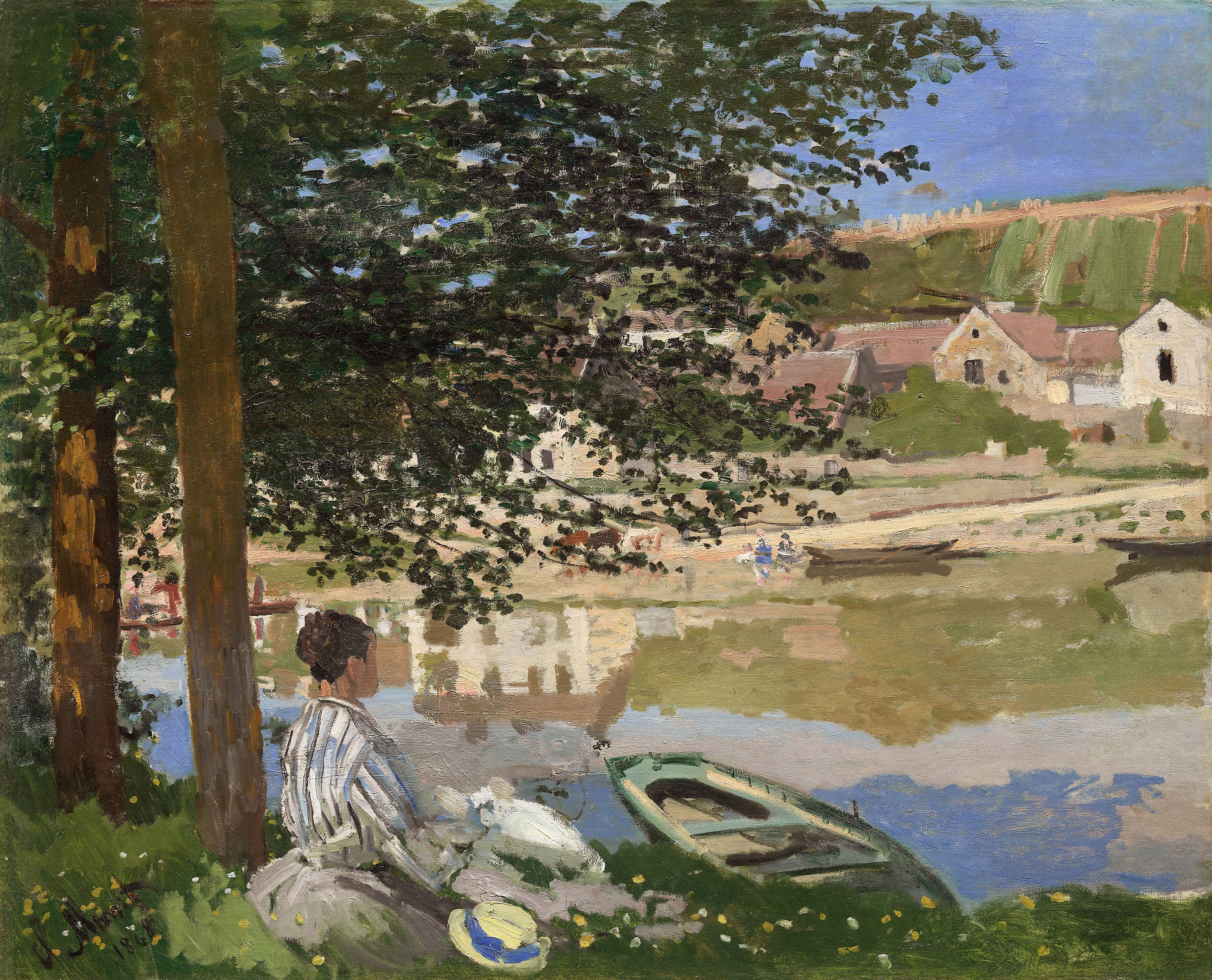
On the Banks of the Seine, Bennecourt is a hand-painted reproduction of Monet’s canvas in the Art Institute of Chicago: a woman in a striped dress sits with her back to us in the shade of two trunks on an island in mid-river, looking across to the houses of the hamlet of Gloton, a straw hat beside her and a green skiff moored at the bank. The original measures 100.7 x 81.5 cm, is oil on canvas and carries accession number 1922.427. The museum dates it 1868 and the signature at the lower left reads »Cl. Monet 1868«. We paint it in eight sizes or to your own, with a photograph of the finished work sent for approval before dispatch.
| Title: | On the Banks of the Seine, Bennecourt |
| Other titles: | On the Bank of the Seine, Bennecourt (the museum’s own name for it, with the bank in the singular); Au bord de l’eau; Bennecourt (the 1889 exhibition); Argenteuil (the Durand-Ruel stock book and the 1905 exhibition); in the Wildenstein catalogue the work is number 110 |
| Painter: | Claude Monet (1840–1926) |
| Year painted: | 1868 per the museum record, without reservation; the signature at the lower left reads »Cl. Monet 1868«, so the two years agree |
| Original size: | 100.7 cm x 81.5 cm |
| Original technique: | Oil on canvas |
| Painting style: | Impressionism |
| Located at: | Art Institute of Chicago (inv. 1922.427) |
| Our reproduction: | Hand-painted oil on canvas, eight sizes or made to measure |
On the Banks of the Seine, Bennecourt – Claude Monet
What is on the canvas?
A summer afternoon by the river, seen from under a tree. Two trunks rise the full height of the left third, and above them a dense crown of short dark green strokes covers almost the whole upper half, blue sky showing through a few gaps. Below, left of centre, a woman sits in the grass with her back to us, in a white dress with dark stripes; at her feet a straw hat with a blue ribbon, and at the water a moored skiff.
The middle is water, in broad horizontal strokes. The houses of the far bank repeat in it, but the repetition is not smoothed into a mirror: it stays a row of separate strokes in pale pink, grey and blue. Over there a sandy bank runs below a line of stone houses with reddish and grey roofs, a tall pale front among them, and above it the slope in bands of worked land. Two tiny blue figures stand at the water, dark boats on the sand at the right.
Who is the woman on the bank?
The museum names her itself, so we name her too. The Art Institute of Chicago record says she is Camille Doncieux, the painter’s future wife, sitting on an island in the Seine and looking toward Gloton, the hamlet next to Bennecourt, from which the two had presumably rowed.
The same record says two things the canvas cannot show: that this is the only work to survive from the couple’s brief period in Gloton, a place Émile Zola had recommended as a cheap rural retreat near Paris; and that pentimenti, traces of an earlier layer, suggest Camille held a bonneted child at an early stage, presumably their baby, Jean. On the finished canvas it is gone.
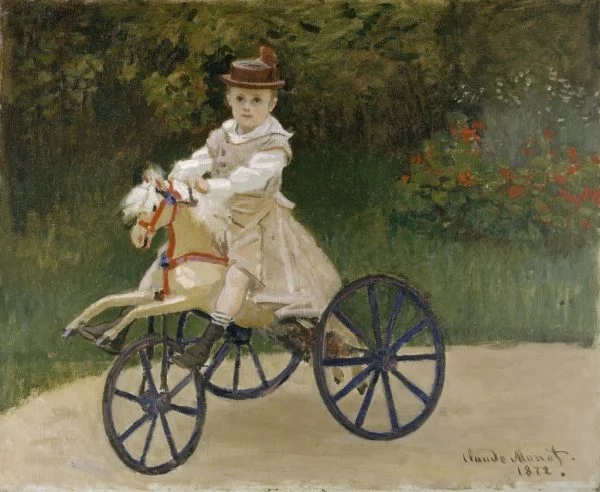
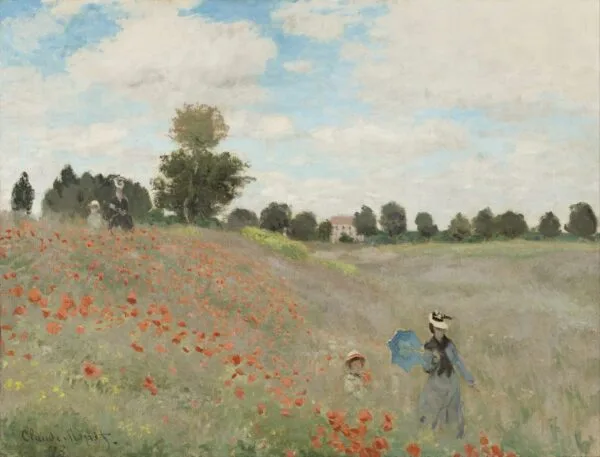
By the records of the museums that hold them, Camille and their son Jean appear on eight more canvases in our collection: Bazille and Camille (Study for “Le Déjeuner sur l’herbe”) (1865); Women in the Garden, of about 1866, where Camille posed for the three figures on the left; Meditation, Madame Monet on the Sofa, of about 1871; Jean Monet on His Hobby Horse (1872), which shows their son; Poppies near Argenteuil (1873), where the museum names the woman with the parasol and the child as probably Camille and Jean; Woman with a Parasol (1875), which shows them both; Madame Monet in a Kimono (1876); and Camille Monet on Her Deathbed (1879). The first is held by the National Gallery of Art in Washington, accession 1970.17.41, dated 1865 and 68.9 x 93 cm.
What is written on the canvas?
At the lower left, in the grass at the foot of the trunk, the signature stands in dark strokes with the year beneath it. It reads Cl. Monet and 1868, and the museum gives it in the same words: inscribed lower left, Cl. Monet, slash, 1868.
Canvas and institution agree on the year, which with Monet is not the rule: several of our Rouen fronts stand a year or two apart.
What does the museum record say about the work?
The work is held by the Art Institute of Chicago under accession number 1922.427. It publishes the measurements height first, 81.5 and 100.7 cm; our table puts the width first. With the frame it gives 117.8 x 98.5 x 8 cm, the credit line reads Potter Palmer Collection, and it hangs in Gallery 201.
In Daniel Wildenstein’s catalogue raisonné of 1979 it carries number 110. Wikidata gives the same year and measurements to the decimal, so the sources do not diverge. We say so on purpose: silence about a divergence and a source never checked look identical on a page.
Whose hands has the canvas passed through?
The museum publishes the full chain of owners with prices, so we give it as it gives it. The first known owner is Louis Aimé Léon Clapisson of Neuilly-sur-Seine, who held it by 21 June 1889, having paid 500 francs; the museum names its source, the Galerie Georges Petit catalogue.
On 21 April 1892 Clapisson sold it to Durand-Ruel for 1,500 francs, and on 18 May Durand-Ruel sold it on to Potter Palmer of Chicago for 7,500 — two sales in a year, a fifteenfold price in three. After Palmer’s death in 1902 it stayed in the family, which gave it to the museum in 1922. Why the price rose the record does not say.
Why was this canvas once shown as Argenteuil?
Because that is the name it was entered under in a stock book. The museum’s provenance note records that in the Paris Durand-Ruel stock for 1891 the work carried number 2127 and the name Argenteuil, and under that title it was shown in Boston in 1905, at the Copley Society, on loan from Mrs Potter Palmer.
That is not the only borrowed name: with Georges Petit in 1889 it was listed as Au bord de l’eau; Bennecourt, and in Chicago in 1910 as Belle Isle, sunshine or The river. Argenteuil is a real place in Monet and not merely a slip — he moved there in 1871, three years after this canvas, and works such as Bridge at Argenteuil came from it. The stock-book name is a confusion of places, not a different work; go by the accession number.
Why does this work matter?
Because of the lower half. The reflection is painted with the same weight and strokes as wide as the houses themselves, nowhere smoothed into a mirror. The viewer gets two equal bodies of information: the thing, and its repetition on the water, different by just enough that the other substance is recognisable.
The year is 1868, the first group exhibition still six years off, and this impressionist painting shows the procedure was worked out well before it. Twelve years on it takes the whole lower half: in Banks of the Seine, Vétheuil the houses have gone and only river and bank are left.
The woman sits with her back to us and tells no story; a Monet reproduction of this kind depends on proportions, not on a face.
How is our hand-painted version made?
Every order is painted individually by an artist, in oil on cotton or linen. That is how every canvas painting leaves us, with no print and no machine step. This oil painting reproduction is demanding above all in the water: the reflection must stay built of separate horizontal strokes, or it becomes a smooth surface and loses what the picture is known for.
The second test is the crown of the tree, which must stay porous, or the upper half tips into one dark patch. Work of this kind will not take a high gloss, so ours is matt. A hand-painted copy is not a facsimile; two canvases of a size always differ in the brushwork.
Which size for which wall?
There are eight sizes, from 45 x 38 to 150 x 120 cm. By size the closest is 90 x 70 cm, 10.7 cm narrower and 11.5 cm shorter than the original. By proportion the closest are 50 x 40 and 150 x 120 cm, both at 1.2500 against 1.2356; 60 x 50 and 120 x 100 sit further off at 1.2000.
For a large wall there is 150 x 120 cm, also one of the two truest in proportion. The greens and blues here are quiet, which is why this painting for the living room works above low furniture. All sizes are listed in our Claude Monet gallery.
How high to hang the painting: centre about 150 cm above the floor, so the water falls at eye level.
Custom size, stretcher bar and frame
For a size not on the list, made to measure is the only route; send us the width and height and we keep the proportion. The canvas is stretched on a wooden bar. A frame is not included; the museum’s own measures 117.8 x 98.5 cm and is 8 cm deep.
Delivery and guarantee
Making it takes two to three weeks, a few days more at the largest sizes. It arrives stretched on its bar in a rigid box, or rolled in a tube, with tracking. If it arrives damaged or differs noticeably from the approved photograph, we replace it or refund. Small differences in the brushwork are expected in handwork; damage is not.
If the painting is a gift and you are unsure of the size, there is a voucher: the recipient chooses the size and the subject.
Frequently asked questions
Where is the original?
In Chicago, at the Art Institute of Chicago, accession 1922.427, Gallery 201.
Does the museum name the person shown?
It does: Camille Doncieux, the painter’s future wife.
What is this work about, in one sentence?
About a reflection on water being no less real than the houses it reflects.
When and where was the painting made?
In 1868 in the hamlet of Gloton at Bennecourt on the Seine, where Monet spent two months with Camille and little Jean in a cheap inn that Émile Zola had recommended. It is the only surviving work from that stay.
- Subject. Camille Doncieux under a tree on an island in the Seine, the water before her carrying the broad reflection of Gloton.
- Original. Oil on canvas, 100.7 x 81.5 cm, 1868; inscribed lower left Cl. Monet 1868; Art Institute of Chicago, inv. 1922.427.
- Ours. Eight sizes; 90 x 70 cm closest by size, 50 x 40 and 150 x 120 by proportion.
- Worth knowing. Under the paint the museum found traces of a bonneted child Camille held in the first idea.