


Description
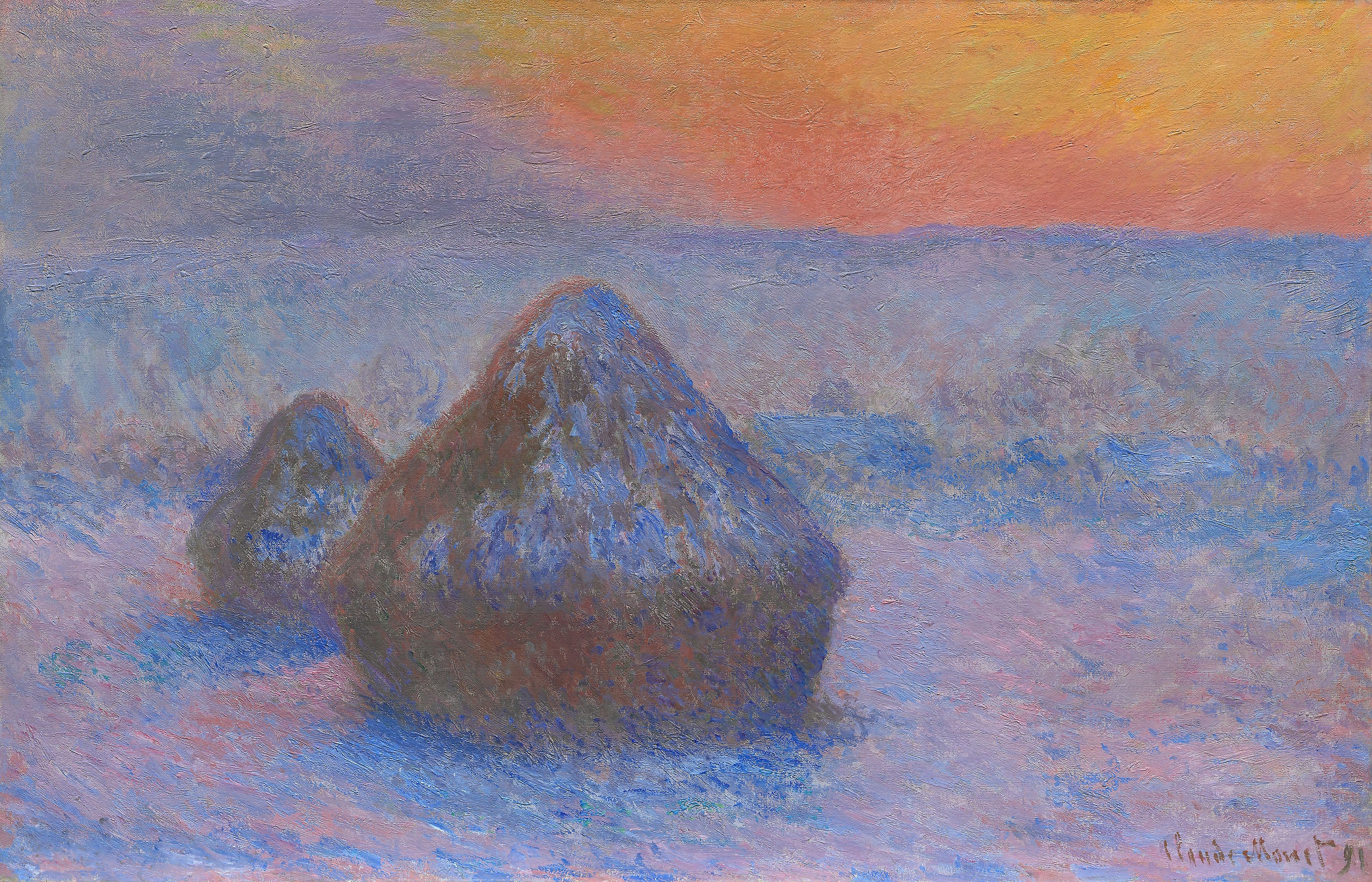
Stacks of Wheat (Sunset, Snow Effect) is a hand-painted reproduction of Monet’s canvas in the Art Institute of Chicago: two stacks in a snowy field, the larger right of centre, their conical tops breaking the horizon into a sky that runs from gold to salmon pink. The original is oil on canvas, 100.4 x 65.3 cm, accession number 1922.431. The museum dates it 1890–91; the signature at the lower right reads “Claude Monet 91”. We paint it in eight sizes or to your own measurement, with a photograph of the finished work for approval before shipping.
| Title: | Stacks of Wheat (Sunset, Snow Effect) |
| Other titles: | Stacks of Wheat (Sunset, Snow Effect) is the name in the museum record; in the Durand-Ruel exhibition catalogue of May 1891 it is number 13, as »Meules. (Coucher du soleil; effet de neige.)«, and in the Art Institute’s own 1910 exhibition it is number 36, as »Haystacks in winter« |
| Painter: | Claude Monet (1840–1926) |
| Year painted: | 1890–91 according to the museum record, beginning 1890 and ending 1891; the signature on the canvas reads »Claude Monet 91«, the later end of the span |
| Original size: | 100.4 cm x 65.3 cm |
| Original technique: | Oil on canvas |
| Painting style: | Impressionism |
| Located at: | Art Institute of Chicago (inv. 1922.431) |
| Our reproduction: | Hand-painted oil on canvas, eight sizes or made to measure |
Stacks of Wheat (Sunset, Snow Effect) – Claude Monet
What is on the canvas?
Two stacks stand in a snowy field. The larger is right of centre, conical, its dark brown and olive flank crossed by blue and violet; the smaller stands behind it to the left, partly hidden. Their tops reach past the distant ridge into the sky — which the museum says of this canvas and of nearly all the autumn views, while on most of the winter ones the stacks are wrapped in bands of hill and field.
The snow is not white. It is pink, grey-violet and blue, gathering at the lower left into a long blue shadow. The sky is brightest at the top right, gold there, passing through orange and salmon into a grey-violet cloud at the upper left.
The sun is not on the canvas: what is painted is the light it left. Which hour of the series is the most extreme we have not counted; the hour we give is the one in the museum’s title.
What did the painter write on the canvas?
At the lower right, across pink and blue snow, the signature stands in dark brown strokes. It reads easily, Claude Monet, and after the name comes the year 91.
The museum says the same, recording »Inscribed lower right: Claude Monet 91«. It is the museum’s record and what the canvas shows, and 91 is the later end of the span the museum gives.
Why does the museum give the span 1890–91?
Because the work was not made in one year, and the museum says so directly. It dates the canvas 1890–91, beginning 1890 and ending 1891, and explains how the series came about: through 1890 and 1891 he worked on it in the field, painting at several easels at once, and in the studio, refining the colour relations.
On the measurements the collection agrees, as it does on Wildenstein 1278.
What does the museum record say about the size?
The work is held by the Art Institute of Chicago under accession number 1922.431 and is on view, by its own record, in Gallery 243. It publishes the measurements height first, 65.3 x 100.4 cm, and beside them in inches, 25 11/16 by 39 1/2. Framed it gives 119.7 x 84.2 x 8.9 cm.
The figures stayed; the order is corrected.
And here is something worth saying aloud. The 100 x 65 cm size on our list is four millimetres narrower and three shorter than the original, and the museum’s own record rounds the same canvas to 100 and 65 centimetres. Our ladder has a size that is exactly the original’s rounded measurement.
Three stacks in one room
The Art Institute holds the largest group of Monet’s Stacks of Wheat in the world, by its own record, and three are in our Claude Monet gallery: ours, Stack of Wheat (Snow Effect) under 1933.1155 and Stacks of Wheat (End of Day, Autumn) under 1933.444.
They are closer than you would expect: the museum dates all three 1890–91 and records a signature with the year 91 on all three — on ours and on the overcast one in the museum record at the lower right, on the autumn one at the lower left — and all three are on view in Gallery 243. They differ in size: ours 100.4 x 65.3 cm, the autumn one 101 x 65.8, the overcast one 93 x 66.
From the painter to Chicago, with prices
The museum publishes the whole chain of owners from the Durand-Ruel stock books, confirmed in 2013 by Paul-Louis and Flavie Durand-Ruel. In our collection that is rare: the chain has two prices.
On 20 July 1891 Durand-Ruel in Paris bought the canvas from the painter for 3,200 francs; on 30 October it passed to the New York branch; on 29 February 1892 Potter Palmer of Chicago bought it for $1,300. It stayed in the family by descent and was given to the Art Institute in 1922, whence the collection name, Potter Palmer Collection.
The same Potter Palmer appears in our collection for the third time: he also owned Poppy Field (Giverny) and the canvas The Willows, now in Washington. All three facts come from the records of the museums holding those works.
May 1891, one small room at Durand-Ruel
This canvas was in the exhibition of recent work by Monet at the Durand-Ruel galleries in Paris in May 1891, as catalogue number 13. Of it the museum writes that he hung fifteen canvases from the series side by side in one small room, and that the response was unprecedented, critically and commercially.
Something came after the stacks. The museum lists what followed: poplars, the facade of Rouen Cathedral, and later his own garden. We sell the first two, Poplars and Rouen Cathedral, the Portal and Saint-Romain Tower, so the order of the series can be walked here.
How is our hand-painted version made?
Every order is painted individually, in oil on cotton or linen. That is how every canvas painting is made here, with no print and no machine step. This one is demanding in the snow, which is not white: pink, violet and blue strokes that have to stay separate, or the field goes grey and the stack loses its ground.
The second test is the sky: from gold at the top right to grey-violet at the top left the transition runs without an edge, and mixed too early the sunset stiffens into a flat field. An impressionist painting of this kind takes no high gloss, so our oil painting reproduction stays matt.
Which size for which wall?
There are eight sizes, from 70 x 45 to 200 x 130 cm, and this time the answers agree. By size the closest is 100 x 65 cm, four millimetres narrower and three shorter than the canvas in Chicago. By proportion the closest is the same size, at 0.6500 against the original’s 0.6504; two sizes match to three decimals, 100 x 65 and 200 x 130.
The choice is simple here, which is not the rule: 100 x 65 cm for a medium room, 150 x 100 cm for a large wall in the same shape, 92 x 60 cm where the space is narrow. As a painting for the living room it works in the evening, because its warm tones survive artificial light.
How high to hang the painting: the centre about 145 cm above the floor, so the horizon sits near eye level.
Made to measure, stretcher and frame
For a size not on the list, painting it to your own measurement is the only way; send us width and height in centimetres. The canvas arrives stretched or rolled. No frame is included; a warm wooden moulding suits this subject, a cold silver one takes the warmth out.
Delivery and guarantee
The work takes two to three weeks, longer at the largest sizes, because the oil has to dry between layers. Stretched canvases travel in a rigid box, rolled ones in a tube. If it arrives damaged or differs from the photograph you approved, we replace it or refund the price. A hand-painted copy is not a factory product and small differences in brushwork are expected; damage is not.
If the painting is a gift and you are unsure of the size, there is a gift voucher: the recipient chooses the size and the subject.
Frequently asked questions
Where is the original?
In Chicago, in the Art Institute of Chicago, accession number 1922.431, Gallery 243.
Where did the stacks stand?
In a field just outside Monet’s house at Giverny, fifteen to twenty feet high. He painted them from the summer of 1890 into the winter of 1891, at several easels at once, and in May 1891 hung fifteen of them together at the Galerie Durand-Ruel in Paris.
Why did Monet paint haystacks?
The stacks stood in a field next to his house at Giverny. He wanted to show how the same simple motif changes with the light, the season and the weather, so he worked on several canvases at once.
How many haystack paintings did Monet make?
About thirty. Between 1890 and 1891 he painted the stacks in a field near his house at Giverny again and again, and fifteen of them were shown together at the Galerie Durand-Ruel in Paris in 1891.
- Subject. Two stacks of wheat in a snowy field, tops past the horizon, a sky from gold to salmon pink.
- Original. Oil on canvas, 100.4 x 65.3 cm, 1890–91; Art Institute of Chicago, inv. 1922.431.
- Our version. Eight sizes; 100 x 65 cm is closest by size and by proportion at once.
- Worth knowing. The museum dates the work 1890–91, while the signature carries the later end, 91.