






Description
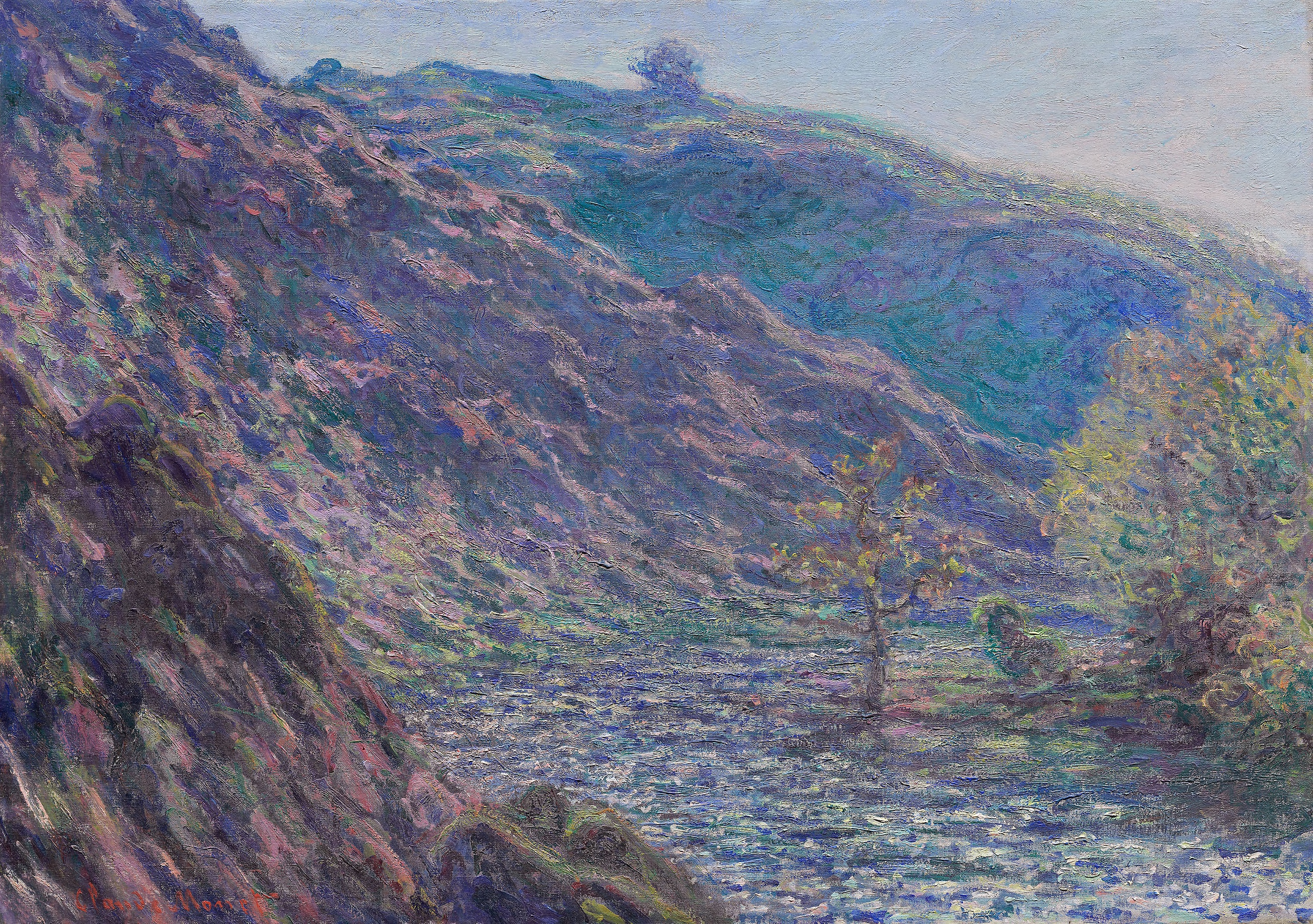
The Petite Creuse River is a hand-painted reproduction of Monet’s canvas in the Art Institute of Chicago: a steep slope in shadow, laid on in diagonal strokes of violet, pink and blue, falls from the upper left towards the water, a broad river glitters in short strokes of blue and white across the lower right, a lone tree with a few yellow leaves stands at its edge, and turquoise hills rise behind under a pale sky. The original measures 93.1 x 65.9 cm, is oil on canvas, dates from 1889 and carries accession number 1922.432. We paint it in eight sizes or to your own, with a photograph of the finished work sent for approval before dispatch.
| Title: | The Petite Creuse River |
| Other titles: | The Petite Creuse River (the museum’s title); La Petite Creuse (the French title in Wikidata); in the Wildenstein catalogue the work is number 1231 |
| Painter: | Claude Monet (1840–1926) |
| Year painted: | 1889 |
| Original size: | 93.1 cm x 65.9 cm |
| Original technique: | Oil on canvas |
| Painting style: | Impressionism |
| Located at: | Art Institute of Chicago (inv. 1922.432) |
| Our reproduction: | Hand-painted oil on canvas, eight sizes or made to measure |
The Petite Creuse River – Claude Monet
What is on the canvas?
A river valley with no building and no figure in it. From the upper left a steep slope in shadow falls across nearly half the canvas, painted in long diagonal strokes of violet, pink, blue and green; at its foot a dark rock meets the water. The river runs across the lower part as a broad band of short, broken strokes of blue, white and lilac, so that its surface glitters.
Right of centre a thin tree stands alone at the water’s edge with only a few yellow leaves; further right, trees in yellow-green light fill the edge of the canvas. Behind them a second slope rises in turquoise and blue to a ridge with a single small tree on top, and the sky shows only as a pale band along the top edge, widest at the right.
When was it painted, and what happened to the tree?
The museum dates the canvas 1889, and Wikidata gives the same year. The museum record also tells how it was made: Monet began it in April 1889 and came back to it only later that spring, by which time the landscape had changed considerably. An oak tree was coming into leaf and hid the view he had already laid down. Instead of reworking the canvas or starting again, he hired workers to strip the tree of its leaves, so that he could paint it as it had looked before.
What does the museum record say about the work?
The work is held by the Art Institute of Chicago under accession number 1922.432, in the Potter Palmer Collection. The technique is oil on canvas, and in the Wildenstein catalogue the work is number 1231.
The record reads »Inscribed lower left: Claude Monet«.
Where has the canvas been?
The museum gives a short chain of owners. The first owner the record names is Potter Palmer of Chicago, who died in 1902; the museum takes this from the Wildenstein catalogue of 1996 and adds that Tucker, in 1989, suggests the canvas was bought by Berthe Palmer and not by Potter Palmer. From there it passed by descent to the Chicago family the record calls the Potter Family, and in 1922 it was given to the Art Institute of Chicago.
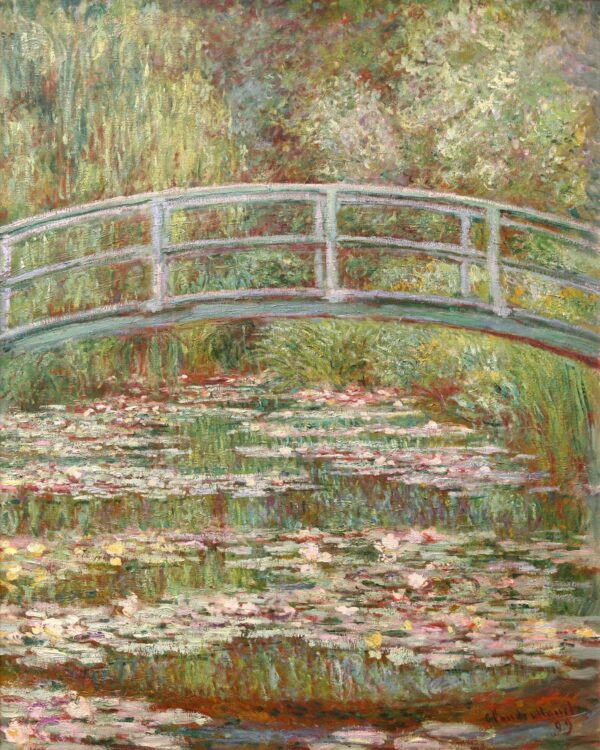
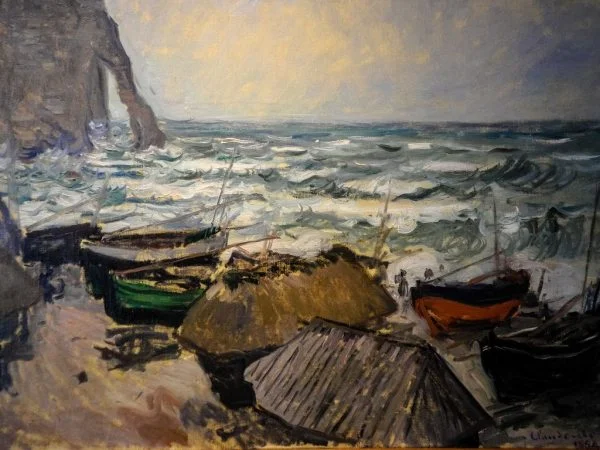
The same Potter Palmer Collection credit line stands on three other canvases we sell: Bordighera of 1884, accession 1922.426, The Departure of the Boats, Étretat of 1885, accession 1922.428, and On the Banks of the Seine, Bennecourt of 1868, accession 1922.427.
Which Petite Creuse is this?
The painter painted the river more than once. The museum says this canvas is one of three of the Petite Creuse. The Metropolitan Museum of Art in New York holds a canvas with the river in its title, Rapids on the Petite Creuse at Fresselines, oil on canvas, 91.8 x 65.4 cm, dated 1889. Ours is 1922.432 in Chicago, 93.1 x 65.9 cm; if you are looking for this work in particular, go by that number.
Why does this work matter?
Because of what came of the trip. The museum record says that Monet spent three months in the remote Creuse valley in central France from early March 1889, after a few days there in February with the critic Gustave Geffroy, and that despite bouts of poor health and bad weather he went home to Giverny with 24 canvases. The museum calls them the painter’s first planned and rigorously defined series.
A later series is in our collection too, the stacks of wheat, which the museum dates 1890–91: Stacks of Wheat (Sunset, Snow Effect), also from the Potter Palmer Collection, and Stacks of Wheat (End of Day, Autumn), both at the Art Institute of Chicago.
On this canvas the light does most of the work: the slope is almost all shadow, and the brightest strokes go to the water. An impressionist painting of this kind tells no story; it holds one spell of light in one valley.
How is our hand-painted version made?
Every order is painted individually by an artist, in oil on cotton or linen. That is how every canvas painting leaves us, with no print and no machine step. This oil painting reproduction is demanding in the slope: the diagonal strokes must stay separate and keep their pinks and violets, or the hillside turns into a flat dark mass.
The second test is the water, whose short strokes of blue and white must stay broken, or the river loses its glitter. A Monet reproduction of this kind depends on shadow and light keeping their distance. Work of this kind will not take a high gloss, so ours is matt. A hand-painted copy is not a facsimile; two canvases of the same size always differ in the brushwork.
Before dispatch you receive a photograph of the finished canvas. Check three things on it: that the slope still shows separate diagonal strokes, that the water still glitters, and that the red signature stands at the lower left, as on the original. If one of them is not right, tell us before you approve it.
Which size for which wall?
There are eight sizes, from 50 x 35 to 150 x 110 cm. By size the closest to the original is 90 x 65 cm, 3.1 cm narrower and 0.9 cm lower, and at 1.3846 slightly less elongated than the original’s 1.4127. By proportion the closest are 70 x 50 and 105 x 75 cm, both at 1.4000.
If you want nearly the size of the original, take 90 x 65; if you want its shape on a larger wall, 105 x 75. The long format and the quiet valley suit a room where you sit and look for a while, which makes this a good painting for the study. All sizes are listed with the product in our Claude Monet gallery.
Light matters as much as size. Most of the canvas is cool shadow in violet and blue, so it reads best in daylight or in warm light from the side; under cold light the slope turns heavy. Hang it with the water, which runs across the lower part, a little below eye level.
Custom size, stretcher bar and frame
For a size not on the list, made to measure is the only route; send us the width and height and we keep the proportion of the original. The canvas is stretched on a wooden bar. A frame is not included; the museum’s own measures 109.9 x 83.2 cm and is 7.3 cm deep.
Delivery and guarantee
Making it takes two to three weeks, a few days more at the largest sizes. It arrives stretched on its bar in a rigid box, or rolled in a tube, with tracking. If it arrives damaged or differs noticeably from the approved photograph, we replace it or refund. Small differences in the brushwork are expected in handwork; damage is not.
If the painting is a gift and you are unsure of the size, there is a voucher: the recipient chooses the size and the subject.
Frequently asked questions
Where is the original?
In Chicago, at the Art Institute of Chicago, accession number 1922.432.
What does it show?
A steep slope in shadow above the Petite Creuse, the glittering river, a lone tree at the water’s edge and turquoise hills behind.
What is this work about, in one sentence?
About the light in a river valley, painted as it was when the painter began the canvas.
Where does the Petite Creuse flow?
Through the Creuse valley in central France, where it joins the Grande Creuse at the village of Fresselines. Monet spent three months there in 1889 and painted fourteen views of the confluence.
- Subject. A slope in shadow above the Petite Creuse, the glittering river, a lone tree and turquoise hills.
- Original. Oil on canvas, 93.1 x 65.9 cm, 1889; signed at the lower left »Claude Monet«, with no year; Art Institute of Chicago, inv. 1922.432.
- Ours. Eight sizes; 90 x 65 cm is closest by size, 70 x 50 and 105 x 75 cm by proportion.
- Worth knowing. The museum records that Monet had an oak stripped of its new leaves to finish this canvas.