
























Description
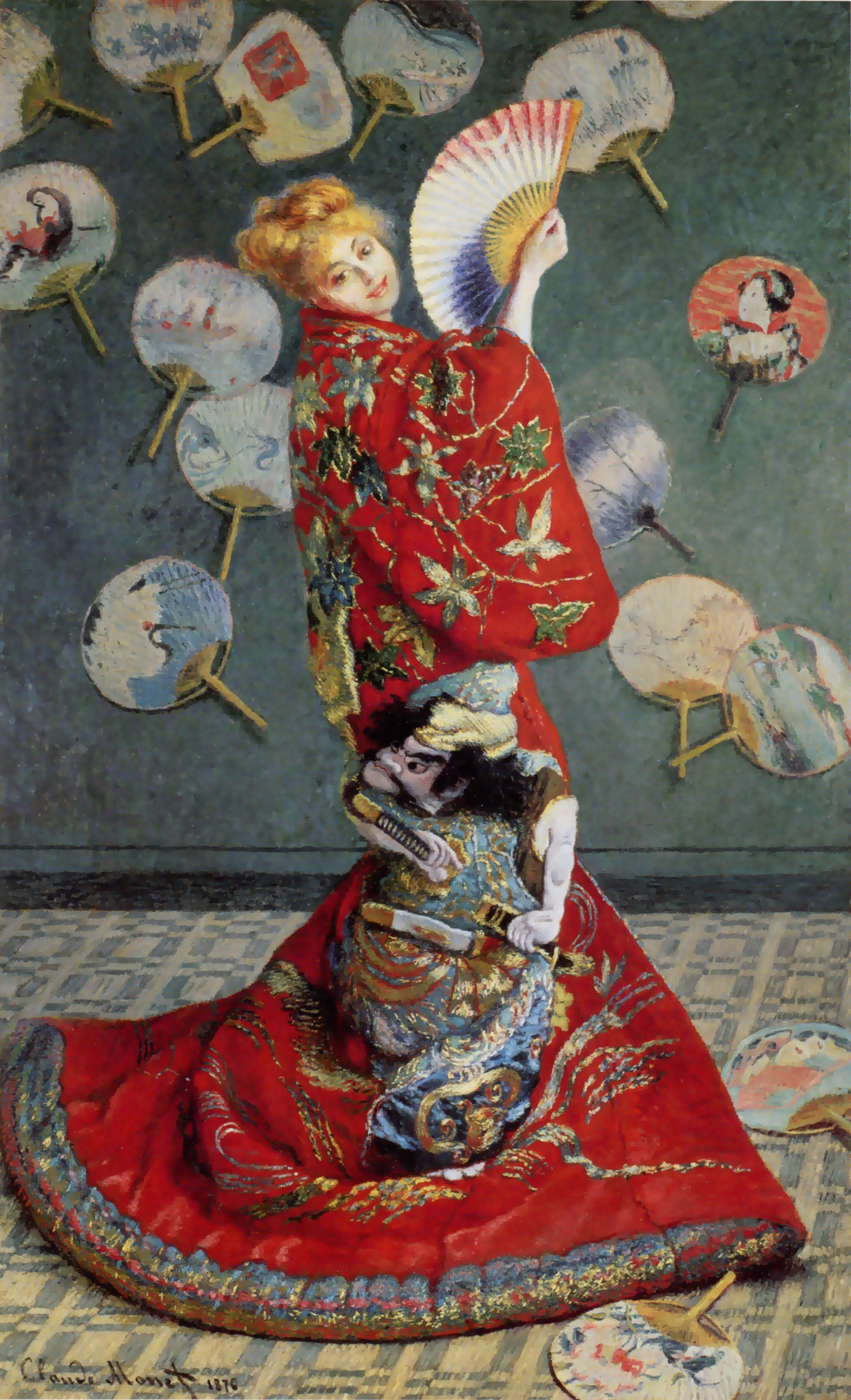
Madame Monet in a Kimono is a hand-painted reproduction of Monet’s canvas in the Museum of Fine Arts, Boston: in an upright format a fair-haired woman in a red kimono embroidered in gold and green turns to us over her shoulder and raises a fan, a warrior holding a sword is embroidered on the lower part of the kimono, and behind her round Japanese fans cover a blue-green wall. The original measures 142.3 x 231.8 cm, is oil on canvas, is signed »Claude Monet 1876« at the lower left, dates from 1876 and carries accession number 56.147. We paint it in eight sizes or to your own, with a photograph of the finished work sent for approval before dispatch.
| Title: | Madame Monet in a Kimono |
| Other titles: | La Japonaise (Camille Monet in Japanese Costume) (the museum’s title); Madame Monet en costume japonais and La Japonaise (the French titles in Wikidata) |
| Painter: | Claude Monet (1840–1926) |
| Year painted: | 1876 |
| Original size: | 142.3 cm x 231.8 cm |
| Original technique: | Oil on canvas |
| Painting style: | Impressionism |
| Located at: | Museum of Fine Arts, Boston (inv. 56.147) |
| Our reproduction: | Hand-painted oil on canvas, eight sizes or made to measure |
Madame Monet in a Kimono – Claude Monet
What is on the canvas?
The woman stands through almost the whole height of the canvas, her body turned away from us and her head turned back over her shoulder, smiling. In her raised hand she holds an open folding fan in red, white and blue. The red kimono is strewn with gold and green leaves on the sleeve, and its train spreads over the floor into a large red circle with a blue and gold hem.
On the lower part of the kimono a warrior is embroidered in blue robes, with dark hair, a fierce face and a sword in his hands. Round fans with painted motifs cover the blue-green wall behind her, among them a red one with a female figure on the right and a white one with a crane on the left; two fans lie on the light, checked matting of the floor at the lower right. The signature stands at the lower left in a dark colour.
When was it painted?
The museum dates the canvas 1876, with no range, Wikidata gives the same year, and the signature at the lower left reads Claude Monet 1876. According to the museum’s record Monet showed it that same year at the second group exhibition of the Impressionist painters, where it attracted much attention.
What does the museum record say about the work?
The work is held by the Museum of Fine Arts, Boston, under accession number 56.147, with the credit line 1951 Purchase Fund. The record calls it La Japonaise (Camille Monet in Japanese Costume), gives the size height first, 231.8 x 142.3 cm, and the technique as oil on canvas; Wikidata gives the same size and the French titles Madame Monet en costume japonais and La Japonaise.
Where has the canvas been?
The museum publishes the whole chain of owners. On 14 April 1876 the canvas was in the Monet and Ernest Hoschedé sale at the Hôtel Drouot in Paris, lot 37. On 19 April 1877 it was in an anonymous sale marked »L.«, also at the Hôtel Drouot, lot 48, and went to Constantin de Rasty of Paris, who died in 1923.
In 1918 Rasty sold it to Paul Rosenberg and Co., in 1920 Rosenberg sold it to Philip Lehman of New York, who lived from 1861 to 1947, and in 1921 Lehman sold it to Duveen Brothers in London. In 1937 it was shipped from the London branch to the New York branch, and in 1956 Duveen sold it to the museum for $45,000; the accession date is 8 March 1956.
The museum’s notes add detail. The 1876 sale, traditionally called Monet’s sale, was organized by Ernest Hoschedé, who also offered works of his own in it; Hélène Adhemar therefore suggested it was a joint sale. René Gimpel noted on 10 August 1918 that the dealer Georges Bernheim had told him »Rosenberg has bought a life-size Monet, a Japanese woman«, and Monet himself wrote to Rosenberg about the canvas on 6 August 1918. For the sale to Duveen the museum cites memos in the Duveen Brothers records at the Getty Research Institute: by a memo of 31 December 1926 the sale dates from 1921, and a memo of 13 December 1937 gives the official date as 1 January 1922.
Who is the woman in the kimono?
According to the museum’s record she is Monet’s wife, Camille, wearing a blond wig to emphasize her Western identity. The record also calls the work a witty comment on the Paris fad of the time for all things Japanese.
By the records of the museums that hold them, Camille and their son Jean appear on eight more canvases in our collection: Bazille and Camille (Study for “Le Déjeuner sur l’herbe”) (1865); Women in the Garden, of about 1866, where Camille posed for the three figures on the left; On the Banks of the Seine, Bennecourt (1868); Meditation, Madame Monet on the Sofa, of about 1871; Jean Monet on His Hobby Horse (1872), which shows their son; Poppies near Argenteuil (1873), where the museum names the woman with the parasol and the child as probably Camille and Jean; Woman with a Parasol (1875), which shows them both; and Camille Monet on Her Deathbed (1879).
Why does this work matter?
Because, as the museum’s record puts it, large-scale figure pictures had traditionally been considered the most significant challenge for an artist, and in this format Monet created a virtuoso display of brilliant colour. The red of the kimono, the gold embroidery and the fans on the wall are that display.
The canvas was among the works Monet showed at the second Impressionist exhibition in 1876. An impressionist painting of this kind tells no story; it shows what colour can do across a large surface.
How is our hand-painted version made?
Every order is painted individually by an artist, in oil on cotton or linen. That is how every canvas painting leaves us, with no print and no machine step. This oil painting reproduction is demanding in the red: the kimono has to stay deep red, with the gold embroidery in separate strokes, or it turns into a flat red field.
The second test is the face and the embroidered warrior, which must stay legible at the smaller sizes too. A Monet reproduction of this kind depends on the fans on the wall staying light and distinct while the wall stays cool. Work of this kind will not take a high gloss, so ours is matt. A hand-painted copy is not a facsimile; two canvases of the same size always differ in the brushwork.
Which size for which wall?
There are eight upright sizes, from 40 x 65 to 120 x 200 cm. The original, at 142.3 x 231.8 cm, is larger than all of them; the largest, 120 x 200 cm, is 22.3 cm narrower and 31.8 cm lower, and at a height-to-width ratio of 1.6667 slightly slimmer than the original’s 1.6290. By proportion the closest is 106 x 173 cm at 1.6321, followed by 80 x 130 and 40 x 65 cm at 1.6250.
If you want it as large as possible, take 120 x 200; if you want the original’s shape, 106 x 173, and 80 x 130 for a smaller wall. The tall, narrow format sits well on a wall beside a door or at the end of a long room, which makes this a good painting for the hallway. All sizes are listed with the product in our Claude Monet gallery.
Custom size, stretcher bar and frame
For a size not on the list, made to measure is the only route; send us the width and height and we keep the proportion of the original. The canvas is stretched on a wooden bar. A frame is not included.
Delivery and guarantee
Making it takes two to three weeks, a few days more at the largest sizes. It arrives stretched on its bar in a rigid box, or rolled in a tube, with tracking. If it arrives damaged or differs noticeably from the approved photograph, we replace it or refund. Small differences in the brushwork are expected in handwork; damage is not.
If the painting is a gift and you are unsure of the size, there is a voucher: the recipient chooses the size and the subject.
Frequently asked questions
Where is the original?
In Boston, at the Museum of Fine Arts, accession number 56.147.
What year is it from?
1876. The museum, Wikidata and the signature at the lower left all give that year.
Who is the sitter?
According to the museum’s record, Monet’s wife Camille, in a kimono in front of a wall of fans.
What is this work about, in one sentence?
About Camille in a red kimono among fans, as a comment on the Paris fad for all things Japanese.
- Subject. Camille in a red kimono with a raised fan, in front of a blue-green wall covered with fans.
- Original. Oil on canvas, 142.3 x 231.8 cm, 1876; signed at the lower left »Claude Monet 1876«; Museum of Fine Arts, Boston, inv. 56.147.
- Ours. Eight upright sizes; 120 x 200 cm is the largest, 106 x 173 cm the closest by proportion.
- Worth knowing. According to the museum’s record Monet showed it in 1876 at the second Impressionist group exhibition, and in the same year it also went to auction at the Hôtel Drouot.