




Description
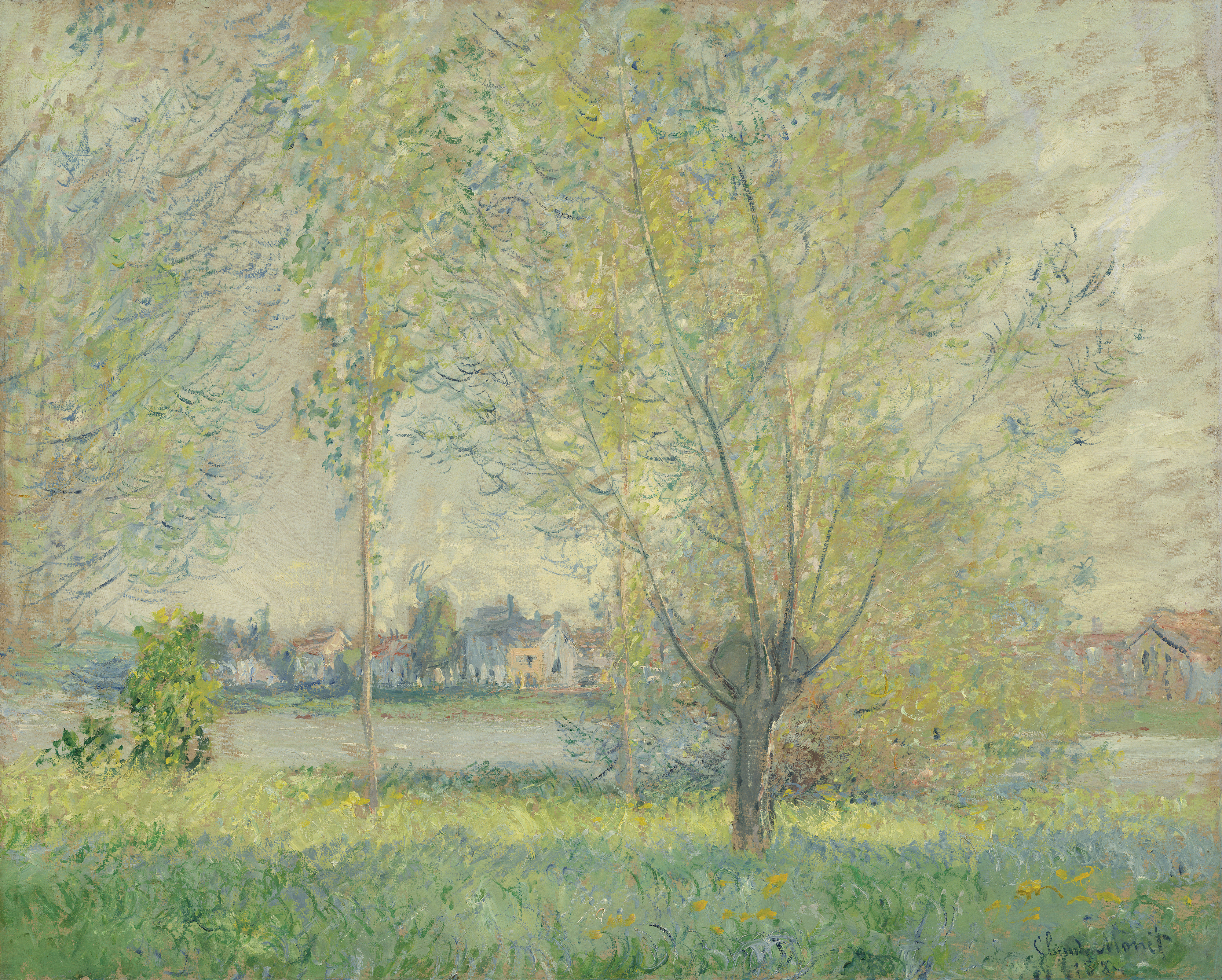
The Willows is a hand-painted reproduction of Monet’s canvas at the National Gallery of Art in Washington: the lower third is a meadow of long upright strokes with yellow flowers, out of it a heavy willow right of centre, a curtain of willow branches from the left, and behind the meadow a pale band of water with low red-roofed houses on the far bank. The original measures 81.92 x 66.68 cm, is oil on canvas and carries the accession number 2015.19.65. The museum dates it to 1880; the signature at the lower right is legible, the year beneath it is not. We paint it in eight sizes or to your own, with a photograph of the finished work for approval before despatch.
| Title: | The Willows |
| Other titles: | The museum gives none; in the Wildenstein catalogue the work stands at number 611 |
| Painter: | Claude Monet (1840–1926) |
| Year painted: | 1880 in the museum record, without reservation; the signature at the lower right is transcribed by the museum as “Claude Monet / 188[?]”, because the last figure cannot be read |
| Original size: | 81.92 cm x 66.68 cm |
| Original technique: | Oil on canvas |
| Painting style: | Impressionism |
| Located at: | National Gallery of Art, Washington (acc. no. 2015.19.65) |
| Our reproduction: | Hand-painted oil on canvas, eight sizes or made to measure |
The Willows – Claude Monet
What is on the canvas?
The lower third is the meadow, painted in long upright strokes of green, blue-green and pale yellow, with yellow flowers thickest at the lower right. Out of it rises a heavy willow, right of centre: a thick trunk with a dark burl, forking at half height into two limbs, from which thin branches open in an arc with small pale-green leaves.
From the left a curtain of willow branches hangs along the top edge in short hooks that fall like rain, and between the two trees rise two slender, almost bare trunks. Behind the meadow lies a pale band of water, grey with a violet cast, and on the far bank low houses with red-brown roofs, one with an ochre front at the centre. The sky is cream white with pink and greenish tints.
None of it is on the canvas: the willow stands in the meadow on our side of the water, no branch touches it, and there is no reflection.
What did the painter write on the canvas?
At the lower right, in dark blue-grey strokes over the grass, stands the signature. The name is legible, Claude Monet. Below it a second line, fainter and covered by blades of grass, carries the year.
That year we cannot read, and neither can the museum, which gives it as “Claude Monet / 188[?]”, noting that the last figure cannot be made out.
How is the work dated, if the year cannot be read?
The museum dates it to 1880 all the same, without reservation; the year stands not on the signature but in the record.
It is supported by the first station of the chain: in November 1880 Cahuzac bought the canvas directly from the painter, in the year the museum dates it to. The unreadable year is confirmed by the history of ownership, not by the painting.
What does the museum record say about the size?
The National Gallery of Art in Washington holds it under accession 2015.19.65, on view in Gallery 80 of the West Building. It publishes the measurements height by width, 66.68 x 81.92 cm; our table puts width first, so here you read 81.92 x 66.68 cm. Framed, 106.05 x 90.49 x 9.53 cm, reordered.
The Wikidata collection agrees with the museum in everything it gives, and we say so aloud, because a checked agreement and a page where nobody compared look the same.
The proportion can be checked on the picture too. Our photograph is at 0.802, the museum’s plate also 0.802, the measured canvas 0.814, so both are a little over one per cent wider, which a crop to the painting gives.
From Cahuzac to Washington
The museum publishes a long chain of owners, credited to the Wildenstein catalogue of 1996. In November 1880 Cahuzac bought the canvas from the painter, it passed to Doctor Filleau in Paris, and in September 1883 to the firm Durand-Ruel.
From there the same name repeats. In July 1891 the firm sold it to Potter and Bertha Palmer of Chicago, in 1892 it returned to Durand-Ruel, in 1893 William H. Fuller of New York had it, in 1897 Durand-Ruel again. Three times the same firm in fourteen years.
By 1907 at the latest it belonged to Edward C. and Mary Griffin Walker of Willistead Manor in Walkerville, Ontario, and Washington. Mary Walker bequeathed it on 4 May 1937 to the Corcoran Gallery, and in 2015 the National Gallery of Art acquired it. Hence the collection name in the record, Corcoran Collection.
Which exhibitions has it been in?
The museum names three, the first with a reservation: possibly the seventh exhibition of the independent artists in Paris in 1882, under number 91, where the word possibly is the museum’s. Without reservation it names two in Detroit, 1913 under number 26 and 1915 under number 32.
The title it hung under is given for none of the three, so the table carries no other titles, only the Wildenstein number.
Which other willows and riverbanks by Monet do we sell?
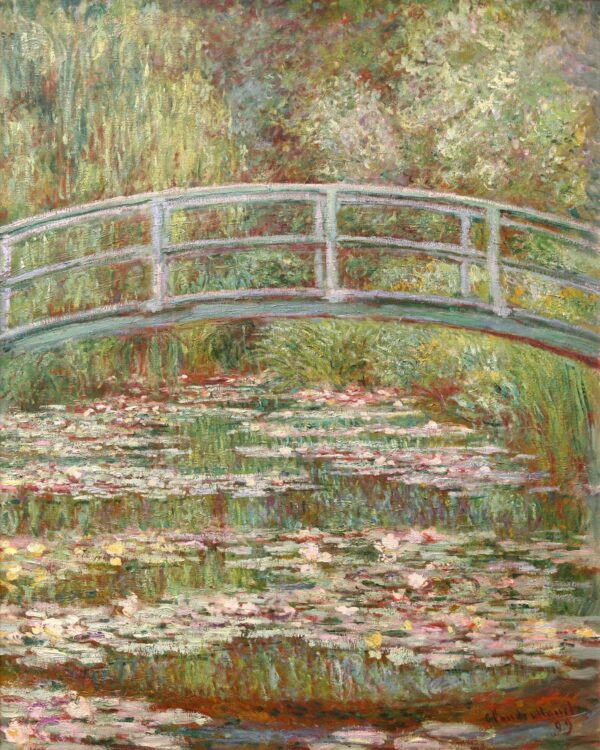
In our Claude Monet gallery the willows are separated by more than thirty years. The Water Lilies – Clear Morning with Willows is a Nymphéas panel at the musée de l’Orangerie under INV 20106. There the willows edge an enormous field of water; here the willow is a whole tree, with roots in the grass.
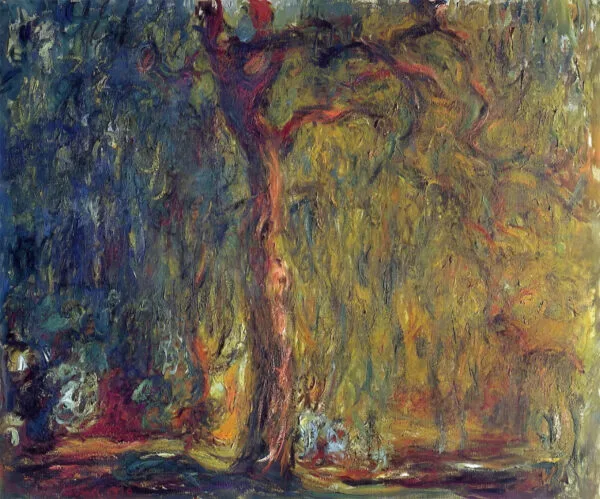
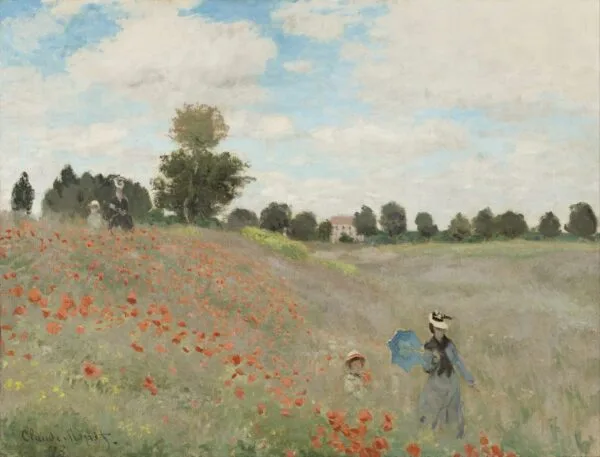
Three works stand beside it. Weeping Willow is a later, darker canvas of the same tree. Poppy Field (Giverny) is from Chicago and between 1893 and 1901 belonged to the same Potter Palmer. Meadow at Giverny is of 1886, at the Museum of Fine Arts in Boston, and Snow Effect in Vétheuil shows such a place in winter, from the Musée d’Orsay.
How is our hand-painted version made?
Every order is painted individually by an artist, in oils on cotton or linen canvas, with no print and no machine step. That is how every canvas painting is made here. This impressionist painting is hard in the foliage: the museum lists the tones it is built from, spring green through sage to steel and sea blue, and that variety keeps it alive.
The second test is the meadow. The long upright strokes must each stay separate, or the lower third sticks into a surface and the tree loses its ground. Out of doors, en plein air, the underlayer stays light and the heavier paint goes into the yellow flowers alone. An oil painting reproduction of this kind takes no gloss, so ours stays matt.
Which size for which wall?
Eight sizes are available, from 46 x 38 to 150 x 120 cm, and there are two answers. By size the nearest is 90 x 70 cm, 8.1 cm wider and 3.3 cm higher than the Washington canvas. By ratio the nearest is 110 x 90 cm, at 0.818 against the original’s 0.814, while 90 x 70 cm sits at 0.778. None matches to three decimals.
The distance between the answers is smaller than on some subjects. For a medium room 90 x 70 cm is right, if proportion matters more 110 x 90 cm, in a narrow space 60 x 50 cm. As a painting for bedroom walls it works because no strong colour pulls the eye in the evening.
How high to hang the painting: the centre about 145 cm above the floor, the band of water near eye level.
Made to measure, stretcher and frame
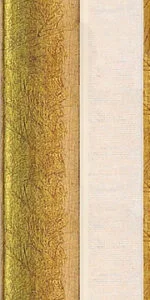
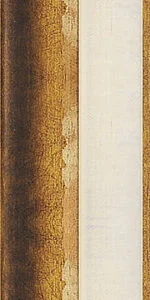
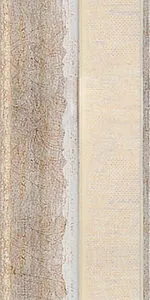
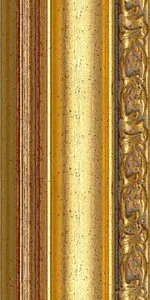
For a size not on the list, work to your own measurement is the only route; send width and height in centimetres. The frame is not included; a pale natural or white moulding suits it, while a dark frame pushes the meadow into shadow.
Delivery and guarantee
Making the work takes two to three weeks, longer at the largest sizes, because the oil must dry between layers. Stretched canvases travel in a rigid box, rolled ones in a tube. If it arrives damaged or differs noticeably from the approved photograph, we replace or refund it. A hand-painted copy is no factory product and small differences in the stroke are expected; damage is not.
If the painting is a gift and you are unsure of the size, there is a gift voucher: the recipient chooses the size and the subject.
Frequently asked questions
Where is the original?
At the National Gallery of Art in Washington, 2015.19.65, by the record in Gallery 80.
What does the work say in one sentence?
That a tree can be the whole scene, given enough canvas.
Is the original for sale and what is it worth?
No, it belongs to the museum. We give no value; the museum records no price anywhere in the chain.
Where was Monet living when he painted the willows?
In Vétheuil, a village on the Seine north-west of Paris, where money troubles had taken the family in 1878. He sold this canvas in November 1880.
- Subject. A willow in a meadow with yellow flowers, a pale band of water and houses behind.
- Original. Oil on canvas, 81.92 x 66.68 cm, 1880; National Gallery of Art, Washington, acc. no. 2015.19.65.
- Ours. Eight sizes; 90 x 70 by size, 110 x 90 by proportion.
- Worth knowing. The year on the canvas cannot be read; 1880 stands in the record and in the chain.