







































Description
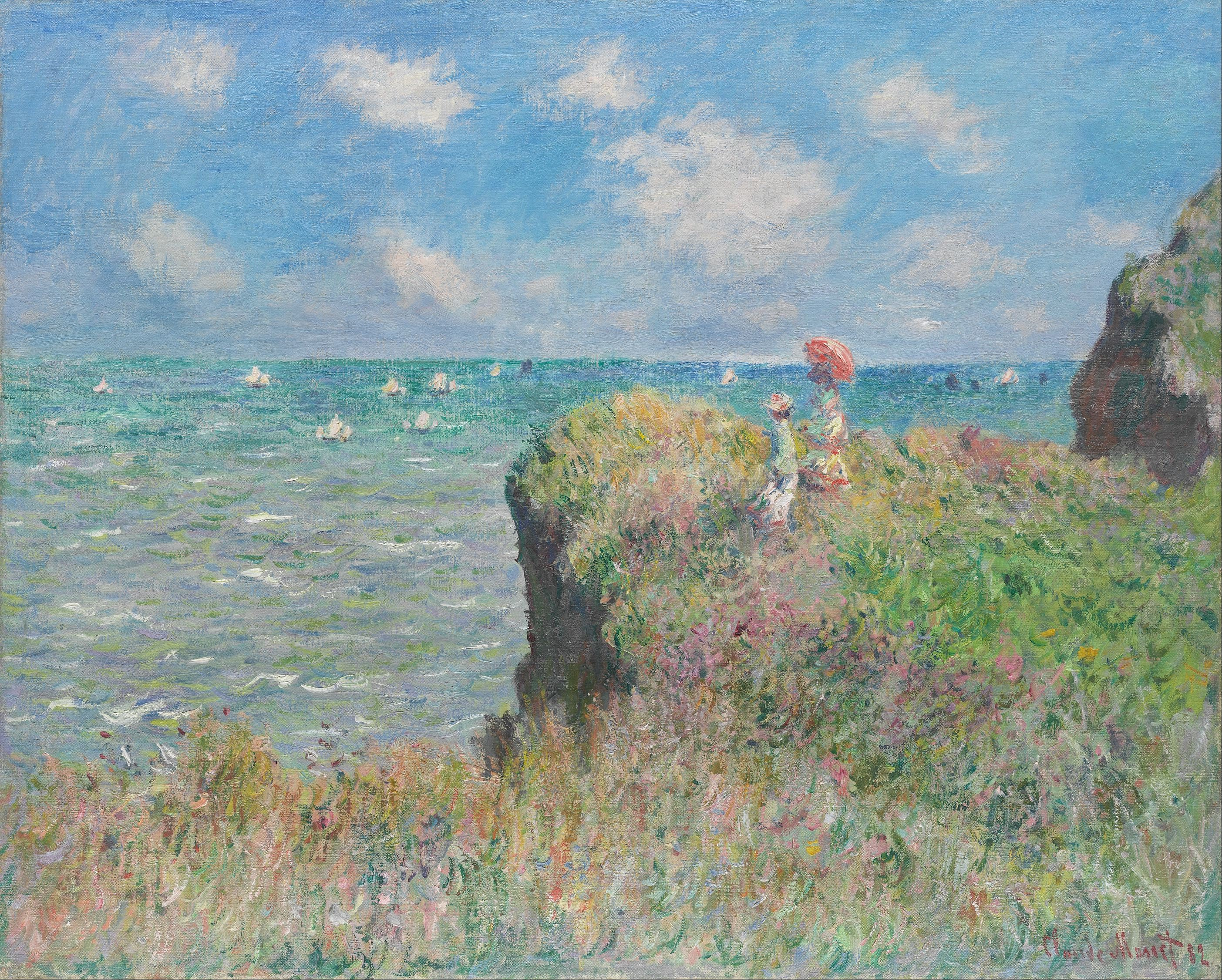
The Cliff Walk at Pourville is a hand-painted reproduction of Monet’s canvas at the Art Institute of Chicago: two figures in long dresses stand on the grassy cliff above the sea, the farther one holding a red parasol. The original measures 82.3 x 66.5 cm, is oil on canvas and carries the accession number 1933.443. The museum dates it to 1882, and the canvas is signed at the lower right “Claude Monet 82”, so the two years agree. We paint it in eight sizes or to your own, with a photograph of the finished work for approval before despatch.
| Title: | The Cliff Walk at Pourville |
| Other titles: | Promenade sur la falaise, Pourville (the name in the Wikidata collection) · Promenade sur la Falaise (Durand-Ruel exhibition, Paris 1883) · Falaises de Dieppe (Brussels 1904) · The Walk on the Cliffs (London 1905) |
| Painter: | Claude Monet (1840–1926) |
| Year painted: | 1882 in the museum record; the museum itself transcribes the signature at the lower right as “Claude Monet 82”, so the two years agree |
| Original size: | 82.3 cm x 66.5 cm |
| Original technique: | Oil on canvas |
| Painting style: | Impressionism |
| Located at: | Art Institute of Chicago (acc. no. 1933.443) |
| Our reproduction: | Hand-painted oil on canvas, eight sizes or made to measure |
The Cliff Walk at Pourville – Claude Monet
Who is standing on the cliff?
The museum does not say for certain. The Art Institute of Chicago writes that the two young women are probably Marthe and Blanche, the eldest Hoschedé daughters; probably is the museum’s word, and no document is offered. Less disputed is what can be seen: two figures in long dresses, both hatted, turned towards the water. The nearer wears a pale straw hat with a dark band; the farther’s red parasol is the only strong red apart from the signature. There are no faces; the figures stay part of the slope.
What is on the canvas?
The grassy cliff rises from the right towards the middle and ends in a ridge just below the two figures; beneath it a dark rock face drops away, the only truly dark area in the lower half. To the left the sea runs to the horizon, scattered with tiny white sails, and the right edge cuts through a second, larger rock.
Between slope and water the handwriting changes plainly. The grass is laid in short, brisk, curved strokes — the museum’s own description — many nearly upright, and it is those that make the blades seem to quiver in the wind; the sea is painted in short horizontal dashes. It is the water that is horizontal, not the grass. The museum also records what the canvas cannot show: X-radiographs reveal that Monet reduced the rocky outcropping at the far right to balance sea and sky.
How is the work dated, and what does the canvas say?
The Art Institute of Chicago gives 1882, with no range and no cautious about, its start and end years the same. In the same record the museum transcribes the inscription itself: signed at the lower right, “Claude Monet 82”. Record and canvas therefore agree, which is less obvious than it sounds: for the three Rouen cathedrals from the Orsay the museum transcribes no inscription at all, and there the year we read differs by two on two of them and cannot be read on the third.
What does the museum record say about the size?
The work is held by the Art Institute of Chicago, accession number 1933.443. It publishes the measurements height by width, 66.5 x 82.3 cm; our table puts the width first, so you read 82.3 x 66.5 cm. We say so out loud: a page with no note and a page where nobody compared look the same. With its frame the museum gives 104.8 x 88.9 x 10.8 cm.
From Hayes to Chicago, and the point where the record contradicts itself
For this canvas the museum publishes a chain of owners, not one line of acquisition. The first is Hayes, who had it by 1 March 1883. Then Hermann Kapferer in Paris, by 17 July 1888, and the same day the sale to the dealer Durand-Ruel for 1,200 francs. Then, the museum says, possibly a sale to Annie Swan Coburn in Chicago by 26 April 1928 — possibly is the museum’s word, resting on a note its archives could not confirm. In 1933 the canvas came by bequest into the Mr. and Mrs. Lewis Larned Coburn Memorial Collection.
In the middle of that chain the record contradicts itself, and the museum says so. The Wildenstein catalogue of 1996 does not list Kapferer and states that Durand-Ruel bought the canvas directly from the painter in October 1882; the Durand-Ruel Archives, the record notes, cannot support that claim. Which version holds we do not know.
Which of our two Pourville cliffs is this one?
We sell two canvases painted in the same year on the same coast, easy to confuse. This is the Chicago one, 82.3 x 66.5 cm. The other is Cliffs at Pourville, held by the National Gallery of Art in Washington under number 1985.64.27 and measuring 100 x 60 cm, far wider and lower. On ours both figures stand, the farther with a red parasol, the signature at the lower right. On the Washington canvas one woman sits and the other stands beside her; no parasol, a higher viewpoint, the signature lower left. Both are signed the same way, “Claude Monet 82”: the corner tells them apart, not the signature. Wildenstein numbers them 758 and 754.
In our Claude Monet gallery it stands beside other canvases from that coast: The Customs House at Varengeville was painted the same year; grass, rock and water meet again in Rocks at Port-Goulphar; from Normandy too comes The Departure of the Boats, Étretat.
How many names has this canvas travelled under?
Four that the museum names itself, and a fifth from the Wikidata collection: in March 1883 at Durand-Ruel in Paris as Promenade sur la Falaise, the same year in London under almost that name, in 1904 in Brussels as Falaises de Dieppe, and in 1905 again in London as The Walk on the Cliffs.
One of those names is a trap. Falaises de Dieppe means the cliffs of Dieppe — and the Wildenstein catalogue lists that other, Washington canvas under the name Sur la Falaise à Dieppe. Both have therefore carried a name from the cliffs at Dieppe, a few kilometres from Pourville. Our title follows the name we sell under.
How is our hand-painted version made?
Every order is painted individually by an artist, in oils on cotton or linen canvas. That is how every canvas painting is made here: no print, no transfer, no machine step. This impressionist painting is demanding in its handwriting: the slope is thousands of short curved strokes, the sea horizontal dashes, and if the hand does not change the cliff becomes a green wall. The red parasol is the only strong accent and will not survive enlargement. The museum records Monet at Pourville from February to mid-April 1882; in work of that kind, en plein air, the underlayer stays light and the shadow is built from cool glazes.
Which size for which wall?
Eight sizes are available, from 45 x 38 to 150 x 120 cm, and there are two answers. By size the nearest is 80 x 60 cm: 2.3 cm narrower and 6.5 cm shorter than the canvas in Chicago. By the ratio of the sides it is the furthest of all eight: the original is 0.808, 80 x 60 cm is 0.750. Nearest by ratio are 50 x 40 and 150 x 120 cm, both at 0.800. In a hallway 50 x 40 cm is enough; as a painting for living room walls, 90 x 70 cm.
How high to hang the painting: the centre about 145 cm above the floor; with a landscape format rather higher.
Made to measure, stretcher and frame
For the exact proportion of the original, work to your own measurement is the only route: send us width and height in centimetres. The canvas comes stretched on a stretcher or rolled in a tube; the frame is not included. A narrow moulding in pale wood suits this scene; a wide gilt one dulls the colour.
Delivery and guarantee
Making the work takes two to three weeks, longer at the largest sizes, because the oil must dry between layers. If it arrives damaged, or differs noticeably from the approved photograph, we replace it or refund the price. A hand-painted copy is not a factory product and small differences in the stroke are expected; damage is not.
If the painting is a gift and you are unsure of the size, there is a gift voucher: the recipient chooses the size and the subject.
Frequently asked questions
Where is the original?
At the Art Institute of Chicago, accession number 1933.443, on view in Gallery 240.
What does the work say in one sentence?
That wind can be painted so that you see it only in the grass.
Why did Monet go to Pourville?
To paint. In 1882 he stayed in this seaside village near Dieppe from February to April and again from June, and that year he painted nearly a hundred canvases along the Normandy coast. It was a hard time: Camille had died three years before and his work was selling slowly.
What year is it from?
1882. The museum dates it so, and the canvas is signed “Claude Monet 82” at the lower right.
- Motif. Two figures on the cliff above the sea, the farther with a red parasol.
- Original. Oil on canvas, 82.3 x 66.5 cm, 1882; Art Institute of Chicago, acc. no. 1933.443.
- Ours. Eight sizes; 80 x 60 cm nearest by size, 50 x 40 cm by proportion.
- Worth knowing. The museum transcribes the signature “Claude Monet 82” itself; the years agree.