







































Description
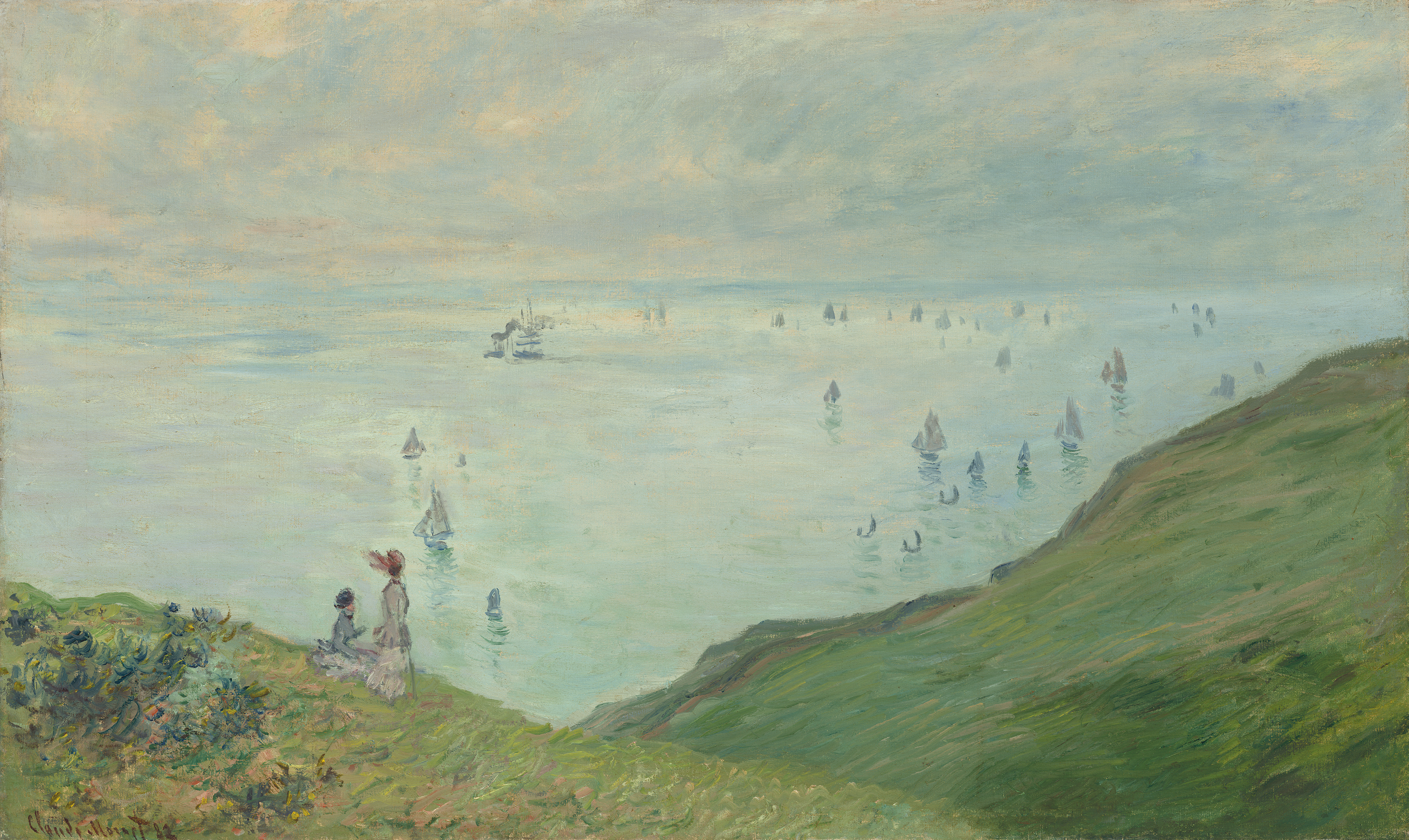
Cliffs at Pourville is a hand-painted reproduction of Monet’s canvas at the National Gallery of Art in Washington: from high up we look across two green hills to a wide pale sea scattered with sails, and on the left-hand hill one woman sits while another stands beside her. The original measures 100 x 60 cm, is oil on canvas and carries the accession number 1985.64.27. The museum dates it to 1882, and the canvas is signed at the lower left “Claude Monet 82”, so the years agree. We paint it in eight sizes or to your own, with a photograph of the finished work for approval before despatch.
| Title: | Cliffs at Pourville |
| Other titles: | Sur la Falaise à Dieppe (Wildenstein catalogue 1974, II, no. 754) · On the Cliff at Dieppe · Cliffs at Dieppe (both in the catalogue of the Vienna exhibition of 2014–2015) |
| Painter: | Claude Monet (1840–1926) |
| Year painted: | 1882 in the museum record; the museum itself transcribes the signature at the lower left as “Claude Monet 82”, so the two years agree |
| Original size: | 100 cm x 60 cm |
| Original technique: | Oil on canvas |
| Painting style: | Impressionism |
| Located at: | National Gallery of Art, Washington (acc. no. 1985.64.27) |
| Our reproduction: | Hand-painted oil on canvas, eight sizes or made to measure |
Cliffs at Pourville – Claude Monet
Who is sitting and who is standing on the hill?
The museum gives no names, not even a cautious probably, and we will not guess one. What it gives is what can be seen: on the hill to our left one woman sits, the other stands next to her. Both wear hats and long skirts in dusky pink and dove grey, and the seated woman has a single touch of peach for a face. Behind the standing woman’s hat a red veil lifts, as if in the wind.
That is wrong: there are two, and the museum names them both. The claim is gone.
What is on the canvas?
Two overlapping emerald-green hills make a shallow V across the lower third, the right-hand one rising past the middle of the right edge. They are laid in dashes and long strokes of seafoam and celery green, with swipes of peach and royal blue. The water is powder blue, the horizon two thirds of the way up, the sky the same tones as a screen of cloud. Triangles and dashes of slate blue give about three dozen sailboats and one steamship; squiggles of teal are their reflections.
First: there is no chalk wall falling into the water — the museum writes of two emerald-green hills, and so does our photograph. Second: there is no white rock built out of pinks and blues. The pinks and blues are in the grass, the water and the sky, which is why the canvas is so light.
How is the work dated, and what does the canvas say?
The National Gallery of Art gives 1882, with no range and no cautious about. In the same record the museum transcribes the inscription itself, naming the corner: lower left, “Claude Monet 82”. Record and canvas agree, and we say so, because a page that says it and a page on which nobody compared look the same.
What does the museum record say about the size?
The work is held by the National Gallery of Art under accession 1985.64.27, by its own record not on view, in the Collection of Mr. and Mrs. Paul Mellon. It publishes the measurements height by width, 60 x 100 cm; our table puts the width first, so here you read 100 x 60 cm. With its frame the museum gives 118.27 x 78.58 x 6.99 cm.
One detail is worth the mention. Here they are stored in centimetres, 100 and 60, and for the Chicago twin in millimetres, so agreement is a claim about units too.
From Durand-Ruel to Mellon
For this canvas the museum publishes a chain of owners, not one line of acquisition. In January 1883 the dealer Durand-Ruel bought it in Paris directly from the painter; in 1939 it was with Arthur Tooth & Sons in London. Then Lady John Hope had it and sold it in 1953 to Paul Mellon, who gave it to the gallery in 1985.
Every station carries a source: the first Wildenstein 1974, the Mellon sale the gallery’s own files. Nothing in the chain contradicts itself, worth saying because on the Chicago twin the museum records that its own entry contradicts itself.
Which of our two Pourville cliffs is this one?
We sell two canvases from the same year and the same coast, easy to confuse. This is the Washington one, 100 x 60 cm, far wider and lower. The other is The Cliff Walk at Pourville, at the Art Institute of Chicago under 1933.443, 82.3 x 66.5 cm; we sell a Monet reproduction of that one too.
Four points tell them apart. On ours one woman sits and the other stands beside her; on the Chicago canvas both stand. On ours there is no parasol, and the red is a veil behind a hat. Our viewpoint is higher and opens across two green hills; the Chicago canvas has a dark rock face below the ridge. And the signature: ours lower left, the Chicago one lower right. Both carry the same year, so it is the corner that separates them.
In our Claude Monet gallery it stands beside canvases from the same coast: The Customs House at Varengeville, painted the same year a few kilometres away; grass, rock and water again in Rocks at Port-Goulphar; the same sea in bad weather in Storm on the Belle-Île Coast; and from Normandy too The Departure of the Boats, Étretat.
How many names has this canvas travelled under?
The Wildenstein catalogue of 1974 lists it as Sur la Falaise à Dieppe, and at the Lower Belvedere in Vienna in 2014 and 2015 it was given under three names at once: On the Cliff at Dieppe, Cliffs at Dieppe and Sur la falaise à Dieppe. Dieppe lies a few kilometres from Pourville, and the name is a trap both ways: the Chicago twin was shown in Brussels in 1904 as Falaises de Dieppe. Our title follows the name we sell under.
How is our hand-painted version made?
Every order is painted individually by an artist, in oils on cotton or linen canvas. That is how every canvas painting is made here: no print, no transfer, no machine step. This impressionist painting is demanding for an unusual reason: a good two thirds of the surface is pale sea and pale sky within a very narrow range of values, so the whole thing rests on differences one tone wide. The museum records the paint as so thin in places that the weave shows, and that thinness must survive enlargement. Out of doors, en plein air, the underlayer stays light and shadow is built from cool glazes.
Which size for which wall?
Eight sizes are available, from 90 x 50 to 394 x 238 cm, and there are two answers. By size the nearest is 90 x 50 cm, the only one smaller than the original: this canvas is smaller than seven of the eight. By the ratio of the sides that same size is one of three that miss, 0.556 against the original’s 0.600. Five sizes, 150 x 90, 200 x 120, 250 x 150, 300 x 180 and 350 x 210 cm, hit 0.600 to three decimals. The proportion therefore costs an enlargement, and the size costs the proportion. In a hallway 90 x 50 cm is enough, above a sofa 150 x 90 cm, as a painting for living room walls 200 x 120 cm.
How high to hang the painting: the centre about 145 cm above the floor; with a format this horizontal, rather higher than lower.
Made to measure, stretcher and frame
For exactly the proportion of the original at a size not on the list, work to your own measurement is the only route: send us width and height in centimetres. The canvas comes stretched on a wooden stretcher or rolled in a tube; the frame is not included. A narrow moulding in pale wood suits this subject; a wide gilt one dulls the pale blue.
Delivery and guarantee
Making the work takes two to three weeks, a few days longer at the largest sizes, because the oil must dry between layers. Stretched canvases travel in a rigid box, rolled ones in a tube. If the work arrives damaged or differs noticeably from the approved photograph, we replace or refund it. A hand-painted copy is not a factory product and small differences in the stroke are expected.
If the painting is a gift and you are unsure of the size, there is a gift voucher: the recipient chooses the size and the subject.
Frequently asked questions
Where is the original?
In Washington, at the National Gallery of Art, accession number 1985.64.27, by its own record not on view.
Who are the two women on the hill?
The museum does not name them. It says only that one sits and the other stands beside her.
What does the work say in one sentence?
That a wide emptiness can be painted so that it reads as full.
Why did Monet go to Pourville?
To paint. In 1882 he stayed in this seaside village near Dieppe from February to April and again from June, and that year he painted nearly a hundred canvases along the Normandy coast. It was a hard time: Camille had died three years before and his work was selling slowly.
- Subject. Two women on a green hill above a wide pale sea, one seated, one standing.
- Original. Oil on canvas, 100 x 60 cm, 1882; National Gallery of Art, acc. no. 1985.64.27.
- Ours. Eight sizes; 90 x 50 cm nearest by size, 150 x 90 cm by proportion.
- Worth knowing. The museum transcribes the signature “Claude Monet 82” at the lower left; the years agree.