




Description
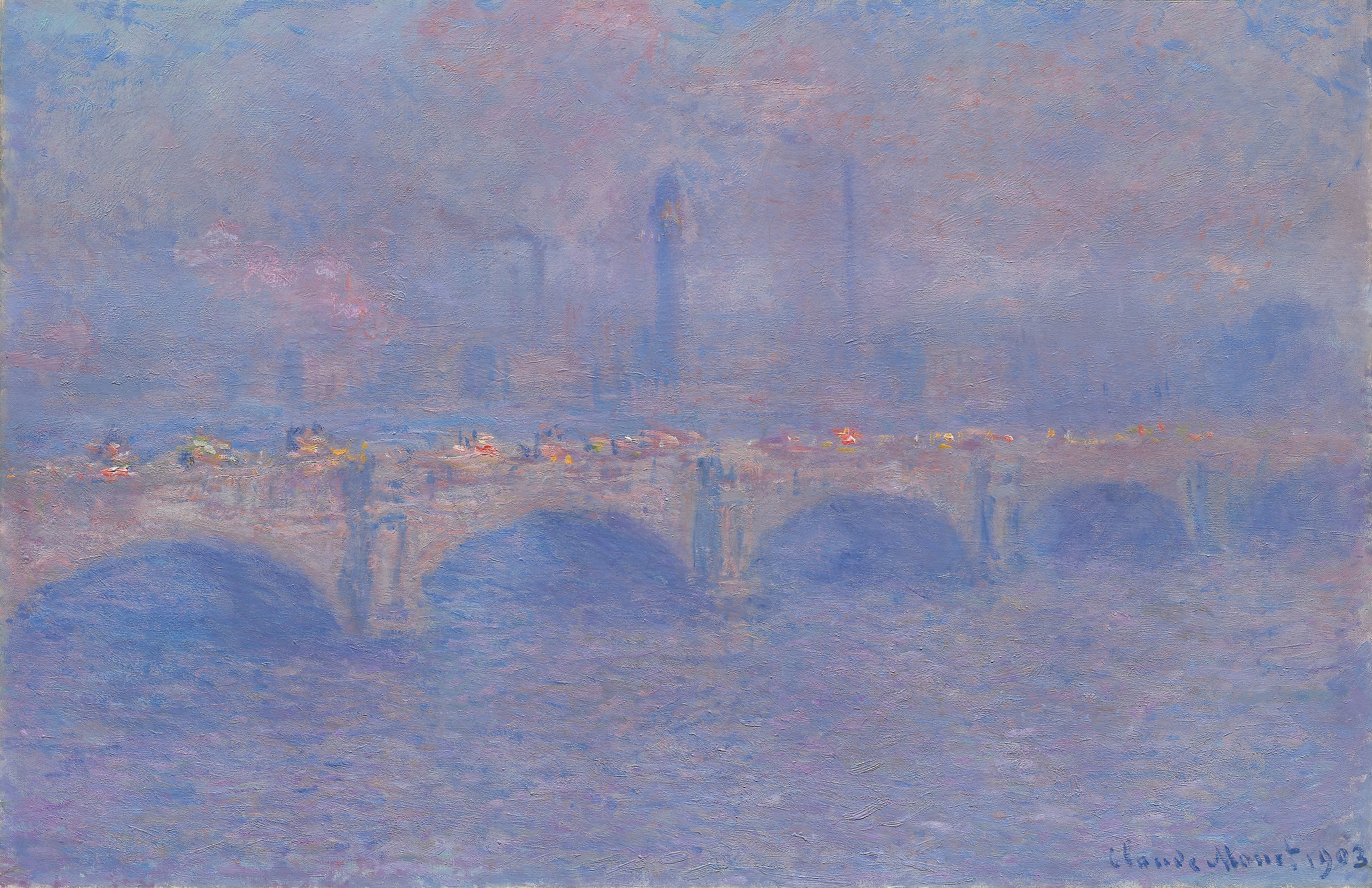
Waterloo Bridge, Sunlight Effect is a hand-painted reproduction of Monet’s canvas in the Art Institute of Chicago: a lilac and blue haze fills the whole canvas, a long bridge with a row of arches crosses the middle with small touches of orange, yellow and red along its top, tall chimneys and a dark tower stand in the fog behind it, and the river takes up the lower third. The original measures 101 x 65.7 cm, is oil on canvas, is signed »Claude Monet 1903« at the lower right, dates from 1903 and carries accession number 1933.1163. We paint it in eight sizes or to your own, with a photograph of the finished work sent for approval before dispatch.
| Title: | Waterloo Bridge, Sunlight Effect |
| Other titles: | Waterloo Bridge, Sunlight Effect (the museum’s title); La Tamise à Londres, Waterloo Bridge, effet de soleil, 1903 (the Durand-Ruel stock book entry of 1904); in the Wildenstein catalogue the work is number 1586 |
| Painter: | Claude Monet (1840–1926) |
| Year painted: | 1903 |
| Original size: | 101 cm x 65.7 cm |
| Original technique: | Oil on canvas |
| Painting style: | Impressionism |
| Located at: | Art Institute of Chicago, Chicago (inv. 1933.1163) |
| Our reproduction: | Hand-painted oil on canvas, eight sizes or made to measure |
Waterloo Bridge, Sunlight Effect – Claude Monet
What is on the canvas?
Haze fills almost the whole canvas, laid on in short strokes of lilac, pale blue and pink. Across the middle runs the bridge, a pale band on a row of broad dark arches, and along its top runs a line of small bright touches in orange, yellow, red and green.
Behind the bridge, tall chimneys and a dark tower rise into the fog; dark smoke drifts from a chimney left of centre and pinkish smoke from the upper left. The river takes up the lower third in lilac and blue strokes with flecks of pink. The signature stands at the lower right in dark blue.
When was it painted, and from where?
The museum dates the canvas 1903, Wikidata gives the same year, and so does the inscription at the lower right, which reads Claude Monet 1903. The museum’s record adds that its two Waterloo Bridge paintings are dated 1900 and 1903, but that Monet likely began both in 1900 and dated them only when he felt they were finished.
The same record describes how the days ran: he rose early to paint Waterloo Bridge in the morning and moved on to Charing Cross Bridge at midday and in the afternoon, both from his fifth-floor window at the Savoy Hotel. He worked on all his London paintings in his studio at Giverny and sent none of them to his dealer until he was satisfied with them as a group. The record also gives Monet’s remark that without the fog London would not be a beautiful city, since it is the fog that gives it its magnificent breadth.
What does the museum record say about the work?
The work is held by the Art Institute of Chicago under accession number 1933.1163, in the Mr. and Mrs. Martin A. Ryerson Collection. The museum gives its size as 65.7 x 101 cm, height first, and 123.2 x 88.9 x 10.8 cm (width first) with the frame; Wikidata gives the same 65.7 x 101 cm. The technique is oil on canvas, and in the Wildenstein catalogue the work is number 1586.
The record reads »Inscribed lower right: Claude Monet 1903«. Whether that photograph is cropped we have not measured.
Where has the canvas been?
The museum gives the chain in full. Monet sold the canvas to Durand-Ruel in Paris on 11 May 1904 for 9,000 francs; the dealer entered it in his stock book as La Tamise à Londres, Waterloo Bridge, effet de soleil, 1903. Durand-Ruel passed it to its New York house on 14 December 1904 or 6 January 1905; the museum prints both days. On 10 January 1905 W. A. Putnam bought it for 4,000 dollars; according to the Wildenstein catalogue of 1996, the buyer was A. M. Putnam.
On 22 May 1913 it was sold back to Durand-Ruel in New York for 25,000 francs; Wildenstein gives Lawrence J. Abbott and William Lowell Putnam as its owners around 1913. On 10 February 1914 Martin A. Ryerson of Chicago, who died in 1932, bought it for 7,500 dollars, and in 1933 it came to the Art Institute of Chicago by bequest.
The museum also cites a receipt on Durand-Ruel letterhead of the same day: with this canvas Ryerson acquired La cabane de douaniers of 1897 and Les nymphéas, paysage d’eau of 1906, the three together for 20,000 dollars. We sell both: The Customs House at Varengeville, 1933.1149, and Water Lilies, 1933.1157.
Which Waterloo Bridge is this?
Monet painted this bridge more than once, so a title alone does not pick out one canvas. The Art Institute holds a second one, Waterloo Bridge, Gray Weather, dated 1900, oil on canvas, 92.6 x 65.4 cm, signed lower left Claude Monet, accession number 1984.1173. Our collection also includes Waterloo Bridge, Gray Day from the National Gallery of Art in Washington, 1963.10.183, dated 1903. Ours is 1933.1163, 101 x 65.7 cm, signed with the year at the lower right; if you are looking for this work in particular, go by that number.
Why does this work matter?
Because of the fog the museum’s record speaks of: here the bridge, the chimneys and the river are painted in the same lilac and blue as the haze, only lighter or darker, and only the line of warm touches along the bridge breaks away from it.
Two more London canvases are in our collection: Charing Cross Bridge, London, the other bridge the museum names as painted from the Savoy, and London, the Houses of Parliament in the Fog. An impressionist painting of this kind tells no story; it shows light seen through fog.
How is our hand-painted version made?
Every order is painted individually by an artist, in oil on cotton or linen. That is how every canvas painting leaves us, with no print and no machine step. This oil painting reproduction is demanding in the haze: the lilac and blue strokes must stay separate and close in value, or the bridge and the chimneys either vanish or turn hard.
The second test is the line of warm touches along the bridge, which must glow without breaking the haze around it. A Monet reproduction of this kind depends on keeping every other colour pale enough to belong to the same air. Work of this kind will not take a high gloss, so ours is matt. A hand-painted copy is not a facsimile; two canvases of the same size always differ in the brushwork.
Which size for which wall?
There are eight sizes, from 70 x 45 to 200 x 130 cm. By size the closest to the original is 100 x 65 cm, 1.0 cm narrower and 0.7 cm lower, and at 1.5385 it is also the closest by proportion, against the original’s 1.5373. 200 x 130 cm has the same proportion at twice the size; after them comes 92 x 60 cm at 1.5333.
If you want nearly the size and the exact shape of the original, take 100 x 65; for the same shape on a large wall, 200 x 130. Its pale, even colour sits quietly above a table where people gather, which makes this a good painting for the dining room. All sizes are listed with the product in our Claude Monet gallery.
Custom size, stretcher bar and frame
For a size not on the list, made to measure is the only route; send us the width and height and we keep the proportion of the original. The canvas is stretched on a wooden bar. A frame is not included; the museum’s own measures 123.2 x 88.9 cm and is 10.8 cm deep.
Delivery and guarantee
Making it takes two to three weeks, a few days more at the largest sizes. It arrives stretched on its bar in a rigid box, or rolled in a tube, with tracking. If it arrives damaged or differs noticeably from the approved photograph, we replace it or refund. Small differences in the brushwork are expected in handwork; damage is not.
If the painting is a gift and you are unsure of the size, there is a voucher: the recipient chooses the size and the subject.
Frequently asked questions
Where is the original?
In Chicago, at the Art Institute of Chicago, accession number 1933.1163.
What year is it from?
1903. The museum, Wikidata and the inscription at the lower right all give that year; the museum adds that it was likely begun in 1900.
What does it show?
Waterloo Bridge in London in a lilac haze, with chimneys in the fog behind it and warm touches of light along the bridge.
How many paintings of Waterloo Bridge did Monet make?
Forty-one, between 1900 and 1904. Together with Charing Cross Bridge and the Houses of Parliament they belong to nearly a hundred views of the Thames from his London stays.
- Subject. Waterloo Bridge in a lilac haze, with chimneys in the fog behind it and warm touches along its top.
- Original. Oil on canvas, 101 x 65.7 cm, 1903; signed at the lower right »Claude Monet 1903«; Art Institute of Chicago, inv. 1933.1163.
- Ours. Eight sizes; 100 x 65 cm is closest both by size and by proportion.
- Worth knowing. The museum records that on 10 February 1914 Ryerson bought this canvas on one receipt with two more canvases that we also sell.