







































Description
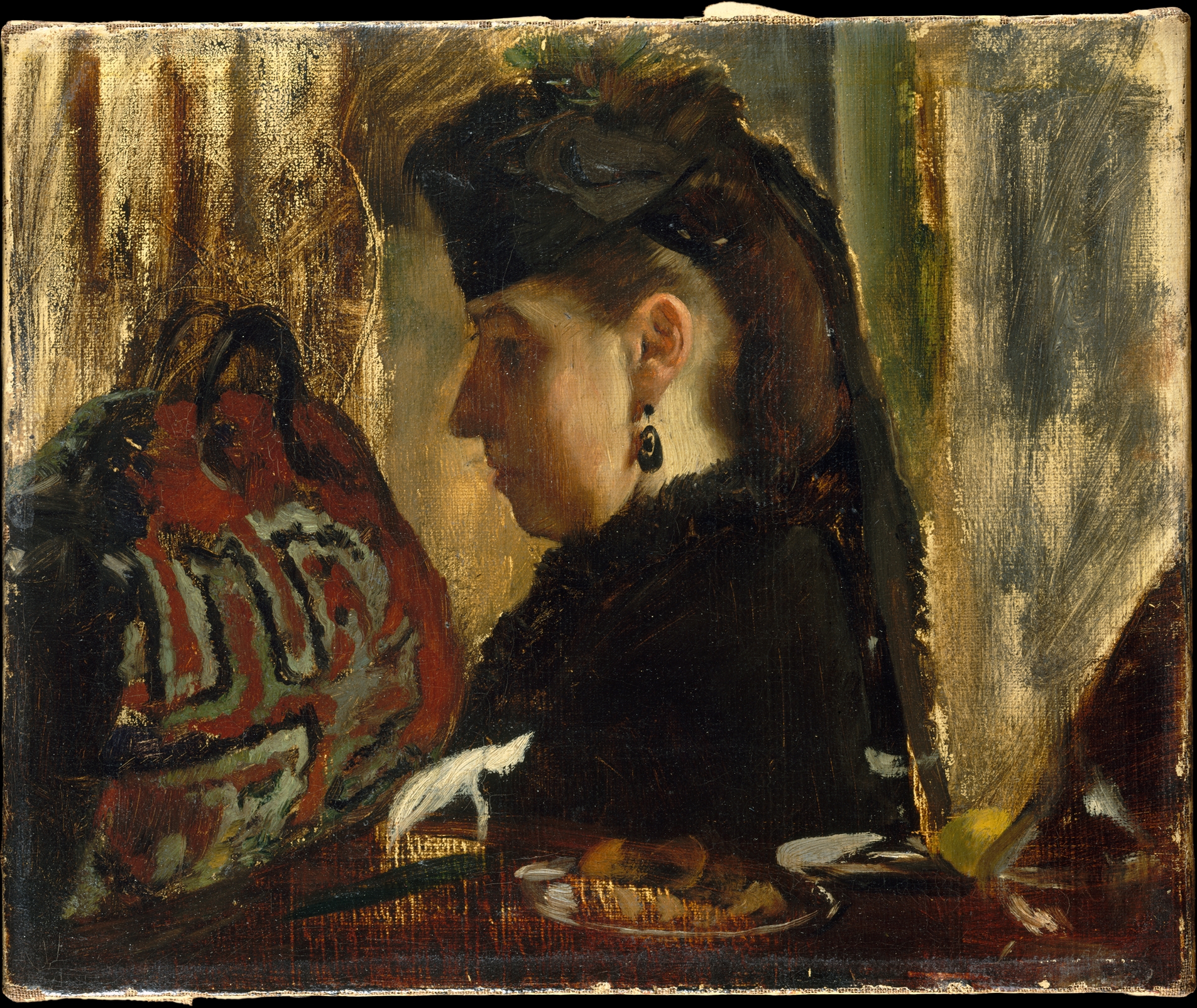
Mademoiselle Marie Dihau shows a woman in strict profile, turned to the left, seated at a table. She wears a dark dress with a fur collar and a dark hat with a green feather and a dark ribbon falling behind her neck; a black earring hangs at her ear. At her left rises a large red form with pale strokes, dark along its upper edge, and it is the nearest thing in the scene. Below, on the dark table, are a plate, a yellow fruit and a white napkin. The original is an oil painting on canvas and is held by the Metropolitan Museum of Art in New York under the accession number 29.100.182. We make it as a hand-painted work, in sizes from 50 x 40 to 100 x 80 cm or to your own measurements, and you receive a photograph of the finished work for approval before dispatch.
| Title: | Mademoiselle Marie Dihau |
| Other titles: | Marie Dihau (1843–1935) |
| Painter: | Edgar Degas (1834–1917) |
| Year of execution: | 1867–1868 |
| Original size: | 22.2 cm x 27.3 cm |
| Original technique: | Oil on canvas |
| Painting style: | Impressionism |
| Located at: | Metropolitan Museum of Art, New York (acc. no. 29.100.182) |
| Our reproduction: | hand-painted oil on linen canvas, 6 sizes from 50 x 40 cm to 100 x 80 cm, custom sizes on request |
Mademoiselle Marie Dihau – Edgar Degas
Who is shown?
A single woman, whom the title names: Marie Dihau, a pianist. She is seen in strict profile, turned to the left, and sits at a table. Her face is pale and calm, her chin slightly raised, her look directed straight ahead. On her head is a dark hat with a green feather on top and a dark ribbon falling behind her neck; a black earring hangs at her ear. She wears a dark dress with a fur collar. There is nobody else.
What is on the canvas?
The scene is landscape in format, small, and painted very thinly — the canvas shows through the colour in many places. At the woman’s left rises a large red form with pale and greenish strokes, dark along its upper edge; it is the nearest thing in the scene and the only strong colour. Below, on the dark table, are a plate with something brown, a yellow fruit and a white napkin. Behind her is a pale striped ground, and down the middle a vertical green band. There are few colours: the dark dress, the pale ground, one red and one yellow.
Why does this particular scene matter?
Because the portrait is painted at a table and not in a studio. In front of the woman are a plate, a fruit and a napkin — the objects of a meal, not of a portrait. Degas painted someone sitting opposite him during a meal, and painted it so quickly that the canvas stays visible through the colour. The second thing is the relation of sizes: the scene is smaller than a sheet of paper, and the woman in it is painted with complete stillness while everything around her is only indicated.
What does the scene mean?
Closeness without staging. Impressionism for Degas always meant a cutting caught when the eye really sees it, and here the cutting is caught across a table. An impressionist painting of this kind is therefore not a commission but a note. As wall art it is small in the original and intimate in effect; it works where it is seen close to. A canvas painting for a dining room, a kitchen or the corner beside a table suits it unusually well, precisely because of the objects in it.
The motif among Degas’s works
The Dihau family is a whole group of works in Degas. Mademoiselle Dihau at the Piano is a larger portrait of the same woman at her instrument, The Orchestra at the Opera belonged for years to the same family, and Joseph-Henri Altès is the portrait of a flautist of the same orchestra. This work is catalogued in the Degas catalogue raisonné as MS 1897, and how Degas saw a woman in a café is shown by Café Singer at the Art Institute of Chicago.
How is our hand-painted version made?
With a brush and oil colours, not a printer, and here the technique of the original is the same as ours: oil on canvas. Every one of our canvases is made layer after layer, and in this motif the hardest thing is to keep the speed. The original is thinly painted and made in one go; copied slowly and thickly, the scene goes solid and loses its character. So we paint the ground and the table with thin layers and let the canvas show through. The face is the only part carried through — exactly as in Degas. We paint the red form at the left last, because it settles the balance of the colours. Every reproduction is made afresh and no two copies are ever quite the same, because the hand does not repeat the same stroke twice; every hand-painted copy is therefore its own. For this work we have no photographs of our finished canvases, so we show and describe none here. The photograph of your canvas reaches you before dispatch.
Which size for which wall?
If you do not know which: 60 x 50 cm. The original measures 22.2 x 27.3 cm and is therefore exceptionally small — smaller than a sheet of paper; our 50 x 40 cm size comes nearest to it in size, while in proportion the nearest is 80 x 65 cm, because our sizes run only slightly wider than the original. The 50 x 40 and 60 x 50 cm sizes are for a smaller room or the wall beside a table, where the scene is seen close to. The 70 x 60 and 80 x 65 cm sizes are the most frequent choice above a chest of drawers. The 90 x 70 cm size is for a larger wall, and at 100 x 80 cm we are at the sizes where a large painting really breathes and the head is bigger than life — a marked effect with an original painted this thinly. Measure your chosen size on the wall with a paper cut-out first; with a landscape format the mistake is usually made in the width. None of the sizes is held in stock as a finished item: every copy is made to order and stays a single piece.
Custom size, stretcher bar and frame
If none of the six sizes suits you, or if you want the original’s proportion, we paint to your measurements and keep the proportions of the scene, so that the red form at the left stays whole and the plate below is not cut off; that is our painting made to order. Every copy is delivered stretched on a wooden bar, ready to hang. For the frame, use our 3D application: on this motif it shows every moulding profile we carry, so you can compare gold, silver, black, white and natural wood – it is for choosing a frame and nothing else. If you want to see how the work looks on your own wall, that is our separate room-placement service.
Delivery and guarantee
Every copy is made to order in our studio in Slovenia, so allow 15 to 45 days depending on the size you choose; for the largest sizes the time is usually at the upper end. We send it stretched and protected for transport, framed if you chose a frame, to sixteen countries in the European Union, without customs duties. You receive a photograph of the finished work for approval before dispatch, and our returns policy applies to every order. The whole range is in the Edgar Degas gallery, and the painter’s life is described in our article about Edgar Degas.
Frequently asked questions
Who is the sitter?
Marie Dihau, a pianist. The museum record gives her years as 1843–1935.
What is the red form at the left?
The record does not say, and the scene itself does not settle it. It is the nearest object to the woman and the only strong colour on the canvas; it is painted in a few quick strokes.
What is on the table?
A plate with something brown, a yellow fruit and a white napkin. The objects of a meal, not of a portrait.
Why does the scene look unfinished?
Because it is painted very thinly: the canvas shows through the colour in many places. Only the face is carried through.
Where is the original located?
In the Metropolitan Museum of Art in New York, under the accession number 29.100.182.
How large is the original?
22.2 by 27.3 cm, so smaller than a sheet of paper. Our 50 x 40 cm size comes nearest to it in size.
Why are two years given?
Because the museum gives a period, 1867–1868, rather than a single year. Where the year is not settled, we do not settle it either.
Are your sizes in the same proportion as the original?
Almost – ours run only slightly wider. In proportion the nearest is 80 x 65 cm; if you want the original’s proportion, we paint it to your measurements.
Is this a print?
No. The work is painted by hand in oil colours; the brushstrokes are visible and can be felt.
Can I have a size that is not listed?
Yes, we paint to measure and keep the proportions of the scene while doing it.
Is it suitable as a gift?
Yes, especially for a musician or for someone who likes small, quiet scenes. Because every copy is made to order, allow for the making time; if you would rather leave the choice to them, there is our gift voucher.
- Subject: a woman in strict profile at a table, in a hat with a black earring, a large red form at the left, and below a plate, a fruit and a napkin
- Original: Edgar Degas, an oil painting on canvas, 22.2 x 27.3 cm, Metropolitan Museum of Art in New York (29.100.182)
- Ours: hand-painted in oil, six sizes from 50 x 40 to 100 x 80 cm, stretched and framed on request
- Worth knowing: the portrait is painted at table during a meal – a plate, a fruit and a napkin in front of her, and everything but the face only indicated