















Description
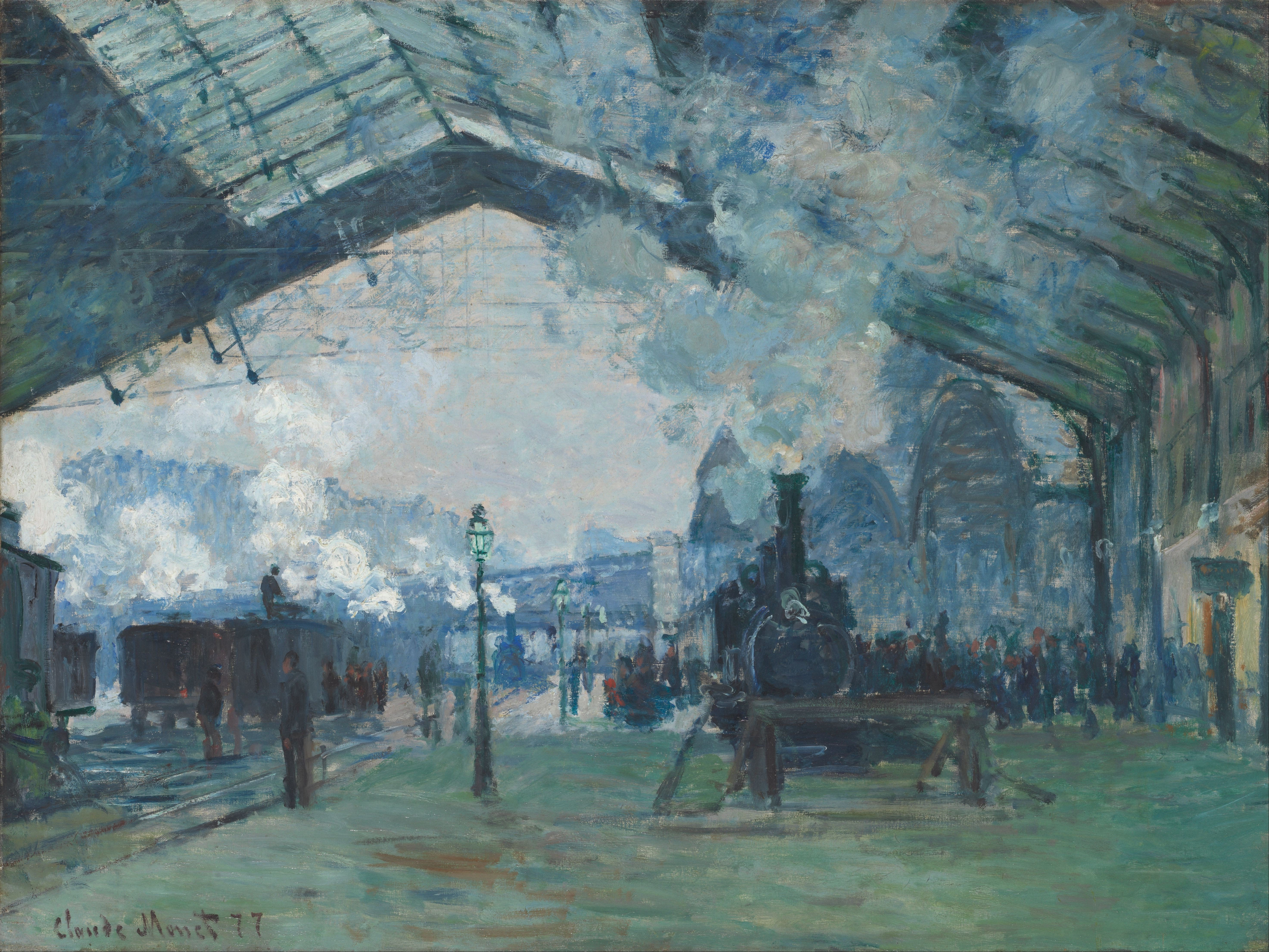
Arrival of the Normandy Train is a hand-painted reproduction of Monet’s Paris station: under a wide glass roof steam rises in blue clouds, a dark locomotive stands to the right, and small figures move along the greenish tracks. The original is oil on canvas, measures 80.2 x 60.3 cm and belongs to the Art Institute of Chicago under accession number 1933.1158. The museum dates it to 1877 and reads the signature at lower left, “Claude Monet 77”. We paint it in eight sizes or to your own measurements, with a photograph of the finished work sent for approval.
| Title: | Arrival of the Normandy Train |
| Other titles: | Arrival of the Normandy Train, Gare Saint-Lazare (the museum’s own designation) |
| Painter: | Claude Monet (1840–1926) |
| Year painted: | 1877; signed lower left “Claude Monet 77” |
| Original size: | 80.2 cm x 60.3 cm |
| Original technique: | Oil on canvas |
| Painting style: | Impressionism |
| Located at: | Art Institute of Chicago (acc. no. 1933.1158) |
| Our reproduction: | Hand-painted oil on canvas, eight sizes or made to measure |
Arrival of the Normandy Train – Claude Monet
What is on the canvas?
The roof is the main thing. The upper two thirds are taken up by the frame of the train shed: slanting bands of glass and iron running in from both sides towards the centre, and beneath them a thick cloud of steam, blue and grey, blurring everything it touches. Right of centre stands a locomotive, dark and almost black, with a tall chimney from which the steam climbs straight up. At the left a goods wagon waits on a side track, two figures beside it. Behind, city houses and the roof of the second shed blur into the haze. The lower third is track, in greenish and brown strokes, and the signature sits at lower left in a dark colour.
Which station is this, and what does the museum say about it?
The Gare Saint-Lazare in Paris. The Art Institute of Chicago records that in the 1870s this station was a familiar and meaningful sight for Monet: it was where he left for Normandy, where he had developed his open-air painting in the 1860s, and where the Impressionists boarded trains for the towns west and north of Paris. The museum adds that Monet concentrated on the train shed of glass and iron because he found in it an appealing mixture of the artificial and the natural: locomotive steam trapped under the structure, and daylight through the glazed parts of the roof.
How is the work dated?
By a single year, and from two independent sources. In its date field the museum gives 1877, with no range and no cautious “about”. The canvas carries an inscription, which the museum transcribes: at lower left it reads “Claude Monet 77”. With Monet’s works that is not a given: where the museum dates by a range, we give no year at all.
What does the museum’s record say about the size?
The work is held by the Art Institute of Chicago under accession number 1933.1158. It gives the dimensions in height by width order, 60.3 x 80.2 cm; our table puts width first, so here you read 80.2 x 60.3 cm. Framed, the whole measures 100.4 x 80.7 x 10.2 cm. The museum measures its own canvas and gets 60.3 in height, seven millimetres more. It also records that the work is not currently on view.
The third Impressionist exhibition, April 1877
This very canvas hung in the third Impressionist exhibition of April 1877, at 6 rue Le Peletier; in the catalogue it carried number 97 and the name “Arrivée du train de Normandie, gare St-Lazare”. The museum states that by then Monet had finished eight of the twelve known Saint-Lazare canvases, and probably showed them together in one room. It adds that they were his last attempt at the life of the city: after them he turned to landscape and stayed with it.
The road to Chicago: from Hoschedé to Ryerson
The museum publishes an unusually long chain of owners, and every step of it is theirs, not ours. Ernest Hoschedé bought the work in March 1877; in 1878 it passed to the collector Georges de Bellio, and after his death in 1894 to his daughter Victorine and his son-in-law Eugène Donop de Monchy. Around 1899 it was with Bernheim-Jeune, by October 1911 with Paul Rosenberg, and on 13 October 1911 Durand-Ruel in Paris bought it for 13,000 francs and moved it to New York that December. From there it came to Martin A. Ryerson of Chicago, and with his collection to the museum in 1933.
Twelve Saint-Lazares — which one is ours?
Twelve known canvases of this station make confusion a real possibility, and two are particularly misleading. The first is at the National Gallery in London, NG6479, and measures 73.6 x 54.3 cm — a smaller canvas with the same glass roof. The second is at Harvard, under number 1951.53, and is called The Gare Saint-Lazare: Arrival of a Train — almost ours by title, but far larger at 101.5 x 83 cm. Ours is the only one the Art Institute of Chicago names after the Normandy train, under 1933.1158. One more, The Gare Saint-Lazare from the Musée d’Orsay, we sell as well.
How is our hand-painted version made?
Every order is painted individually by a painter, in oils on cotton or linen canvas. A canvas painting is made here with no print, no transfer and no machine step in between. This subject is demanding because of the steam: it is not an object with an edge but a transition between two colours, and if the painter puts it down as a white patch the roof behind it disappears instead of showing through. So it is built in thin layers that overlap as they dry. The iron supports, by contrast, have to be drawn in one stroke, or the frame sags. Every hand-painted oil painting that leaves our workshop is a little its own, and before dispatch you receive a photograph of it for approval.
Stretched on a stretcher in a hard box, or rolled in a tube, as you prefer, with tracking. You receive a photograph of the finished work first.
Which size for which wall?
Eight sizes are available, from 40 x 30 to 130 x 98 cm. Something is worth saying here that does not hold for Monet’s other works: the 80 x 60 cm size is two millimetres from the original in width and three in height. It is at once the closest by size and all but identical in proportion, 1.33 against the original’s 1.33. The scene is low and wide, so it sits well above a sofa or a chest of drawers. As a painting for living room walls or above a dining table, 120 x 90 cm works more strongly, because at a larger size the steam separates into individual strokes. Related subjects in the Claude Monet gallery: The Railway Bridge at Argenteuil, Bridge at Argenteuil and The Tuileries Gardens.
How high to hang the painting: put the centre about 145 cm above the floor; above furniture, leave 20 to 30 cm of clear wall below it. We write more about arrangement on our blog.
Made to measure, stretcher and frame
If you want the exact proportion of the original, a made-to-measure canvas is the only route: send us the width and the height in centimetres — although here 80 x 60 cm is already so close that you will not see the difference. The canvas can arrive stretched on a wooden stretcher and ready to hang, or rolled in a tube if you mean to have it framed yourself. A frame is not included in the price. This scene takes a dark, narrow frame that echoes the iron of the roof; a wide gilt frame argues with it.
Delivery and guarantee
Making it usually takes two to three weeks, a few days more in the largest sizes, because the oil has to dry back between layers. If the work arrives damaged, or differs noticeably from the approved photograph, we replace it or refund the price. A hand-painted copy is not a factory product and small differences in the stroke are expected; damage or the wrong subject are not, and those are ours to put right. We deliver within the European Union.
If the painting is a gift and you are unsure of the size, there is a gift voucher: the recipient chooses the size and the subject.
Frequently asked questions
Where is the original?
In Chicago, at the Art Institute of Chicago, under 1933.1158. The museum records that it is not currently on view.
Which station is painted?
The Gare Saint-Lazare in Paris, the station for Normandy. Monet painted twelve known canvases of it, eight finished by the exhibition of April 1877.
What does the painting say in one sentence?
That steam under a glass roof is as worth painting as a cloud over a field, and that with it Impressionism moved into the city.
How many paintings of the Gare Saint-Lazare did Monet make?
Twelve known canvases, all from 1877. He showed seven of them at the third Impressionist exhibition in April that year, and the group was his first series devoted to a single motif.
- Subject. Glass and iron roof across the upper two thirds, a cloud of blue steam beneath it, a dark locomotive at the right, tracks below.
- Original. Oil on canvas, 80.2 x 60.3 cm, 1877, signed lower left “Claude Monet 77”; Art Institute of Chicago, acc. no. 1933.1158, Ryerson Collection.
- Ours. A Monet reproduction in eight sizes from 40 x 30 to 130 x 98 cm; 80 x 60 cm is only two and three millimetres from the original.
- Worth knowing. This very canvas hung in the third Impressionist exhibition of April 1877 under catalogue number 97.