







































Description
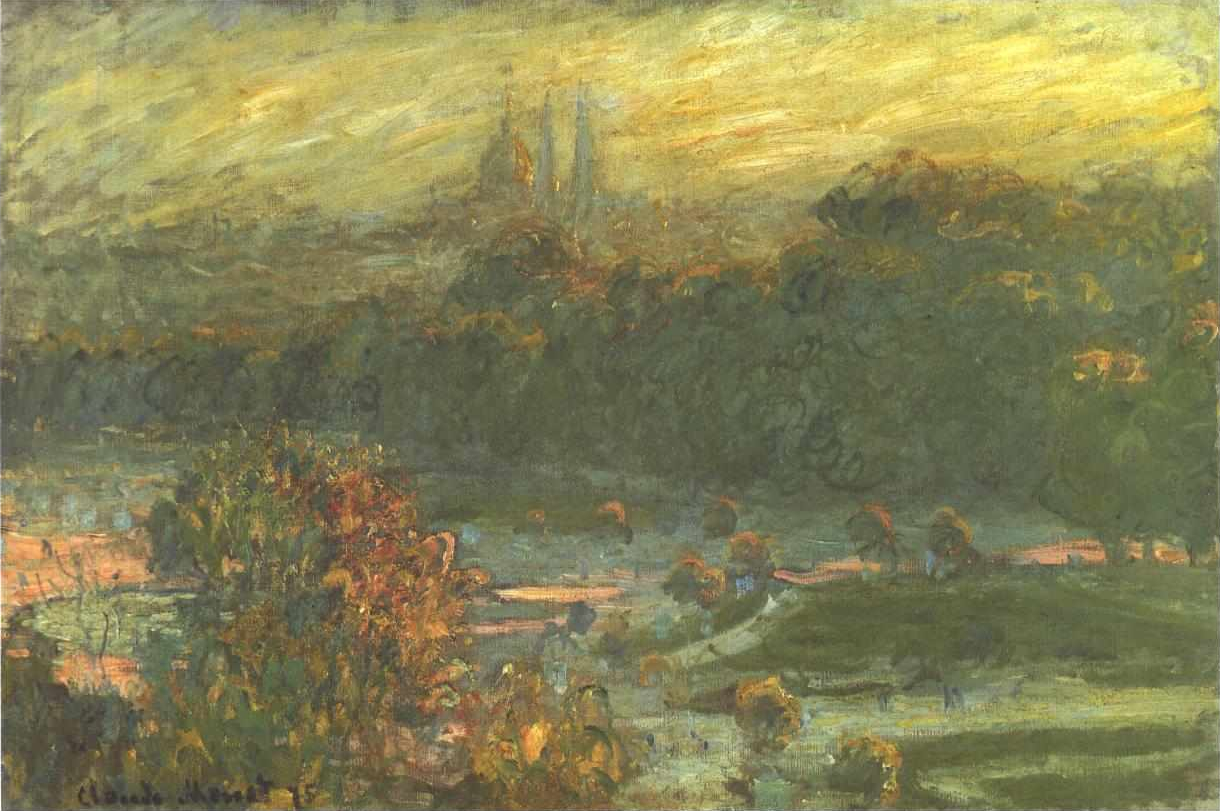
The Tuileries Gardens is a hand-painted reproduction of Monet’s Paris view from a window: the lower two thirds are taken up by the park, above it the city stretches away in a pale haze with two slender spires rising out of it, and a pale oval basin gleams at lower left. The original measures 75.5 x 50 cm, is oil on canvas and belongs to the Musée d’Orsay in Paris under accession number RF 2705. The museum dates it to around 1876 and calls it a sketch in its own record. We paint it in eight sizes or to your own measurements, with a photograph of the finished work sent for approval before dispatch.
| Title: | The Tuileries Gardens |
| Other titles: | Les Tuileries ; esquisse (the museum’s own designation) |
| Painter: | Claude Monet (1840–1926) |
| Year painted: | around 1876, as the museum dates it; it gives no exact year |
| Original size: | 75.5 cm x 50 cm |
| Original technique: | Oil on canvas |
| Painting style: | Impressionism |
| Located at: | Musée d’Orsay, Paris (acc. no. RF 2705) |
| Our reproduction: | Hand-painted oil on canvas, eight sizes or made to measure |
The Tuileries Gardens – Claude Monet
What is on the canvas?
The view drops steeply away. The lower half is the dark mass of the trees, wide and closed in short circular strokes, no crown separating from the next. In the bottom left corner lies an oval basin, pale and smooth, a pink path beside it. At lower right a lawn opens out, lighter and greener, with tiny figures on it. Above the trees runs a band of city blurred into haze, and out of it rise two slender spires with a lower tower beside them. The top quarter is sky, pale and brushed horizontally. The range of colour is narrow: green, grey and a pale yellow.
Where was Monet looking from?
From the window of an apartment lent to him by the collector Victor Chocquet. The Musée Marmottan Monet, which holds a related canvas, records that Chocquet was a humble customs official and an early supporter of Paul Cézanne, and that in 1876 he made his apartment available to Monet. It was on the fifth floor at 198 Rue de Rivoli and looked down on the Tuileries Garden. That outlook, the museum says, inspired four paintings by Monet. Looking down was an unusual choice then: from up there a city reads not as a street but as a surface.
Why does the museum call this canvas a sketch?
Because that is what its designation says. The Musée d’Orsay records the work under a two-part name divided by its own semicolon: “Les Tuileries ; esquisse”. The second part is not a title but a classification: a sketch, a canvas that sets the subject down without carrying it through. You can see it: the trees are painted as a mass, the figures are strokes without faces, the city behind is blurred. Our table gives that designation in the Other titles row precisely because it is the museum’s and not ours.
Why is there no single year?
Because the museum gives none. Its date field reads “vers 1876”, around 1876, and it does not narrow that. So we state no single year either. Where museum and database disagree we follow the museum — including when the database looks more precise than the institution that actually owns the work.
What does the museum record say about size?
The work belongs to the Musée d’Orsay under accession number RF 2705. The museum measures its own canvas and arrives at 75.5 cm across, a centimetre and a half more.
The same bequest, a different work: the Caillebotte collection
The museum records one means of acquisition: “Legs Gustave Caillebotte, 1896”. Caillebotte was a painter himself and one of the few who bought his companions’ work when nobody else wanted it; his collection is one of the main routes by which Impressionism reached the French public collections. Snow Effect in Vétheuil, which we sell, reached the Orsay the same way: same bequest, same year, different painting. The museum publishes no chain of owners before that, so we invent none.
Four paintings from one window — which is ours?
Confusion here is real, because all four show the same outlook. The best known hangs at the Musée Marmottan Monet, accession number 4016, 73 x 54 cm, dated 1876. That museum calls it the most fully realized of them and says a balanced composition sets it apart. Both canvases show it. The Marmottan picture is anchored at the left by the large pale mass of the Pavillon de Marsan, its horizon sits high, and in the park you can pick out ponds, flowerbeds and statues. Ours has no pavilion, its horizon sits lower, and the park is a single dark mass. The Marmottan canvas is the finished version, then, and ours the one the Orsay calls a sketch.
How is our hand-painted version made?
Every order is painted individually by an artist, in oils on cotton or linen. A canvas painting is made here without printing, transfer or any machine step in between. This subject is demanding precisely because it is a sketch: the mass of the park is not made of traceable shapes but of hundreds of short circular strokes in three or four greens. Smooth them into an even field and the park stiffens and loses the original’s flicker. So it is built from a dark ground upward. Every hand-painted oil painting that leaves our workshop is a little its own; a Monet reproduction from our collection is a new object, not a copy of a photograph. Before dispatch you receive a photograph of the finished work for approval.
Stretched in a rigid box or rolled in a tube, with tracking. Before that you receive a photograph of the finished work.
Which size for which wall?
Eight sizes are available, from 60 x 40 to 150 x 100 cm. The original is 75.5 cm wide and 50 cm high, so the closest by size is 80 x 55 cm, and the closest in proportion are 60 x 40, 90 x 60 and 150 x 100 cm, all at 1.50 against the original’s 1.51. The scene is wide and low, so it sits well over a sofa, a sideboard or a bed. As a painting for living room walls, 110 x 75 cm reads calmly, because this canvas keeps to a narrow, quiet range. Related Paris subjects are in the Claude Monet gallery; close in place and time are The Gare Saint-Lazare and Women in the Garden, and from the same decade The Argenteuil Basin.
How high to hang the painting: centre it about 145 cm above the floor; over furniture, keep the lower edge 20 to 30 cm clear. We write more about hanging on our blog.
Made to measure, stretcher and frame
None of the eight sizes repeats the original’s proportion exactly. If that proportion is what you want, made to measure is the only route: send us the width and height in centimetres. The canvas can arrive stretched and ready to hang, or rolled in a tube if you will have it framed yourself. A frame is not included in the price. This scene suits a narrow pale frame that does not compete with the dark mass of the park. The museum keeps its original in a frame that brings the whole to 93 x 68.5 cm.
Delivery and guarantee
Painting usually takes two to three weeks, longer at the largest sizes, because the oil has to dry between layers. Stretched canvases travel in a rigid box, rolled ones in a tube. If the work arrives damaged, or differs noticeably from the photograph you approved, we replace it or refund you. A hand-painted copy is not a factory product and small differences in the brushwork are expected; damage or the wrong subject are not. We deliver within the European Union.
If the painting is a gift and you are unsure of the size, there is a gift voucher: the recipient chooses the size and the subject.
Frequently asked questions
Where is the original?
In Paris, at the Musée d’Orsay, under accession number RF 2705. It arrived in 1896 with the bequest of Gustave Caillebotte.
Which park is painted?
The Tuileries Garden in Paris, seen from a fifth-floor window at 198 Rue de Rivoli, lent to Monet by the collector Victor Chocquet in 1876.
What does the work say in one sentence?
That from a high window a city looks like landscape, and a park is not a row of trees but one dark surface.
Is the original for sale, and what is it worth?
It is not. It has been in a public collection since 1896. Nobody sets a price on it, and neither do we.
- Subject. The Tuileries Garden from a high window: the dark mass of the park trees across the lower half, an oval basin at lower left, the blurred city above it with two slender spires.
- Original. Oil on canvas, 75.5 x 50 cm, around 1876 by the museum’s dating; Musée d’Orsay, acc. no. RF 2705, bequest of Gustave Caillebotte 1896; the museum records it as a sketch.
- Ours. Eight sizes from 60 x 40 to 150 x 100 cm, or made to your own measurements, the only option that keeps the original’s proportion.
- Worth knowing. One outlook gave four Monet paintings; the most fully realized is at the Musée Marmottan Monet, and ours is the one the Orsay calls a sketch.