



Description
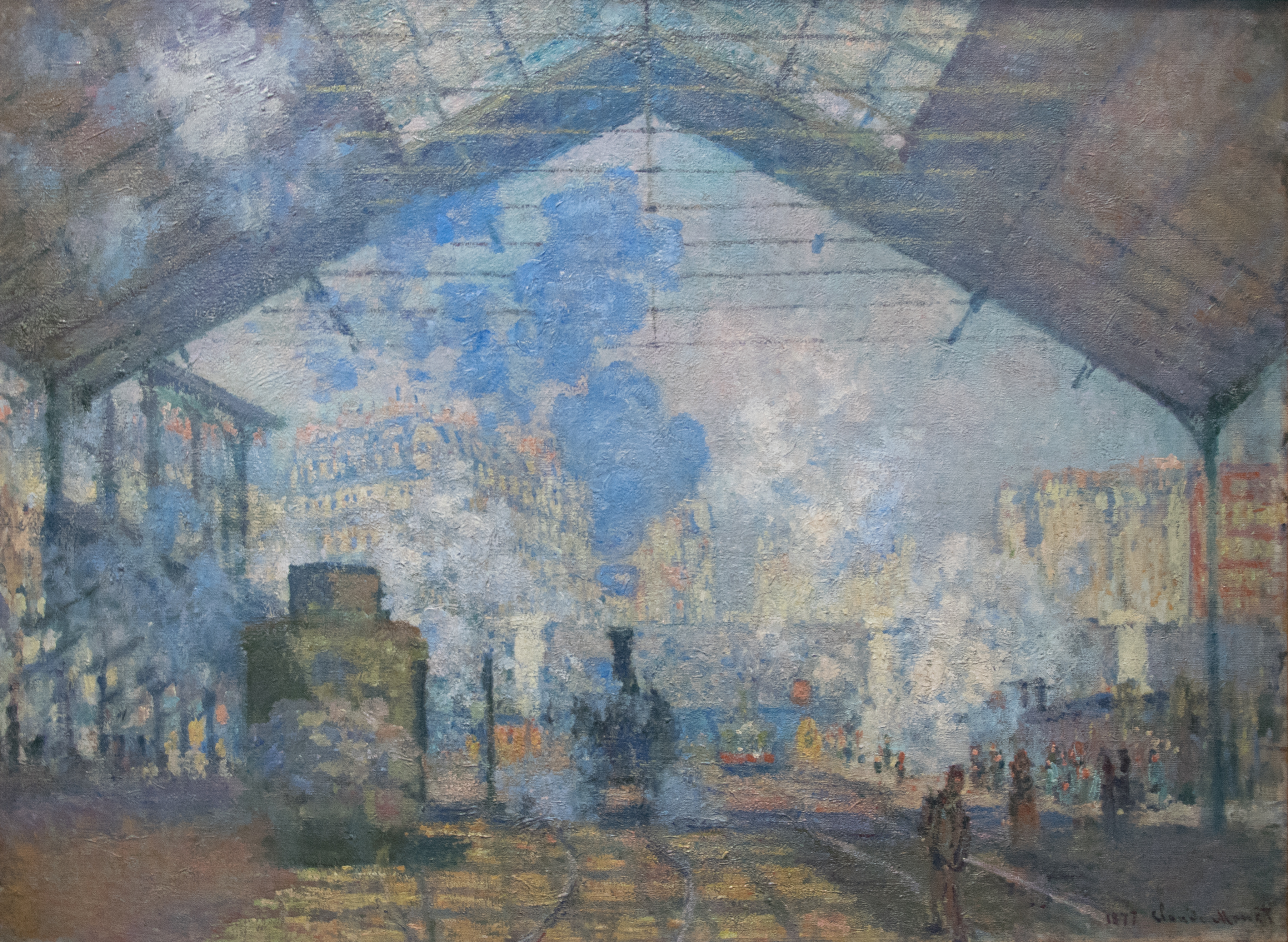
The Gare Saint-Lazare is a hand-painted reproduction of Monet’s canvas in the Musée d’Orsay in Paris: under the great glass roof of the train shed a blue-grey cloud of steam rises in the middle, a dark locomotive stands beneath it, and to left and right pale Paris blocks show through the steam. The original measures 105 x 75 cm, is oil on canvas and carries accession number RF 2775. The museum dates it 1877, and at the lower right the canvas reads »1877 Claude Monet«. We paint it in eight sizes or to your own, with a photograph of the finished work sent for approval before dispatch.
| Title: | The Gare Saint-Lazare |
| Other titles: | La Gare Saint-Lazare is the museum’s own title; in the Wildenstein catalogue the work is number 438 |
| Painter: | Claude Monet (1840–1926) |
| Year painted: | 1877 per the museum record, without reservation; at the lower right the canvas reads »1877 Claude Monet«, with the year BEFORE the signature |
| Original size: | 105 cm x 75 cm (per the museum record; Wikidata gives 104 cm for the width) |
| Original technique: | Oil on canvas |
| Painting style: | Impressionism |
| Located at: | Musée d’Orsay, Paris (inv. RF 2775) |
| Our reproduction: | Hand-painted oil on canvas, eight sizes or made to measure |
The Gare Saint-Lazare – Claude Monet
What is on the canvas?
The upper third is the roof of the shed: two sloping planes of iron and glass meeting at a ridge, crossed by dark girders, with the glass between them reading as a blue-grey mesh. Under the ridge a great cloud of steam rises, blue at its core and white at the edges, and reaches almost to the girders.
In the middle of the tracks a locomotive stands head-on: a dark, almost black mass with its funnel, and a lighter patch of firebox below. To its left a tall dark green block of building, to its right carriages and then pale Paris houses in white, ochre and rose, half erased by the steam.
Along the bottom the tracks converge toward the viewer over yellowish grey ground. Right of centre a single dark figure stands on the platform, and a group of tiny figures at the right edge. Space here is described not by drawing but by steam: what lies behind it is lost, what stands in front of it stays hard.
What is written on the canvas?
At the lower right, across the greyish ground, an inscription stands in dark strokes: the year 1877 first, and the signature Claude Monet after it. The order is unusual, because with this painter the year almost always follows the name.
The museum record has no field for inscriptions and does not mention a signature. The year on the canvas agrees with the museum’s.
What does the museum record say about the work?
The work is held by the Musée d’Orsay in Paris under accession number RF 2775. It dates it 1877, without reservation and without a span. The technique is oil on canvas; it publishes the measurements height first, 75 and 105 cm, and with the frame 95.5 and 121 cm. In the Wildenstein catalogue the work is number 438.
Why does this page say 105 and not 104?
Because the sources differ and the holding institution takes precedence. The museum gives a width of 105 cm in its record.
Our 105 x 75 cm is, at the museum’s width, exactly the original; at 104 it would be a centimetre too wide.
How did the canvas reach the museum?
By the bequest of the painter Gustave Caillebotte in 1896. That is what stands in the museum’s acquisition field, and it is all the museum publishes about this canvas’s path; it names no chain of owners before that, so we assemble none.
Caillebotte was a painter and collector from the same circle, and his bequest was contested at the time. We do not narrate that dispute here, because the museum record says nothing of it; only the year and the name are recorded.
Which Gare Saint-Lazare is which?
The painter worked at Saint-Lazare more than once and we sell two of those canvases. This is the Paris one, the large one, looking straight up under the ridge. The other is held by the Art Institute of Chicago: Arrival of the Normandy Train, Gare Saint-Lazare under number 1933.1158, also of 1877 but smaller, 80.2 x 60.3 cm, and inscribed lower left “Claude Monet 77”.
With us that second canvas is Arrival of the Normandy Train. Anyone after a particular one should go by the accession number: RF 2775 is the Paris canvas, 1933.1158 the Chicago one. The railway returns on the canvas The Railway Bridge at Argenteuil.
Why does this work matter?
Because it takes as its subject something that is not an object. The main motif of this canvas is steam: a substance with no form and no outline, which can only be painted as light. Everything hard on the canvas — roof, locomotive, blocks — is there so that the steam can be seen beside it.
The year is 1877, and for this work the painter asked permission to set his easel on the platform. Modern, industrial Paris was a new subject then; an impressionist painting of this kind showed that smoke deserved a canvas as much as a garden did. He painted fog and smoke again in London, on the canvas London, the Houses of Parliament in the Fog, and it was exactly that substance that gave the whole movement its name when Impression, Sunrise angered a critic in 1874.
The third thing is space. Because edges in steam are soft, the viewer infers depth from whatever is still sharp. A Monet reproduction of this kind therefore depends on where the stroke stops, not on drawing.
How is our hand-painted version made?
Every order is painted individually by an artist, in oil on cotton or linen. That is how every canvas painting leaves us, with no print and no machine step. This oil painting reproduction is demanding in the steam: the blue and white layers must stay translucent, or the cloud becomes a white blot and loses its depth.
The second test is the roof. The girders must stay straight and thin, or the shed collapses into a flat plane. Work of this kind will not take a high gloss, so ours is matt. A hand-painted copy is not a facsimile; two canvases of the same size always differ in the brushwork.
Which size for which wall?
There are eight sizes, from 50 x 35 to 150 x 110 cm. One of them, 105 x 75 cm, is by the museum’s record exactly the size of the original — the same proportion and the same measurements, with no rounding. That is rare in our collection, and it holds here only because we took the width from the museum and not from Wikidata.
The same proportion of 1.4000 is carried by 70 x 50 cm at two thirds the size; that is the nearest smaller measure for a narrower wall. For a large wall there is 150 x 110 cm. The grey-blue range does not press itself on you, which is why this painting for the office works above a desk as well. All sizes are listed in our Claude Monet gallery, where The Tuileries Gardens also stands, the other Paris subject in our collection.
How high to hang the painting: centre about 150 cm above the floor, so the locomotive stays at eye level.
Custom size, stretcher bar and frame
For a size not on the list, made to measure is the only route; send us the width and height. The canvas is stretched on a wooden bar. A frame is not included; the museum’s own measures 121 x 95.5 cm.
Delivery and guarantee
Making it takes two to three weeks, a few days more at the largest sizes. It arrives stretched on its bar in a rigid box, or rolled in a tube, with tracking. If it arrives damaged or differs noticeably from the approved photograph, we replace it or refund. Small differences in the brushwork are expected in handwork; damage is not.
If the painting is a gift and you are unsure of the size, there is a voucher: the recipient chooses the size and the subject.
Frequently asked questions
Where is the original?
In Paris, at the Musée d’Orsay, under accession number RF 2775.
What does it show?
The train shed of the Paris Gare Saint-Lazare under its glass roof, with the steam of the locomotives.
How many paintings of the Gare Saint-Lazare did Monet make?
Twelve known canvases, all from 1877. He showed seven of them at the third Impressionist exhibition in April that year, and the group was his first series devoted to a single motif.
What year is it from?
1877. Monet painted all his views of the Gare Saint-Lazare that year and showed seven of them in April at the third Impressionist exhibition.
- Subject. The train shed at Saint-Lazare: a glass roof, a blue-grey cloud of steam under the ridge, a dark locomotive on the tracks and pale Paris houses behind the steam.
- Original. Oil on canvas, 105 x 75 cm, 1877; lower right 1877 Claude Monet; Musée d’Orsay, Paris, inv. RF 2775, bequest of Gustave Caillebotte 1896.
- Ours. Eight sizes; 105 x 75 cm is exactly the size of the original, and 70 x 50 cm has the same proportion smaller.
- Worth knowing.