







































Description
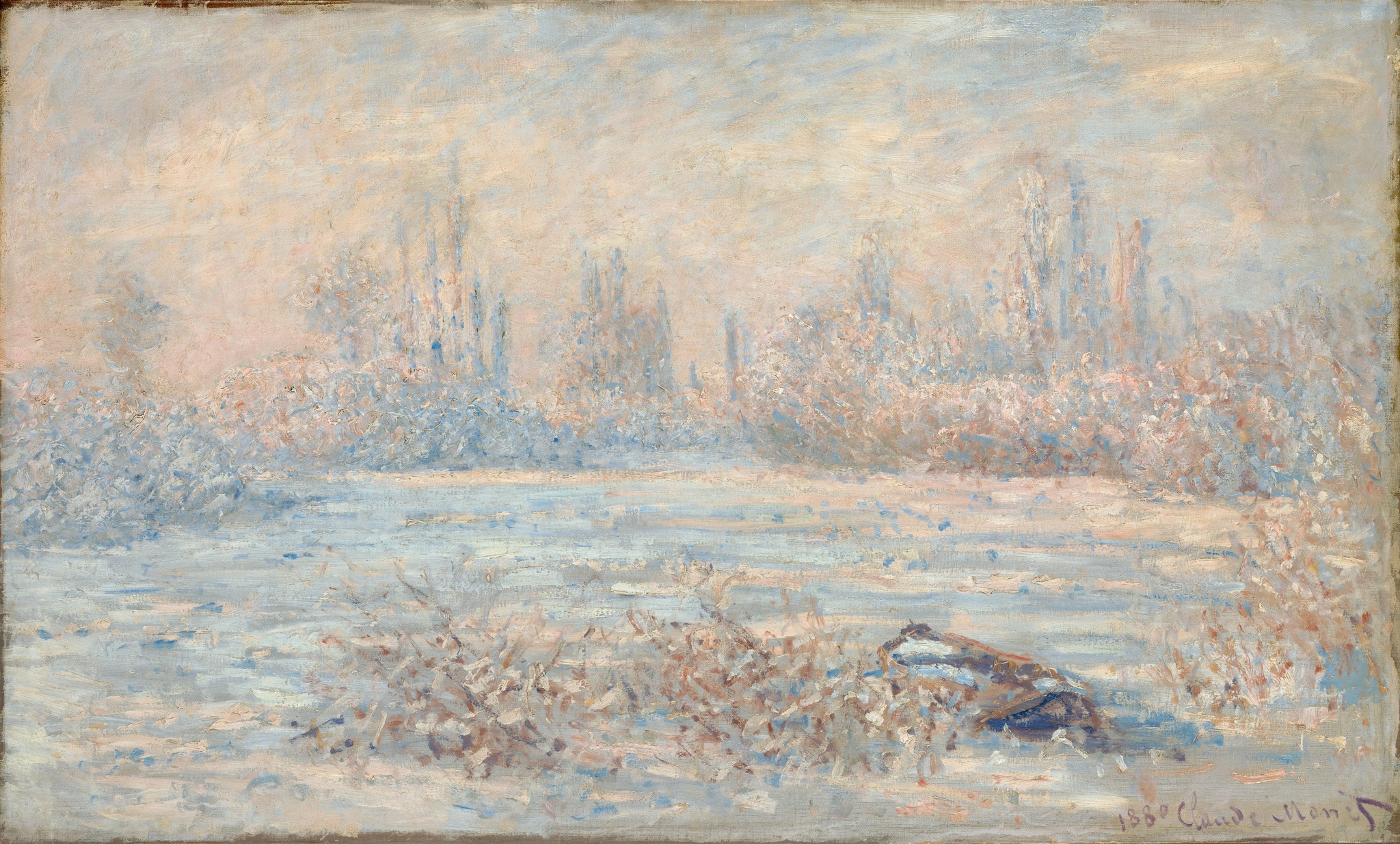
Frost is a hand-painted reproduction of Monet’s canvas in the Musée d’Orsay in Paris: frosted bushes stand in the foreground with a dark boat lying among them on the right, a pale, flat stretch with small blue touches crosses the middle, and behind it a band of rimed trees with tall slender poplars rises into a pink haze. The original measures 99.5 x 60.5 cm, is oil on canvas, is signed »1880 Claude Monet« at the lower right, dates from 1880 and carries inventory number RF 2706. We paint it in eight sizes or to your own, with a photograph of the finished work sent for approval before dispatch.
| Title: | Frost |
| Other titles: | Le Givre, effet de soleil ; Le Givre (title in the museum record) |
| Painter: | Claude Monet (1840–1926) |
| Year painted: | 1880 |
| Original size: | 99.5 cm x 60.5 cm |
| Original technique: | Oil on canvas |
| Painting style: | Impressionism |
| Located at: | Musée d’Orsay, Paris (inv. RF 2706) |
| Our reproduction: | Hand-painted oil on canvas, eight sizes or made to measure |
Frost – Claude Monet
What is on the canvas?
A winter day in sunlight, painted in pale colours. Almost the whole canvas is painted in pale blue, rose and cream, without a single stroke of pure white. The lower part is a bank of frosted bushes, and among them on the right lies a dark boat drawn up on shore, with blue shadows.
Across the middle runs a broad, pale, flat stretch scattered with small blue and pink touches. Behind it stands a band of rimed trees and bushes from which tall slender poplars rise into the haze, and above everything lies a pink and cream sky with patches of blue. The signature stands at the lower right in violet.
The frost is laid on thickly in the foreground: short strokes of cream and pink lie over reddish-brown twigs, and where the bushes are in shadow, touches of dark blue are added. Further back the strokes grow softer and the colours closer, so that the trees and poplars almost dissolve into the haze, while the sky is lightest at the upper left and darkens a little towards the right.
When was it painted?
The museum’s record dates the canvas 1880, without reservation. The same year stands on the canvas, before the painter’s name.
The museum does not describe the events of that winter, and neither do we. What it gives is the title: Le Givre, effet de soleil, frost in sunlight.
What does the museum record say about the work?
The work is held by the Musée d’Orsay in Paris under inventory number RF 2706. It gives the size height first, 60.5 by 99.5 cm, and 83.5 by 121.5 cm with the frame, and the technique as oil on canvas. The title in the museum’s record reads Le Givre, effet de soleil ; Le Givre: the museum lists the canvas under both names.
How did the canvas reach the museum?
The museum gives a single entry: »Legs Gustave Caillebotte, 1896«, the bequest of Gustave Caillebotte in 1896. That is the way it was acquired, not a chain of owners, so we write no provenance section here.
The same bequest line stands on four canvases we sell: Snow Effect in Vétheuil, RF 3755, The Tuileries Gardens, RF 2705, A Corner of the Apartment, RF 2776, and The Gare Saint-Lazare, RF 2775.
Which winter canvas of 1880 is this?
The Musée d’Orsay holds another Monet canvas of the same year and exactly the same size, Les Glacons ; Debacle sur la Seine, oil on canvas, inventory number RF 1965 10, which the museum received in 1965 as a gift from Baroness Eva Gebhard-Gourgaud. Ours is RF 2706, Le Givre; if you are looking for this work in particular, go by that number, because the size and the year are the same.
Why does this work matter?
Because its white is built from colours: the frost on the bushes, the flat stretch and the sky are painted in pale blue, rose and cream, and only the dark boat at the lower right shows how light everything else is.
One more winter canvas from the same museum is in our collection: A Cart on the Snowy Road at Honfleur, RF 2011. An impressionist painting of this kind tells no story; it holds the light of one cold, sunlit day. Monet’s best-known snow scene, a single black bird perched on a gate above blue shadows, is The Magpie.
How is our hand-painted version made?
Every order is painted individually by an artist, in oil on cotton or linen. That is how every canvas painting leaves us, with no print and no machine step. This oil painting reproduction is demanding in the white: the frost has to be built from pale blue, rose and cream, or the canvas turns chalky and flat.
The second test is the boat at the lower right, which must stay the only dark mass on the canvas. A Monet reproduction of this kind depends on the poplars staying soft in the haze while the frost in the foreground stays sharp. Work of this kind will not take a high gloss, so ours is matt. A hand-painted copy is not a facsimile; two canvases of the same size always differ in the brushwork.
Before dispatch you receive a photograph of the finished canvas. Check three things on it: whether the frost in the foreground is made of separate pale strokes rather than flat white, whether the boat at the lower right stays the darkest thing on the canvas, and whether the signature, with the year before the name, stands at the lower right as on the original. If any of these is wrong, tell us before you approve the work.
Which size for which wall?
There are eight sizes, from 90 x 55 to 175 x 110 cm. By size the closest to the original is 100 x 60 cm, 0.5 cm wider and 0.5 cm lower, but at 1.6667 slightly more elongated than the original’s 1.6446. By proportion the closest is 90 x 55 cm at 1.6364, followed by 130 x 80 cm at 1.6250.
If you want nearly the size of the original, take 100 x 60; if you want its shape, 90 x 55, and 130 x 80 for a larger wall. Its pale, cool colours sit well beside warm wood and light tiles, which makes this a good painting for the kitchen. All sizes are listed with the product in our Claude Monet gallery.
Light matters as much as size. The canvas is built almost entirely from pale blue, rose and cream, so it looks best in daylight or soft warm light; under cold light the rose turns grey and the frost loses its warmth. Hang it so that the band of trees sits at about eye level.
Custom size, stretcher bar and frame
For a size not on the list, made to measure is the only route; send us the width and height and we keep the proportion of the original. The canvas is stretched on a wooden bar. A frame is not included; the museum’s own measures 121.5 x 83.5 cm.
Delivery and guarantee
Making it takes two to three weeks, a few days more at the largest sizes. It arrives stretched on its bar in a rigid box, or rolled in a tube, with tracking. If it arrives damaged or differs noticeably from the approved photograph, we replace it or refund. Small differences in the brushwork are expected in handwork; damage is not.
If the painting is a gift and you are unsure of the size, there is a voucher: the recipient chooses the size and the subject.
Frequently asked questions
Where is the original?
In Paris, at the Musée d’Orsay, inventory number RF 2706.
What year is it from?
1880. The museum and Wikidata both give that year, and on the canvas it stands before the signature.
What does it show?
A frosted bank with bushes and a dark boat, a flat pale stretch behind it and rimed trees in a pink haze.
Which winter does the painting show?
The great frost of December 1879 and January 1880, when the Seine froze at Vétheuil and the cold almost brought Paris and its surroundings to a halt. Monet painted the frozen river and then the ice floes when the ice broke up.
- Subject. A frosted bank with a dark boat, a pale flat stretch and rimed trees in a pink haze.
- Original. Oil on canvas, 99.5 x 60.5 cm, 1880; signed at the lower right »1880 Claude Monet«; Musée d’Orsay, Paris, inv. RF 2706.
- Ours. Eight sizes; 100 x 60 cm is closest by size, 90 x 55 cm by proportion.
- Worth knowing. The Musée d’Orsay received this canvas in 1896 through the bequest of Gustave Caillebotte, by its own records together with four more canvases from our collection.