







































Description
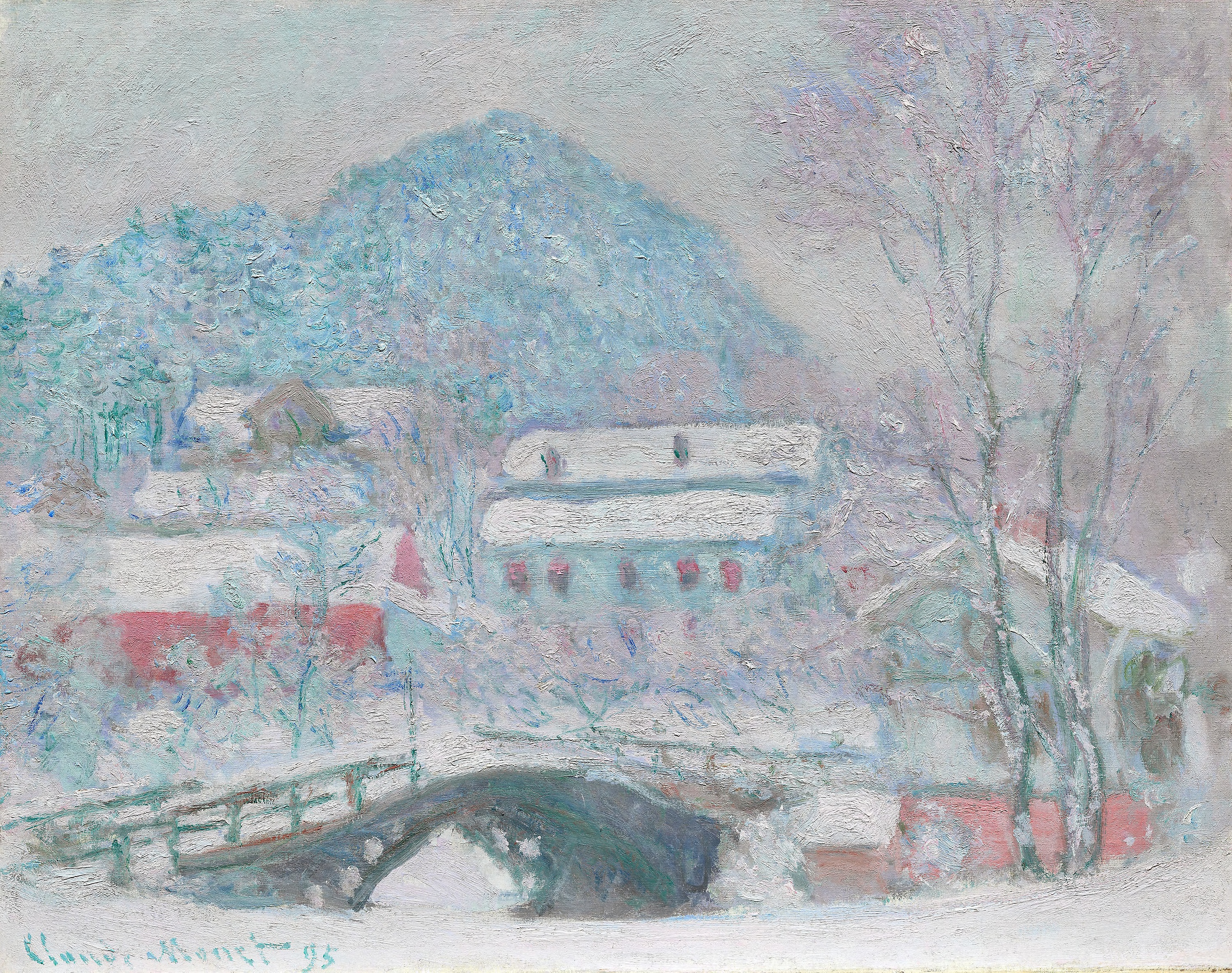
Sandvika, Norway is a hand-painted reproduction of Monet’s canvas at the Art Institute of Chicago: a bridge arches in a single thin-railed span across a frozen channel, and behind it stands a snow-covered village with red window frames, bare birches on the right and a bluish hill beyond. The original measures 92.5 x 73.4 cm, is oil on canvas and carries the accession number 1961.790. The museum dates it to 1895, and the canvas is signed at the lower left “Claude Monet 95”, so the years agree. We paint it in eight sizes or to your own, with a photograph of the finished work for approval before despatch.
| Title: | Sandvika, Norway |
| Other titles: | Village de Sandviken (Temps de neige) or Village de Sandviken (Durand-Ruel, Paris 1895) · Sandviken, village près Christiania (sale catalogue, Paris 1899) · Sandviken, Norway (Durand-Ruel, New York stock book) · Wildenstein catalogue, no. 1397 |
| Painter: | Claude Monet (1840–1926) |
| Year painted: | 1895 in the museum record, with the same start and end year; the museum itself transcribes the signature at the lower left as “Claude Monet 95”, so the two years agree |
| Original size: | 92.5 cm x 73.4 cm |
| Original technique: | Oil on canvas |
| Painting style: | Impressionism |
| Located at: | Art Institute of Chicago (acc. no. 1961.790) |
| Our reproduction: | Hand-painted oil on canvas, eight sizes or made to measure |
Sandvika, Norway – Claude Monet
What is on the canvas?
The lower third is taken by the bridge. It arches in a single span across a frozen channel, dark grey-green, with a sparse railing of thin upright posts, rising from left to right. Under the arch everything is white.
Behind it stands the village. The large building at the centre has a snow-laden roof and a row of small red-framed windows; to its left the red roofs of lower houses, to its right snow again and red walls. On the right third, bare birches rise on slender trunks, pinkish grey, almost to the top edge. Beyond, a bluish hill of trees the snow has turned pale blue. There is almost no sky: above the hill is one even grey-lilac field with no cloud in it.
How did Monet come to Sandvika?
The museum says an unusual amount about this season. The journey to Norway in 1895 was, by its record, among the most physically taxing of Monet’s painting campaigns. He was shown the country by his stepson Jacques Hoschedé, who lived in Christiania, now Oslo, and the museum writes that Monet was awestruck by the landscape but at first frustrated in his search for a motif.
In two months twenty-nine Norwegian scenes were painted, among them at least six views of Sandvika, a village near Christiania whose iron bridge, the museum says, may have reminded Monet of the Japanese bridge in his garden at Giverny.
How is the work dated, and what does the canvas say?
The Art Institute of Chicago gives 1895, with the same start and end year and so no range. In the same record the museum transcribes the inscription itself: signed at the lower left, “Claude Monet 95”. Record and canvas agree, and we say so, because a page that says it and a page on which nobody compared look the same.
What does the museum record say about the size?
The work is held by the Art Institute of Chicago under accession number 1961.790, by its own record not on view. It publishes the measurements height by width, 73.4 x 92.5 cm; our table puts the width first, so here you read 92.5 x 73.4 cm. With its frame the museum gives 118.2 x 98.8 x 11.2 cm.
The Wildenstein catalogue number, 1397, is the same in both sources.
From the Sisley sale to Chicago, and two places where the record contradicts itself
The museum publishes a long chain of owners and sources every station. The painter gave the canvas to the sale held for Sisley’s children at the Galerie Georges Petit in Paris on 1 May 1899, where it was lot 65, and the dealer Durand-Ruel bought it for 6,300 francs. In 1900 it passed to the firm’s New York branch, and on 13 February 1901 Harriet Borland of Chicago bought it for $3,500. After her death in 1933 it went to her son Bruce Borland, who gave it to the museum in parts from 1961; the museum held all of it by 1963.
In two places the records contradict each other, and the museum says so itself. First the date of the New York sale: the firm’s Paris and New York stock books give 24 October and 13 November 1900. Second the sale itself: Wildenstein 1996 holds that Durand-Ruel and Bernheim-Jeune bought the canvas together, while two differently annotated copies of the sale catalogue note 6,000 and the name Bernheim in one and only 6,000 in the other. Which holds we do not know and do not choose; both stand on the museum’s page and both here.
How many names has this canvas travelled under?
Four that the museum names itself, and one is still open. In May 1895 at Durand-Ruel in Paris it was shown either as Village de Sandviken (Temps de neige) or as Village de Sandviken — the museum gives both catalogue numbers and does not choose. At the 1899 sale it stood as Sandviken, village près Christiania, in the New York stock book as Sandviken, Norway, and in Boston in 1905 in a form the museum itself marks [sic].
Which other snow canvases by Monet do we sell?
In our Claude Monet gallery it stands beside several winter scenes: Stack of Wheat (Snow Effect) from the same Chicago collection; Snow Effect in Vétheuil and Frost, the same whiteness on the Seine; and a winter road in A Cart on the Snowy Road at Honfleur.
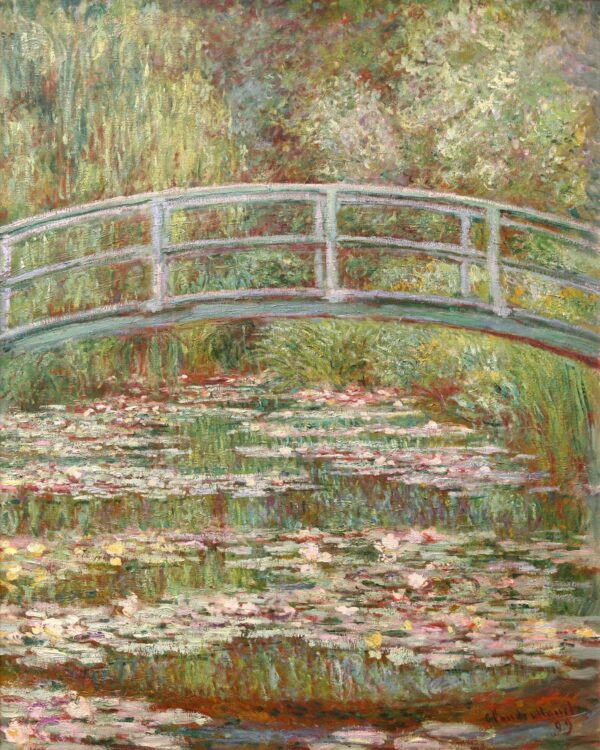
And the bridge from the museum’s sentence: The Water Lily Pond (Japanese Bridge) is that bridge at Giverny, held by the Metropolitan Museum of Art under 29.100.113 and painted in 1899, four years after Norway. We sell a Monet reproduction of it.
How is our hand-painted version made?
Every order is painted individually by an artist, in oils on cotton or linen canvas. That is how every canvas painting is made here: no print, no transfer, no machine step. This impressionist painting is demanding in the snow. The white areas are not white — they are lilac, pale blue, greenish and pink, and if the hand reaches for white out of the tube the village turns papery. The second test is the birches, which must stay thin and still read against a hill of the same lightness. Out of doors, en plein air, the underlayer stays light and shadow is built from cool glazes.
Which size for which wall?
Eight sizes are available, from 45 x 38 to 150 x 120 cm, and there are two answers. By size the nearest is 90 x 70 cm: 2.5 cm narrower and 3.4 cm lower than the canvas in Chicago. By the ratio of the sides the nearest are 50 x 40 and 150 x 120 cm, both at 0.800, while the original is 0.794 and 90 x 70 cm is 0.778. The gap is small, so size and proportion are not in conflict here as they are on some other motifs. In a hallway 45 x 38 cm is enough, as a painting for living room walls 90 x 70 cm, and on a large wall 150 x 120 cm.
How high to hang the painting: the centre about 145 cm above the floor; here it helps to have the bridge at eye level.
Made to measure, stretcher and frame
For a size that is not on the list, work to your own measurement is the only route: send us width and height in centimetres. The canvas comes stretched on a wooden stretcher or rolled in a tube; the frame is not included. A narrow moulding in cool grey or white wood suits this subject; warm walnut or gilt pushes the snow’s lilac towards brown.
Delivery and guarantee
Making the work takes two to three weeks, a few days longer at the largest sizes, because the oil must dry between layers. Stretched canvases travel in a rigid box, rolled ones in a tube. If the work arrives damaged or differs noticeably from the approved photograph, we replace or refund it. A hand-painted copy is not a factory product and small differences in the stroke are expected.
If the painting is a gift and you are unsure of the size, there is a gift voucher: the recipient chooses the size and the subject.
Frequently asked questions
Where is the original?
In Chicago, at the Art Institute of Chicago, accession number 1961.790, by its own record not on view.
Which place is on the canvas?
Sandvika, a village near Christiania, now Oslo. Monet painted at least six views of it.
What does the work say in one sentence?
That snow is full of colour if you look long enough to freeze.
What year is it from?
1895, when Monet spent two months in Norway; it is signed “Claude Monet 95” at the lower left.
- Subject. A snow-covered village behind an arched bridge, bare birches right, a bluish hill beyond.
- Original. Oil on canvas, 92.5 x 73.4 cm, 1895; Art Institute of Chicago, acc. no. 1961.790.
- Ours. Eight sizes; 90 x 70 cm nearest by size, 50 x 40 and 150 x 120 cm by proportion.
- Worth knowing. The museum transcribes the signature “Claude Monet 95” at the lower left; the years agree.